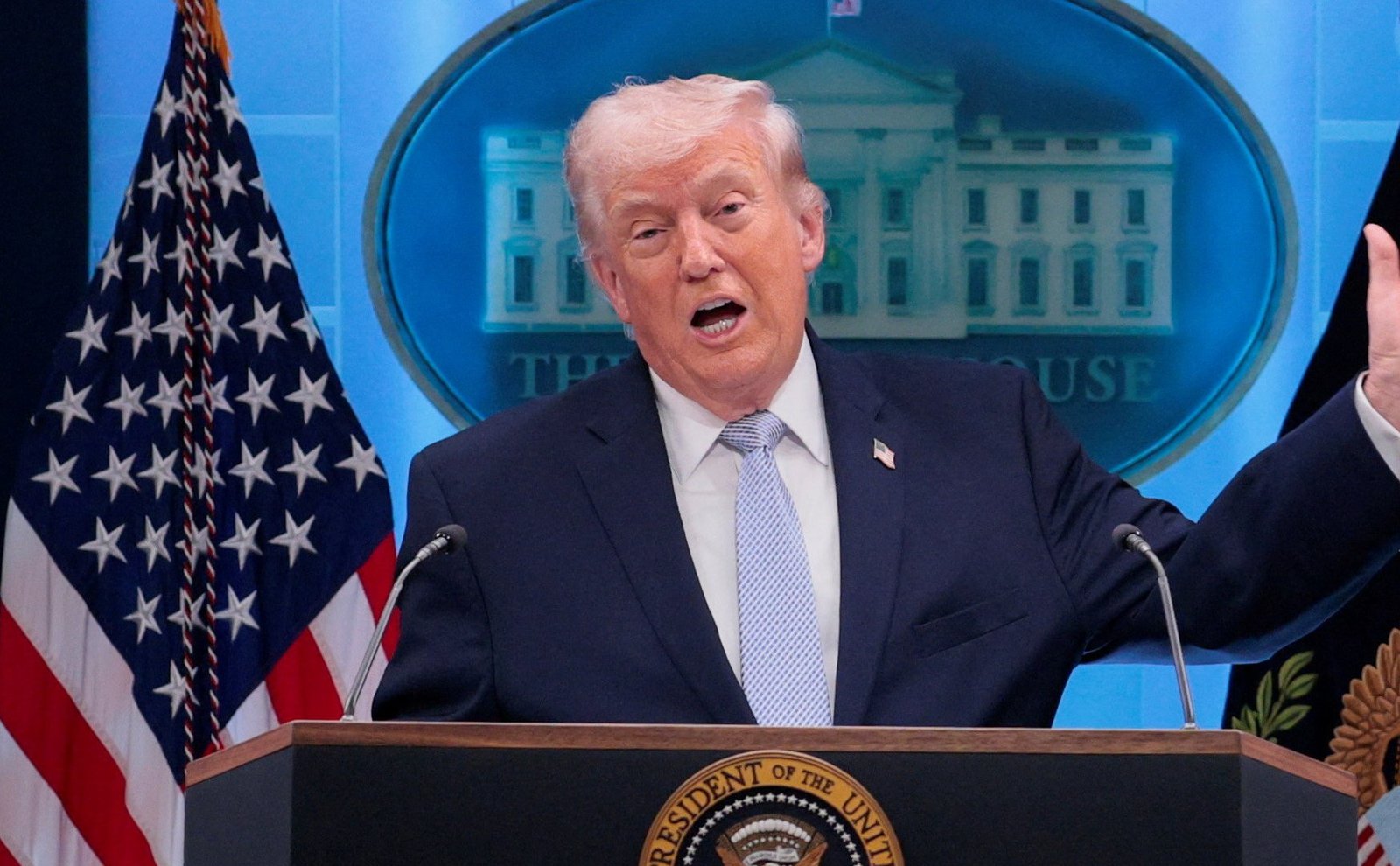
The recent announcement by President Trump to impose a staggering 50% tariff on countries supplying military weapons to Iran is not merely a trade maneuver; it is a bold geopolitical statement that could reshape the dynamics of power in the Middle East and beyond. This move, while fraught with legal ambiguities, signals a renewed American assertiveness in the region, particularly against the backdrop of Iran’s military ambitions and its alliances with global powers like China and Russia.
The geopolitical landscape surrounding Iran has been tumultuous for decades, characterized by a complex interplay of regional and global powers. Iran’s military capabilities have been significantly bolstered by its relationships with countries like China and Russia, which have supplied advanced weaponry and technology. The United States, under various administrations, has sought to curb Iran’s influence, particularly in the wake of its nuclear ambitions and its support for proxy groups across the Middle East. Trump’s latest tariff threat comes at a time when the U.S. is grappling with the implications of a ceasefire agreement with Iran, brokered by Pakistan, which has temporarily eased tensions but does not address the underlying issues of military support and arms proliferation.
<pTrump’s announcement, made via social media, was immediate and sweeping, declaring that any country supplying military weapons to Iran would face a 50% tariff on all goods sold to the United States. This declaration raises significant questions about the legal authority under which such tariffs could be imposed, especially following a Supreme Court ruling that curtailed Trump’s previous use of the International Emergency Economic Powers Act (IEEPA) for broad tariff applications. The lack of specificity regarding which countries would be targeted adds to the uncertainty, but analysts suggest that China and Russia are the most likely candidates due to their historical support for Iran’s military capabilities.
The potential ramifications of Trump’s tariff threat are profound. Politically, it could exacerbate tensions between the U.S. and its adversaries, particularly China, which has been increasingly assertive in its support for Iran. Economically, such tariffs could lead to retaliatory measures from affected countries, disrupting global supply chains and impacting U.S. consumers. Security-wise, the threat could push Iran closer to its allies, solidifying a bloc that challenges U.S. interests in the region. Furthermore, the ambiguity surrounding the legal basis for these tariffs could undermine U.S. credibility on the global stage, particularly if the measures are perceived as empty threats rather than actionable policies.
From a strategic perspective, Trump’s tariff threat reflects a broader trend of using economic tools as instruments of foreign policy. However, the effectiveness of such measures is contingent upon their implementation and the willingness of other nations to comply. The complexities of international trade law and the potential for legal challenges mean that the U.S. may find it difficult to enforce these tariffs without a solid legal foundation. Moreover, the looming Trump-Xi meeting complicates the situation further; any aggressive tariff action could derail diplomatic efforts and provoke a trade war that neither side desires. The strategic calculus must consider not only the immediate effects of tariffs but also the long-term implications for U.S. relations with key global players.
Looking ahead, several scenarios could unfold. If Trump pursues these tariffs, it could lead to heightened tensions with China and Russia, potentially resulting in a more unified front against U.S. interests in the Middle East. Alternatively, if the tariffs are perceived as unenforceable or merely rhetorical, it could embolden Iran and its allies, undermining U.S. influence in the region. The upcoming meeting between Trump and Xi will be pivotal; a failure to address these issues could lead to a deterioration of relations and an escalation of hostilities. Conversely, a diplomatic resolution could pave the way for a more stable balance of power in the region, albeit at the cost of U.S. leverage over Iran.
In conclusion, Trump’s threat to impose 50% tariffs on countries supplying Iran with weapons is a high-stakes gamble that could have far-reaching consequences for U.S. foreign policy and regional stability. While it signals a tough stance against Iran, the legal and practical challenges of implementing such tariffs cannot be overlooked. As the geopolitical landscape continues to evolve, the U.S. must navigate these complexities with a clear strategy that balances assertiveness with diplomacy, ensuring that its actions do not inadvertently strengthen the very adversaries it seeks to contain.
About the Author