UAE Air Defences Intercept Nine Drones from Iran as Total Engagements Pass 2,100
 Yemen Herald News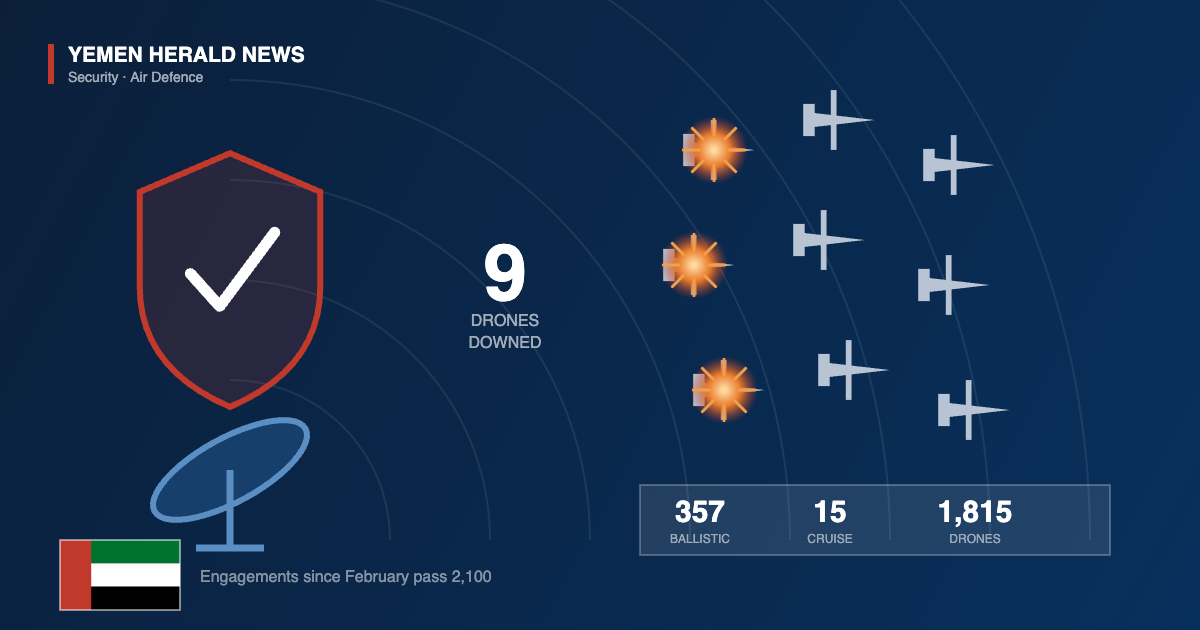
The United Arab Emirates defence ministry said its air defence systems intercepted nine drones launched from Iran in the last week of March 2026. The daily figure was modest by the standards of that month, but the ministry used the same statement to update its running totals for the campaign, and those numbers told a starker story.
Since the start of hostilities the ministry said its systems had engaged 357 ballistic missiles, 15 cruise missiles and 1,815 drones — more than 2,100 aerial threats in roughly four weeks. The trajectory of those cumulative figures is instructive: the ministry had reported 294 ballistic missiles and about 1,600 drones in mid-March, and by 29 March the totals stood at 414 ballistic missiles and 1,914 drones. The pace of ballistic launches in particular accelerated sharply in the final week of the month.
The ministry also set out the human toll as it stood at that date, saying three members of the UAE armed forces had been killed in the line of duty and that six civilians of various nationalities — among them Pakistani, Nepalese, Bangladeshi and Palestinian nationals — had died as a result of the attacks. It put the number of injured at 166, with wounds ranging from minor to severe.
Those figures were revised as the ministry consolidated its reporting. By 29 March its published breakdown listed two members of the armed forces killed alongside a Moroccan civilian contracted by the armed forces, and eight foreign nationals dead, with 178 people injured. The shift reflects reclassification of individual cases rather than a change in the overall scale, and it is a reminder that casualty accounting during active fighting is provisional.
The nationalities involved reflect the makeup of the Emirati population, where foreign residents form the large majority of the workforce. Ministry statements over the course of the campaign listed injured people from across South Asia, the Arab world, Africa and Southeast Asia. Yemeni nationals appeared among those recorded as injured, one of the clearest documented points of contact between this conflict and Yemeni citizens.
For Yemen the exposure runs mainly through labour and money. Large numbers of Yemenis work in the Gulf states, and the remittances they send are among the more dependable sources of hard currency reaching Yemeni households. Risk to that workforce, and any disruption to the Gulf economies employing it, feeds back into Yemen through channels that rarely feature in coverage of the war itself.
Diplomatically the ground had already shifted. The Security Council adopted Resolution 2817 on 11 March 2026, condemning in the strongest terms what it described as unprovoked missile and drone attacks by Iran against the UAE, fellow Gulf Cooperation Council states and Jordan. Emirati officials noted repeatedly that launches continued at pace after its adoption, and by the time of this statement the daily interception reports had become a routine fixture of the ministry’s public communications.
A drone-only day, as this one was, points to something about how the campaign was being run. Ballistic missiles are scarce, expensive and closely counted; one-way attack drones are comparatively cheap and can be launched in volume. Alternating between drone-heavy nights and concentrated ballistic salvoes stretches a defender’s radar coverage and crew endurance while conserving the more valuable munitions for moments of maximum effect.
That asymmetry cuts at the defending side’s economics too. Interceptors cost far more than the drones they destroy, and stocks cannot be replenished at the rate a sustained campaign consumes them. The problem of trading expensive interceptors against cheap drones became one of the most discussed operational lessons of the conflict across the region.
Debris remained a persistent hazard even on nights when interception was complete. Fragments from engagements fell across populated and industrial areas, and clearing them became routine work for police and military engineering teams. In early April the UAE suspended operations at the Habshan gas facility after wreckage from an interception landed on the site, an illustration of how a defensive success can still carry an economic cost.
That asymmetry cuts at the defending side’s economics too. Interceptors cost far more than the drones they destroy, and stocks cannot be replenished at the rate a sustained campaign consumes them. The problem became one of the most discussed operational lessons of the conflict.
The ministry reiterated its commitment to safeguarding the country’s sovereignty and security and said it would continue to respond to any threat. It announced no offensive action against Iran, holding to the defensive framing Emirati officials maintained in public throughout the fighting even while condemning Tehran in the strongest terms available at the United Nations.
The attacks belonged to the wider war that began in late February 2026, when the United States and Israel launched a joint offensive against Iran and Tehran responded by striking American and allied targets across the region. Saudi Arabia, Kuwait, Qatar, Bahrain and Jordan reported comparable attacks and published their own interception counts over the same weeks.
The fighting ended, at least formally, within a fortnight of this statement. The United States and Iran agreed a ceasefire on 7 and 8 April 2026 that also covered Israel, closing more than five weeks of open conflict. Gulf states reported drone activity within hours of the announcement, and the truce frayed repeatedly through the months that followed as attacks resumed at intervals across the region.
About the Author