UN allocates $18 million from its emergency fund to aid operations in Yemen
 Yemen Herald News
GENEVA, Switzerland — The United Nations allocated $18 million to humanitarian operations in Yemen from its central emergency fund, part of a $160 million release for 12 underfunded crises.
The UN Office for the Coordination of Humanitarian Affairs announced the package on Oct. 2. The money comes from the Central Emergency Response Fund.
The fund is the UN’s global pool for rapid response and underfunded emergencies, and OCHA manages it. Its disbursements this year had reached $483 million by the time of the announcement.
Tom Fletcher, the UN under-secretary-general for humanitarian affairs and emergency relief coordinator, announced the release.
“There are 87 million people to reach and no time to waste,” Fletcher said. He said the funding would help deliver aid to people who might otherwise be left behind.
Afghanistan and the occupied Palestinian territory each received $18 million. No country in the round received more.
Somalia and Sudan were allocated $16 million each. South Sudan received $15 million.
Burkina Faso, Mali and Niger were allocated $10 million each. Chad received $9 million, Cameroon $6 million and Cuba $4 million.
The country allocations account for $150 million of the total. OCHA said the remaining $10 million was set aside for the needs of people with disabilities across all 12 responses.
OCHA said the Yemen money would support an expansion of life-saving assistance across the country. It said needs were rising as international funding fell short.
The account of the allocation rests on OCHA’s own announcement. Yemen Herald found no independent confirmation of the Yemen figure beyond the agency’s statement and the outlets that carried it.
The fund runs its underfunded emergencies window twice a year. It is reserved for crises that draw little donor money.
The emergency relief coordinator selects the countries, according to the fund’s published criteria. Those criteria list funding levels, humanitarian needs, risk and vulnerability, recommendations from UN agencies and a review of humanitarian needs overviews.
Where a country has a humanitarian response plan, the window can finance only projects already in that plan, the criteria say.
Non-governmental organisations cannot receive the money directly. They take part through the humanitarian country team and often act as implementing partners.
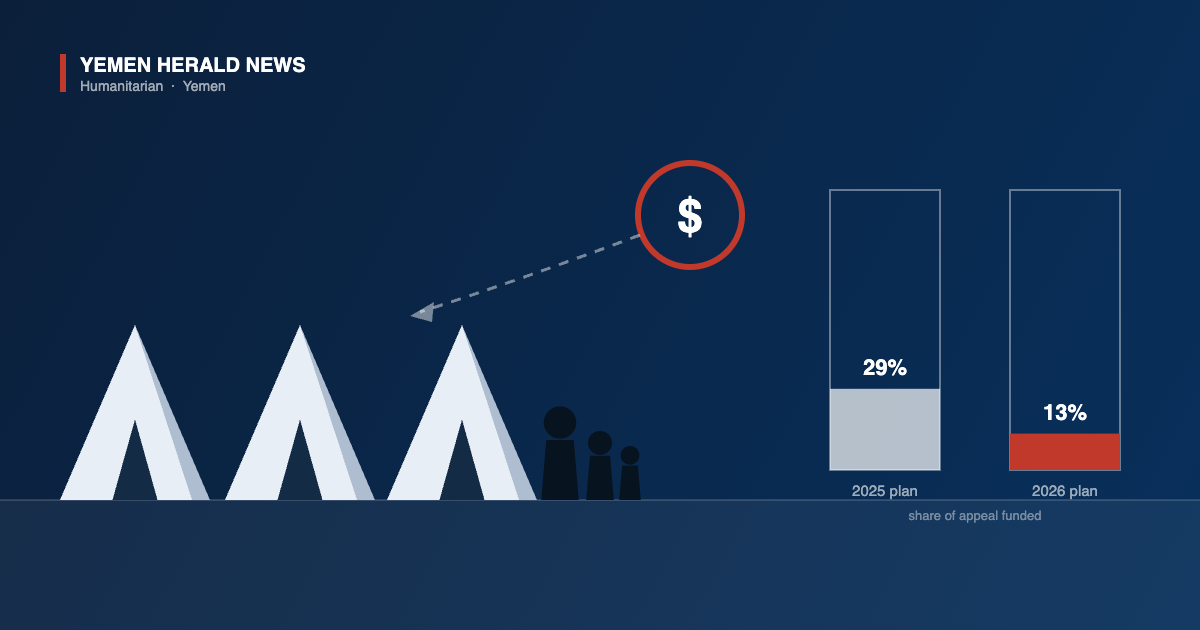
Yemen’s 2026 humanitarian response plan seeks $2.16 billion to reach 12 million people. OCHA published the plan in March.
OCHA said in May that the plan was about 13 percent funded. It said the 2025 plan had closed at 29 percent.
The March plan put the number of people needing aid at more than 22 million. It said 18.3 million were acutely food insecure.
More than 2.2 million children under five were acutely malnourished, according to the plan. It recorded 516,157 cases of severe acute malnutrition.
The plan counted 5.2 million internally displaced people.
The allocation follows weeks of fighting in southwest Yemen. A UN inter-agency flash update covering Sept. 15 to Sept. 28 said more than 145,000 people had been displaced since early September.
The update said that figure had doubled in two weeks. It said the displacement was concentrated on Yemen’s western coast and the southern Taiz frontlines.
About 35,000 women of childbearing age were among those displaced, the update said. It put the number of pregnant women at more than 3,200.
Nine health facilities were destroyed or left non-functional, according to the update. Eight others suspended services.
The update said safe spaces for women and girls had closed in Mokha, Hays and Khokha. It said more than 20 key staff had themselves been displaced.
The UN-led rapid response mechanism had reached nearly 92,000 people as of Sept. 28, the update said.
An earlier update in the same series, covering Sept. 9 to Sept. 14, recorded nearly 94,000 people displaced. It said that was a rise of 135 percent since Sept. 8.
The rapid response mechanism had reached nearly 59,000 people by Sept. 14, that update said. It said about 400 displaced pregnant women needed emergency obstetric and newborn care.
Shelter, privacy and sanitation were limited at displacement sites, according to the update. It reported a shortage of dignity kits.
Military escalation, insecurity and impassable roads were limiting the response, the update said.
Agencies sought $22.7 million for that response through December. The update said 6 percent of it had been received.
Volker Türk, the UN high commissioner for human rights, said on Sept. 24 that his office had documented the killings of 32 civilians since the start of August. He said 15 children and three women were among them.
Türk put the number of civilians killed or wounded over that period at about 125. The rights office said 125,000 people had been displaced by the renewed violence.
Those counts are the rights office’s own. Yemen Herald could not independently verify them.
OCHA did not say when the money would reach agencies working in Yemen.
About 3,000 people had crossed to Djibouti to seek refuge as of Sept. 24, according to Security Council Report’s October forecast. The same forecast said 73 UN staff members remain arbitrarily detained by the Houthis.
The Security Council is due to hold a briefing on Yemen this month, followed by closed consultations. Hans Grundberg, the UN special envoy, and an OCHA official are the expected briefers.
The Yemen sanctions regime set out in resolutions 2140 and 2216 expires on Nov. 14.
About the Author