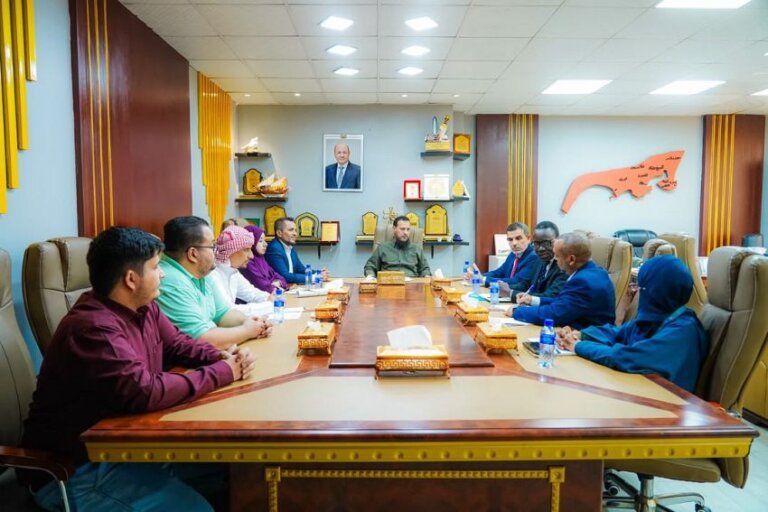
Al-Muharrami and al-Zindani review services and displacement response in Aden
 Yemen Herald News

ADEN, Yemen — A member of Yemen’s Presidential Leadership Council met the prime minister in Aden to review government priorities and public services.
Abdulrahman al-Muharrami held the talks with Prime Minister Shaya al-Zindani. The state news agency Saba reported the meeting, and Yemen Monitor carried the same account.
The two reviewed electricity, water, health, education and sanitation in Aden and other areas under government control, according to the readout.
They discussed measures to keep those services running and to improve their performance, the readout said.
The account of the meeting rests on the official readout carried by Saba. Yemen Herald found no independent account of what was discussed.
Al-Muharrami pressed for service and humanitarian work to be given priority across government, according to the readout. He called for closer coordination between ministries.
Al-Zindani restated the government’s commitment to carrying out plans to improve services, the readout said.
The talks covered the humanitarian situation and displacement. They also covered military and security developments, economic and financial conditions, and the capacity of state institutions to meet their commitments, according to the readout.
The readout attributed the rise in displacement to Houthi escalation. The Houthis have not responded publicly to it.
Al-Zindani became prime minister on Jan. 15. He had previously served as foreign minister.
He succeeded Salem Saleh bin Braik, who held the post from May 2025. Ahmed Awad bin Mubarak was prime minister before that.
The appointment followed the Presidential Leadership Council’s takeover of Aden from the Southern Transitional Council on Jan. 7.
Council forces entered the city and took the international airport and the presidential palace. The Southern Transitional Council announced its dissolution on Jan. 9, and its leader, Aidarus al-Zoubaidi, left for the United Arab Emirates.
The council has said it controls Aden and the surrounding governorates. The Southern Transitional Council disputed that, saying it held some areas.
Al-Muharrami, whose name is also rendered al-Mahrami, sits on the council. He attended the emergency session that Rashad al-Alimi chaired on Jan. 7, along with Sultan al-Aradah, Tariq Saleh, Abdullah al-Alimi and Othman Majali.
That session instructed authorities to take all necessary steps to protect civilians and public facilities in Aden and the governorates under government control, according to the Saudi Press Agency.
It also ordered the unification of command over military and security formations and a halt to unauthorised movements.
The council expelled al-Zoubaidi from his position and referred him to the attorney general on charges including high treason, the agency reported.
Abdulsalam Hamid, the transport minister, and Waed Badhib, the planning and international cooperation minister, were dismissed and referred for investigation.
Aden has served as Yemen’s temporary capital since 2015, when the Houthis took Sanaa.
Electricity has been among the most visible pressures on the government in the city. Residents faced about 20 hours of cuts a day in early June, according to reporting at the time.
The Hiswa power station was offline then after a fault on the network. Output at another station fell after crude deliveries were delayed.
The cuts disrupted water supply, healthcare, education and commercial activity in the Mualla, Sirah and Crater districts.
Diesel in Hadramout rose 50 percent over the same period, to 1,800 riyals a litre from 1,200.
Saudi Arabia announced a $150 million fuel support package at the end of May. An earlier grant that year covered 339 million litres of diesel valued at $81.2 million.
An emergency committee monitors fuel supplies and reports daily to the Ministry of Oil and Minerals.
Displacement from the current fighting has risen sharply. A UN inter-agency flash update covering Sept. 15 to Sept. 28 recorded more than 145,000 people displaced since early September.
The update said the number had doubled in two weeks. It said displacement was concentrated on the western coast and the southern Taiz frontlines.
About 35,000 women of childbearing age were among those displaced, the update said. It put the number of pregnant women at more than 3,200.
Nine health facilities were destroyed or left non-functional, according to the update. Eight others suspended services.
The update said safe spaces for women and girls had closed in Mokha, Hays and Khokha.
The UN-led rapid response mechanism had reached nearly 92,000 people as of Sept. 28, the update said.
Agencies sought $22.7 million for that response through December. The update said 6 percent of it had been received.
Yemen’s 2026 humanitarian response plan seeks $2.16 billion to reach 12 million people. OCHA published it in March.
The plan put the number of people needing aid at more than 22 million, with 18.3 million acutely food insecure.
It recorded 5.2 million internally displaced people. It counted 516,157 cases of severe acute malnutrition among children under five.
OCHA said in May that the plan was about 13 percent funded. It said the 2025 plan had closed at 29 percent.
Houthi forces took the Red Sea port of Mokha on Sept. 10. Tareq Saleh, vice chairman of the Presidential Leadership Council, and a Houthi commander both confirmed the town had fallen.
Pro-government forces pulled back to Dhubab, 46 kilometres south of Mokha.
The Security Council is due to hold a briefing on Yemen this month. Hans Grundberg, the UN special envoy, is among the expected briefers.
The Yemen sanctions regime set out in Security Council resolutions 2140 and 2216 expires on Nov. 14.
About the Author