UNFPA says more than 13,000 pregnant women in Taiz lack essential care
 Yemen Herald News
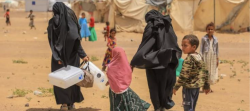
GENEVA, Switzerland — The UN Population Fund says more than 13,000 pregnant women in and around Taiz are without essential maternal care as fighting isolates the Yemeni city.
About 6,400 of those women have been displaced, the agency said.
UNFPA expects roughly 1,500 obstetric emergencies among them.
Francesco Galtieri, the agency’s representative in Yemen, set out the figures to journalists in Geneva on Tuesday. He spoke by video link from Aden.
The account rests on UNFPA’s own briefing. Yemen Herald found no independent verification of the agency’s figures.
“No woman should have to risk her life simply because she’s giving birth to a new life in a war zone,” Galtieri said.
Only five of 27 designated emergency maternal and newborn hospitals in the Taiz area are partially functioning, according to UNFPA.
More than 147,000 women and girls of childbearing age in Taiz city have been cut off from lifesaving services, the agency said.
Galtieri described the situation in the city as both a health and a protection emergency.
At the Swedish Motherhood and Childhood Hospital, deliveries have halved to about five a day from 10, UNFPA said.
The number of working incubators there has fallen to 10 from 40 for want of fuel, according to the agency.
Nighttime admissions have dropped to almost zero.
“Unless access restrictions are lifted in the coming days, the hospital itself could close,” Galtieri said.
Fighting in parts of Yemen has intensified to levels not seen since 2020, the agency said.
Displacement from Yemen’s west coast and Taiz has tripled, with nearly 300,000 people driven from their homes, according to UNFPA.
More than half of them are women and children, the agency said.
More than a third of the displaced families are headed by a woman.
Before the current escalation, an estimated three women a day died in childbirth in Yemen, UNFPA said.
The agency says Yemen has the highest maternal mortality rate in the Arab region.
About 6.2 million women and girls across the country lacked access to basic protection services before the latest fighting, according to the agency.
Galtieri said UNFPA and its partners had reached more than 182,000 people through the UN Rapid Response Mechanism.
That is about 75 percent of displaced households, he said.
The agency linked the fighting to forced and child marriage.
Galtieri cited the case of a 14-year-old girl identified as Safa, whose father married her off a few weeks ago.
“Safa’s words show how war can strip away protection at every turn,” he said.
He described the case as a reminder of the choices some families are facing.
“Their voices must not disappear behind the statistics of war,” Galtieri said.
Reuters reported on Tuesday that Taiz had been largely isolated for a month and that the road linking the city to Aden had been blocked by Houthi forces. UNFPA did not attribute the access restrictions to any party.
The World Food Programme says more than 800,000 people in Taiz and surrounding areas have been cut off from food assistance since early October, Reuters reported.
Front lines have divided Taiz for most of the war.
The International Committee of the Red Cross said in October that only a small proportion of Yemen’s functioning health facilities can provide comprehensive trauma care.
It said then that it supports more than 40 health facilities across the country.
UNFPA described a similar pattern in September, when it said more than 120,000 people had been displaced by that month’s escalation, including about 30,000 women of childbearing age and more than 2,700 pregnant women.
It said then that at least 500 of those women would need emergency obstetric and newborn care.
Emergency obstetric and neonatal care facilities had closed in the Maqbanah and Jabal Habashi districts of Taiz governorate, the agency said in September.
It said violence had forced reproductive health facilities and safe spaces for women and girls to close or operate at reduced capacity.
“For women and girls in Yemen, this is a race against time,” Galtieri said in that September statement. “When violence closes a health facility or an impassable road prevents a woman from reaching skilled care, a preventable complication can become a death sentence.”
UNFPA said in September that it required 22.7 million dollars to reach 80,000 households with emergency relief kits and 140,000 displaced women and girls with reproductive health and protection services.
The agency’s 2026 appeal for Yemen stood at 71 million dollars and was 20 percent funded at that point, according to the same statement.
The Rapid Response Mechanism had reached more than 60,000 displaced people within 72 hours of that escalation, UNFPA said.
The United Nations says more than 22 million people in Yemen need humanitarian assistance, according to the humanitarian needs and response plan published in March.
The plan records 5.2 million internally displaced people.
It puts the number of acutely food insecure at 18.3 million, and the number of children under five who are acutely malnourished at more than 2.2 million, including 516,157 severe cases.
It seeks 2.16 billion dollars to reach 12 million people.
UNFPA gave no updated funding figure for its Yemen operation at Tuesday’s briefing.
About the Author


 Adel Haddad