Warplanes strike Houthi-run brigade headquarters in Ibb’s Yarim district, local media say
 Yemen Herald News
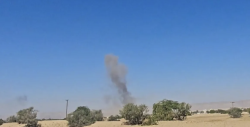
YARIM, Yemen — Warplanes struck the headquarters of a Houthi-run armored brigade in Yarim district, Ibb province, at midday Thursday, Yemen Monitor reported, citing local and media sources.
The outlet identified the target as the base of the 55th Armored Brigade, a unit under Houthi control in Yemen’s central highlands.
It did not identify the aircraft or say which air force flew them. No casualties were reported.
Yemen Herald could not independently verify the account. Other outlets report strikes in Yarim the same day but describe the target differently. TRT World, citing local sources, said they hit a camp holding a missile launcher. Only Yemen Monitor names the 55th Armored Brigade.
The strike was one of several reported across Houthi-held territory the same day.
Yemen Monitor said an airstrike hit Hodeidah International Airport, on the Red Sea coast, citing local and media sources.
In Raymah province, the outlet said, telecommunications infrastructure on Mount Barad in Kusmah district was targeted.
Four more strikes hit weapons depots in al-Bayda province, according to the same report. It named Jabal Jamil and Jarjarah in Dhi Na’im district, and the al-Nasreen area, among the sites.
Another strike hit al-Azimiya Mountain inside al-Bayda city.
Local sources told the outlet that a further strike hit Houthi positions in the al-Kawr mountain range, which runs between Abyan and al-Bayda provinces.
Houthi military spokesman Yahya Saree said Saudi aircraft carried out 59 airstrikes and missile attacks in the preceding 24 hours. The figure is the group’s own and has not been independently confirmed.
Houthi accounts have also described coalition airstrikes on al-Jawf and Saada provinces.
Thursday’s reported strikes came in the second week of a counteroffensive the Yemeni government announced on Oct. 4.
President Rashad al-Alimi, chairman of the Presidential Leadership Council, said the operation, named Dawn of Yemen, was “launched to restore state institutions, liberate the capital, Sana’a, and end the coup by the terrorist Houthi militias.”
Saudi-led coalition spokesman Turki al-Maliki said the coalition “continues to provide full operational support to the Yemeni Armed Forces.”
Al-Maliki said on Oct. 5 that the coalition had destroyed 324 targets it described as high value. He said it had supported Yemeni forces with 100 fighter jets.
Those figures are the coalition’s own. No independent assessment of them has been published.
He also reported a coalition naval strike in Hodeidah province that he said destroyed weapons depots and naval mines.
The counteroffensive followed two months of Houthi advances. The group began its campaign on Aug. 6.
It took Mocha on Sept. 10. By Sept. 11 it had reached the Bab al-Mandab Strait and nearby islands.
On Oct. 4 the Houthis seized al-Turbah, south of Taiz.
Forces aligned with the government retook ground at Bab al-Mandab and Dhubab the following day.
Yemeni Armed Forces spokesman Majid al-Nuzaili said the strait was back under government control, and announced an offensive directed at Sanaa.
The Southern Giants Brigade said it had taken Dhubab Airport.
Claims of control have been contested. Analysts and Yemeni journalists questioned the armed forces’ statement that it holds Mocha, saying government troops had not entered the city.
The Taiz Axis of the Yemeni Armed Forces said Houthi losses on Oct. 5 came to about 100 killed and 150 wounded.
That tally is the government’s. It has not been corroborated independently, and the Houthis dispute government accounts of their casualties.
Saudi Arabia confirmed that two of its southern airports were damaged on Oct. 5.
Middle East Eye reported on Oct. 7 that Saudi aircraft bombed Mudhaykhirah district in Ibb and Sharab district in Taiz. It attributed the account to media outlets associated with the Houthis.
The UN Security Council was due to meet on Yemen on Friday. Special Envoy Hans Grundberg and Mohamed Yahya, the assistant secretary-general for humanitarian affairs, were expected to brief members.
Grundberg said on Oct. 1 that the fighting carried “grave risks to the civilian population.”
Farhan Haq, deputy spokesperson for the UN secretary-general, said on Oct. 5 that the secretary-general was concerned by the escalation. He condemned the cross-border attacks on Saudi Arabia and called for “maximum restraint.”
Saudi Arabia said strikes on King Khalid International Airport in Riyadh and Abha International Airport on Oct. 7 killed three people and wounded 36. The coalition said it intercepted three more Houthi missiles the following day.
The International Organization for Migration says more than 200,000 people have been displaced since the hostilities began.
Akhil Iyer of UNICEF said on Sept. 25 that at least 15 children had been killed and 14 injured since Sept. 3. The agency put the number of displaced children at about 71,000.
The World Health Organization has reported that cholera cases tripled in recent weeks.
The United Nations published its latest humanitarian response plan for Yemen in March, before the current escalation.
That plan said more than 22 million people in the country needed assistance, and put the number of acutely food insecure people at 18.3 million.
It said more than 2.2 million children under five were acutely malnourished, 516,157 of them severely.
The plan recorded 5.2 million internally displaced people. It sought 2.16 billion dollars to reach 12 million of those in need.
Ibb lies on the main road between Sanaa and Taiz. It has been under Houthi control for most of the war.
Yemen Monitor published its account of Thursday’s strikes the same day. It did not say how long they lasted.
About the Author