Houthi missile strike on Mokha port kills eight, including two security officers
 Yemen Herald News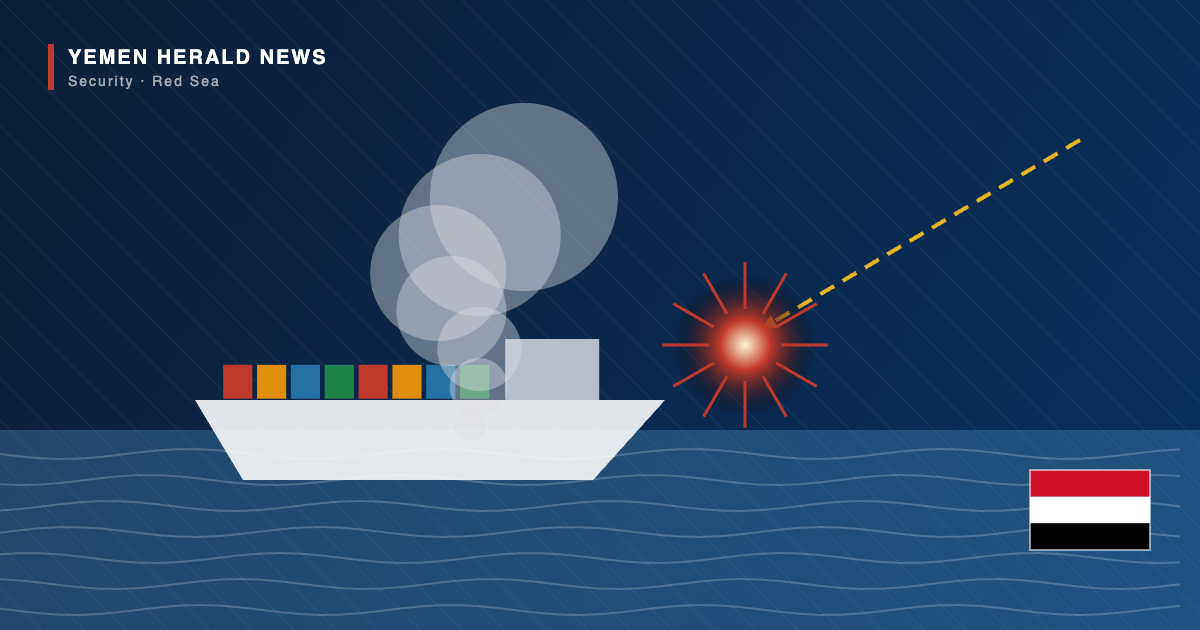
Eight people were killed and cargo vessels set ablaze when Houthi missiles struck Mokha port on Yemen’s Red Sea coast on Friday, according to Yemeni officials, in one of the deadliest single attacks on the government-held coastline this year. Officials said the dead included two members of the security forces and six civilians, most of them dock workers and crew caught while cargo was being unloaded.
Accounts of the toll vary. An initial Yemeni government statement put the number of civilians killed at at least four, and later official tallies raised the figure to eight. The discrepancy is common in the early hours after strikes on Yemeni ports, where casualties are moved to several small facilities and where the distinction between port security staff and military personnel is not always clear. No independent body has verified a final figure.
Port officials said several missiles hit vessels berthed at the quay, starting fires that spread across decks and took hours to bring under control. Photographs circulated by local media showed smoke rising from the harbour, and the port authority reported damage to handling equipment as well as to the ships themselves. Firefighting capacity at Mokha is limited, and crews were working without the marine firefighting tugs available at larger regional ports.
The Houthi movement claimed the attack. The group’s military spokesman, Yahya Saree, said in a statement that the operation had targeted military reinforcements and naval craft, and asserted that vessels and supplies had been destroyed. Yemeni officials rejected that characterisation, saying the ships hit were commercial and that the casualties were overwhelmingly civilian. Neither claim can be independently confirmed, and the two accounts should be read as the positions of the parties making them.
Mokha sits in the western part of Taiz province, on the stretch of coast approaching the Bab al-Mandab Strait. That geography explains why the port has drawn repeated fire. Bab al-Mandab is the southern gateway to the Red Sea and one of the busiest chokepoints in global shipping, and the coastal strip above it has been contested since forces aligned with the internationally recognised government pushed north along it in 2017 and 2018. Mokha itself is modest by regional standards, but for government-held areas it is one of very few working maritime entry points that does not run through Houthi-controlled Hodeidah.
Friday’s strike was part of a sustained series. Earlier in the month, missile and drone attacks on the same port killed seven people, including four soldiers and three civilians, and wounded more than thirty, according to the Yemeni military, which said it intercepted eleven drones during that assault. Days after the Friday attack, the port director announced that Mokha had suspended commercial and maritime operations altogether after being hit by more than twenty-five missiles over the preceding period, with officials estimating losses in the region of sixteen million dollars.
The suspension matters well beyond the harbour. Traders in Taiz and along the southern coast use Mokha for food, fuel and construction materials, and diverting cargo to Aden adds both freight cost and inland transport risk on roads that pass close to front lines. Local businesses have warned that even a short closure feeds through to prices in markets already strained by currency depreciation in government-held areas. Insurance premiums for calls at Yemeni ports, already high, rise further with each publicised strike, and some carriers simply decline the route.
For the wider war, the attacks on Mokha fit a pattern of escalation that also reached Marib, where the provincial authority reported repeated ballistic missile and drone strikes on the city during the same week. Read together, the two campaigns suggest pressure applied simultaneously to the government’s principal inland stronghold and to its coastal supply line. The United Nations Special Envoy for Yemen has warned that the country now faces its highest risk of returning to large-scale conflict since the truce agreed in April 2022.
That truce lapsed formally within months of being signed but held in practice across most front lines, and the calm it produced allowed fuel imports, some commercial flights from Sanaa and a partial recovery in port traffic. The current escalation puts each of those arrangements in question. Diplomats involved in Yemen file have spent much of the past two years trying to convert the informal calm into a durable roadmap; strikes of this scale make that harder, both because they raise the political cost of engagement for the government and because they narrow the space in which mediators can argue that the front lines are stable.
Inside Mokha, the immediate consequences are practical. Dock workers have lost income while operations are suspended, and the families of those killed are dealing with a compensation system that functions unevenly in wartime Yemen. Port authorities have said they intend to resume operations once damage is repaired and safety can be assured, but have not set a date, and no announcement has been made about additional air defence coverage for the harbour.
What happens next depends largely on whether the strikes continue. Yemeni officials have called for stronger international pressure and raised the attacks with Western and regional envoys, while humanitarian agencies have warned that closing a working port during an escalation compounds shortages that were already worsening. For now the harbour is quiet, its cranes idle, and its approaches watched.
About the Author