
Yemen and Bulgaria Agree to Open a Yemeni Section at Sofia’s National Library
 Yemen Herald News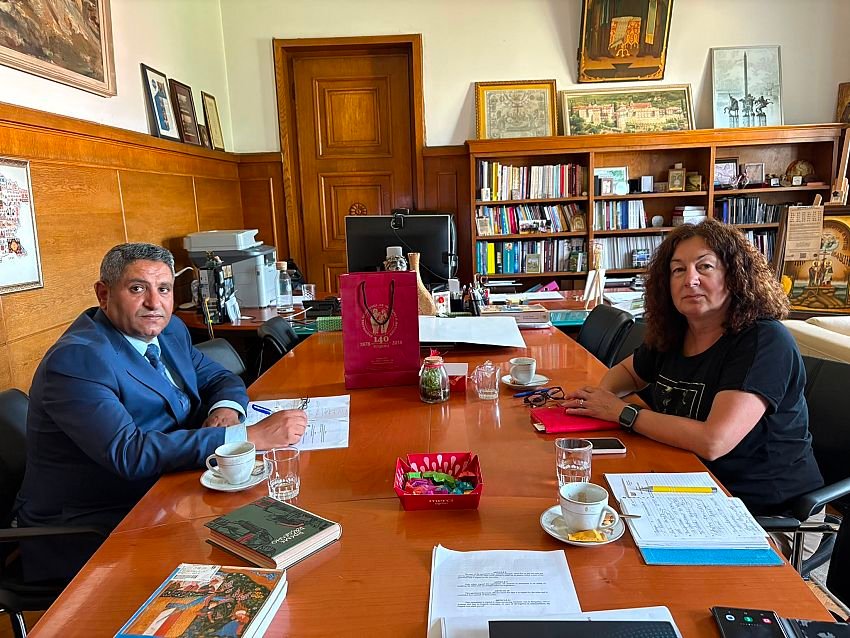
Yemen’s Chargé d’Affaires in Sofia, Ambassador Ahmed Shammar, met this week with Professor Kalina Ivanova, director of the Bulgarian National Library, to discuss ways of deepening cultural cooperation between the two countries. Yemen’s state news agency SABA, which reported the meeting on 28 July 2026, said the two sides reviewed bilateral relations and agreed on a set of practical steps intended to give Yemeni history and scholarship a permanent footing in the Bulgarian capital.
The clearest outcome was an agreement to establish a dedicated Yemen section inside the national library. According to the agency’s account, the section will hold books and publications covering Yemeni history, civilisation and culture, and is intended to serve researchers and general readers who want to study the country’s cultural heritage. No opening date, budget or figure for the number of volumes was announced.
The institution receiving the collection is the SS. Cyril and Methodius National Library, founded in Sofia on 4 April 1878 and Bulgaria’s principal repository of published and archival material. It is not a newcomer to Middle Eastern scholarship. Its Department of Oriental Collections is among the larger holdings of Islamic manuscript material in south-eastern Europe, containing thousands of Arabic manuscripts alongside substantial bodies of Ottoman Turkish and Persian material, much of it assembled from waqf endowments and private libraries transferred to the state.
That collection has been catalogued in stages. A volume compiled by the Bulgarian orientalist Stoyanka Kenderova and published by the Al-Furqan Islamic Heritage Foundation in 1995 described 243 of the library’s Arabic manuscripts in the hadith sciences alone. A Yemen section would therefore sit alongside an established Arabic-language tradition in Sofia rather than begin from nothing.
Beyond the reading room, Shammar and Ivanova went over a draft memorandum of understanding covering broader cooperation. The proposed areas include exchanging books and manuscripts, sharing professional expertise, and supporting digitisation and archiving projects. The two sides also weighed the possibility of a research grant for a Yemeni student working in library documentation and on the Arabic and Yemeni manuscripts held in Sofia. The memorandum remains a draft, and no signing date was given.
The digitisation element carries particular weight given conditions in Yemen. More than a decade of war has left the country’s cultural institutions under severe strain, and all three of Yemen’s cultural World Heritage properties – the Old City of Sana’a, the Old Walled City of Shibam and the Historic Town of Zabid – are inscribed on UNESCO’s List of World Heritage in Danger. UNESCO announced an Emergency Action Plan for the Safeguarding of Yemen’s Cultural Heritage in July 2015, drawing together experts to document damage and coordinate protection efforts.
The damage recorded since then is extensive. UNESCO has reported that the Old City of Sana’a and the historic centre of Sa’ada were hit by shelling, with the al-Qasimi neighbourhood near the urban garden of Miqshamat al-Qasimi among the worst affected, and many of the decorated doors and window panes characteristic of Sana’ani domestic architecture shattered or damaged. Archaeological sites at Marib, including the Great Dam whose collapse is referred to in the Qur’an, have also sustained harm. Sana’a itself has been inhabited for more than 2,500 years and contains 103 mosques, 14 hammams and more than 6,000 houses built before the 11th century.
Against that backdrop, holding accurate digital copies in a stable foreign institution functions as a form of insurance. A digital surrogate cannot replace an original, but it survives shelling, flooding and displacement, and it can be consulted by scholars who are unable to travel to Yemen.
The Sofia meeting also fits a wider pattern in Yemeni cultural diplomacy, in which the country’s embassies have negotiated custody and visibility arrangements abroad while conditions at home remain unsettled. In September 2023, the Metropolitan Museum of Art in New York hosted a ceremony transferring ownership of two ancient sculptures back to the Yemeni government, alongside a temporary custody agreement signed with Yemen’s embassy in Washington, then headed by Ambassador Mohammed Al-Hadhrami. The museum announced a further loan from Yemen in 2024 involving fourteen ancient objects that had been voluntarily returned by a family in New Zealand.
Yemen and Bulgaria have an older institutional relationship to build on. The two governments have signed a number of intergovernmental agreements and established a joint Bulgarian-Yemeni committee for economic cooperation. Bulgaria’s foreign ministry notes that many Yemeni citizens completed their higher education in Bulgaria and went on to hold responsible positions in Yemeni government and business, which gives the proposed student grant a recognisable precedent.
Several details remain unresolved. Neither side has published a timetable for opening the Yemen section, named a funding source, or said which institutions in Yemen would supply the books and manuscripts. The report of the meeting came from SABA, the news agency aligned with Yemen’s internationally recognised government, and did not carry comment from the library.
Measured against the scale of Yemen’s heritage crisis, a library section and a draft memorandum are modest instruments. They are also the kind of arrangement that can be delivered without a ceasefire, a donor conference or access to contested territory. If the section opens and the memorandum is signed, Sofia would join a small group of European capitals hosting a permanent, publicly accessible record of Yemeni cultural production at a moment when much of the original material is difficult to reach.
About the Author




