
Bin Daghr Warns UN Envoy Grundberg That Houthi Escalation Threatens Yemen Peace Efforts
 Yemen Herald News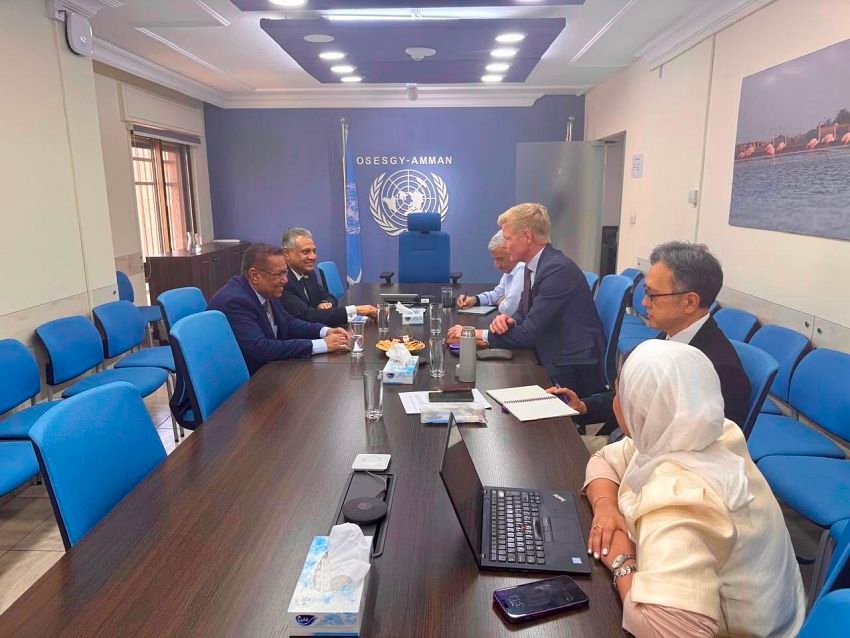
Dr. Ahmed Obeid bin Daghr, chairman of Yemen’s Shura Council, met United Nations Special Envoy for Yemen Hans Grundberg in Amman on Wednesday for talks on a political and military situation that both sides described as shifting quickly. Yemen’s state news agency said the two men reviewed the risks the government attributes to escalation by the Houthi movement, and examined what regional and international actors could still do to keep a negotiated settlement within reach.
Bin Daghr devoted much of the meeting to attacks that Yemeni officials say the Houthis have continued to carry out against Yemeni civilians and against Saudi Arabia. He warned that these operations carry serious consequences for the crisis and risk pushing the country into a more dangerous phase of war. Sustained military escalation, he argued, does not threaten Yemen alone; in his account it widens the geographic scope of the conflict, deepens the suffering of ordinary Yemenis, and erodes the regional and international diplomacy assembled over several years to end the fighting.
The current phase, he told the envoy, requires all parties to prioritise dialogue and halt hostile operations, because further escalation only makes the crisis harder to unwind. Bin Daghr also heard Grundberg’s own reading of events and the United Nations assessment of where mediation now stands. The two then discussed concrete measures for responding to the escalation, along with the case for intensifying regional and international engagement so that the prospect of a political settlement does not collapse entirely.
Grundberg, a Swedish diplomat, has held the post of UN Special Envoy for Yemen since September 2021, and he has spent much of his tenure moving between Riyadh, Muscat, Aden, Sana’a and Amman in search of a framework all sides will accept. The two-month truce he helped broker in April 2022 was renewed twice before lapsing that October, and although several of its provisions endured in practice, no comprehensive agreement has followed. Jordan’s capital has since become one of the neutral venues used for Yemeni consultations.
The meeting took place against a sharply deteriorating regional backdrop. The Houthis have threatened to impose a naval blockade on Saudi Arabia affecting traffic through the Bab al-Mandab Strait, and on 27 July they announced what they called a fourth phase of escalation. Oil prices climbed above $100 a barrel on 23 July after an attack on shipping in the Red Sea, the first time they had reached that level since May. The European Union’s foreign policy chief has described the blockade threat as a dangerous escalation.
Those maritime routes matter far beyond Yemen. Bab al-Mandab links the Red Sea to the Gulf of Aden and carries a substantial share of the cargo and energy moving between Asia and Europe, which is why disruption there registers almost immediately in freight rates and insurance premiums. Yemen’s government has said it supports Saudi Arabia’s right to defend its territory and vital installations, and this week it also condemned a missile attack that it said had targeted Jordan.
Humanitarian conditions supply the most sobering context for any diplomacy. The United Nations Office for the Coordination of Humanitarian Affairs estimates that 22.3 million people in Yemen, more than two thirds of the population, need humanitarian assistance and protection in 2026, among them 5.2 million internally displaced people. Some 18.3 million are acutely food insecure, and the most recent food security analysis points to further deterioration, with districts moving from crisis to emergency levels. More than 2.2 million children under five are acutely malnourished, including roughly 516,000 with severe acute malnutrition.
Funding has not kept pace with those needs. Aid agencies are seeking $2.16 billion to reach 12 million people this year, yet only about 12.7 per cent of that appeal had been met by May. Roughly 14.4 million people are expected to require water, sanitation and hygiene support, a consequence of damaged infrastructure and chronic water scarcity that also drives recurring outbreaks of preventable disease.
Yemen’s internationally recognised government is meanwhile managing upheaval of its own. The Presidential Leadership Council and much of the cabinet have operated from Riyadh since December, when the Southern Transitional Council mounted an offensive that pushed the government from its headquarters in Aden and left the separatist movement claiming control across much of the south. Prime Minister Salem Saleh bin Braik resigned in January and was replaced by Shaya Mohsen al-Zindani, who had been serving as foreign minister.
That fragmentation is one reason UN mediation has proved so difficult. Any durable settlement must accommodate not only the Houthis and the government but also southern factions with territorial and political demands of their own. Observers of the file have long noted that each round of military escalation hardens positions and narrows the space in which compromise can realistically be discussed.
Neither the Shura Council nor the United Nations announced a date for further talks, and no new negotiating round has been scheduled. Grundberg’s office continues to press for a de-escalation that would allow a return to discussion of a roadmap covering a nationwide ceasefire, the payment of public salaries, the reopening of roads and a resumption of political negotiations. For now the trajectory of Yemen’s war, and the fate of civilians who have endured more than a decade of it, remains unsettled.
About the Author




