Yemen’s Ambassador to Turkey and Deputy Foreign Minister Nuh Yılmaz Discuss Bilateral Ties in Ankara
 Yemen Herald News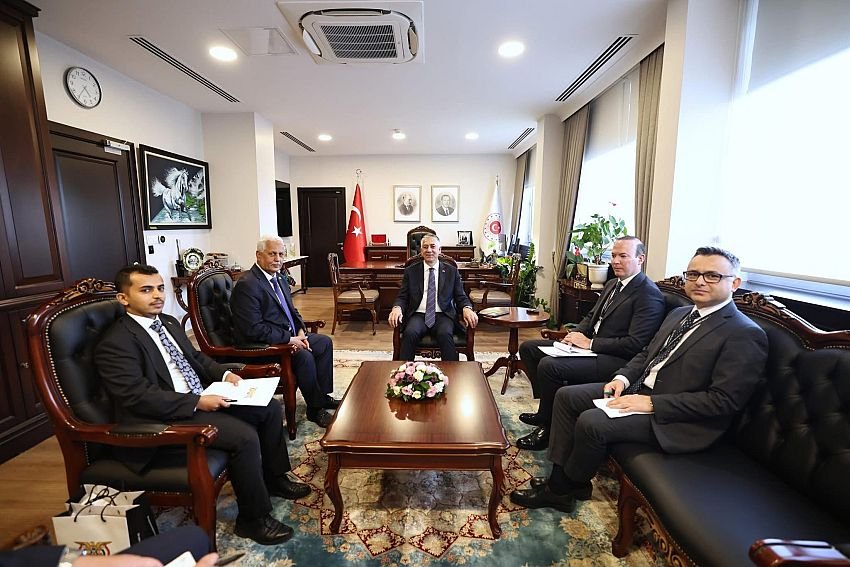
Yemen’s Ambassador to Turkey, Mohammed Tureik, held talks with Turkish Deputy Foreign Minister Nuh Yılmaz in Ankara, in a meeting intended to strengthen the relationship between the two countries and expand cooperation across a range of areas. The encounter added to a series of diplomatic contacts through which Yemen’s internationally recognised government has sought to consolidate international support while it contends with a protracted civil war and a deep humanitarian emergency.
According to Yemen’s foreign ministry, the two officials reviewed the state of bilateral relations and explored ways to deepen cooperation, while also exchanging views on regional and international developments. Tureik used the meeting to express appreciation for Turkey’s supportive positions toward the internationally recognised Yemeni government, and Yılmaz, for his part, reaffirmed Ankara’s backing for Yemen’s unity, stability and territorial integrity.
The discussion also touched on the situation inside Yemen, including what the government describes as continued violations by the Houthi movement, which it and its allies characterise as an Iranian-backed militia. Yemeni officials have consistently framed the conflict in those terms, and the ambassador’s remarks reflected the government’s effort to keep international partners focused on the security challenges it says the movement poses to the country and the wider region.
Practical matters affecting the Yemeni community in Turkey also featured among the topics raised. Turkey hosts a sizeable population of Yemeni students, professionals and families, many of whom rely on the embassy for consular services, and improving the administrative mechanisms that serve them has been a recurring concern. Streamlining such services is among the ways the two governments have sought to translate warm political ties into tangible benefits for ordinary citizens.
Turkey has positioned itself as a supporter of the Yemeni government led by the Presidential Leadership Council, the eight-member body formed in 2022 to unify the anti-Houthi camp. Ankara’s engagement forms part of a wider ambition to maintain influence across the Middle East and the Red Sea region, where it has cultivated economic, humanitarian and political relationships in a number of states affected by instability and conflict.
Geography lends the relationship added strategic weight. Yemen sits along the Red Sea and commands one side of the Bab al-Mandab Strait, a chokepoint through which a large share of global trade passes. Turkey, a significant trading nation with growing interests in maritime security, has an evident stake in the stability of these waters, which have been disrupted by attacks on shipping linked to the wider regional conflict in recent years.
The humanitarian dimension was never far from the discussion. The United Nations estimates that more than 18 million Yemenis need assistance and that over four million have been displaced, while recurring outbreaks of cholera and measles have compounded the strain on a fragile health system. Turkish humanitarian organisations have been active in Yemen, and continued cooperation on relief efforts is one area where the two governments can point to concrete results.
For Yemen’s government, cultivating ties with regional powers such as Turkey is part of a broader strategy of diversifying its international relationships. While Saudi Arabia and the United Arab Emirates remain its principal backers, engagement with Ankara offers additional diplomatic support and a further platform from which to press its case on the international stage, particularly regarding the humanitarian situation and the conduct of the war.
Education has been one of the more visible strands of the Yemeni-Turkish relationship. Turkish universities and scholarship programmes have hosted a growing number of Yemeni students in recent years, and Turkey’s state scholarship foundation has previously engaged directly with Yemen’s embassy in Ankara. For a generation of young Yemenis whose schooling was disrupted by war, access to study abroad represents both a personal opportunity and a potential investment in the country’s eventual reconstruction.
Trade and investment also feature in the two countries’ calculations. Turkey exports a range of goods to Yemen, from food products to construction materials, and Turkish companies have expressed interest in participating in reconstruction once conditions allow. Yemeni officials, in turn, have sought to attract foreign investment as part of their economic recovery agenda, and stable political ties with a manufacturing power like Turkey are viewed as a useful foundation for expanding commercial links.
Turkey’s approach to Yemen also fits its broader regional diplomacy, which has at times placed it at odds with, and at other times alongside, the Gulf states involved in the conflict. In recent years Ankara has worked to repair relations with Saudi Arabia and the UAE, and its measured support for Yemen’s recognised government reflects a preference for stability and for maintaining a presence in a strategically important corner of the region.
Meetings of this kind rarely produce immediate breakthroughs, but they help sustain the channels of communication on which longer-term cooperation depends. The exchange in Ankara allowed both sides to reaffirm shared priorities — Yemen’s territorial integrity, the welfare of Yemeni nationals abroad and coordination on regional issues — and to signal a mutual interest in building on an already established relationship.
The talks come at a moment when Yemen’s government continues to seek international attention amid competing crises elsewhere in the world that have, at times, pushed the country’s plight down the global agenda. By maintaining active diplomacy with partners like Turkey, officials hope to ensure that Yemen’s humanitarian and political needs remain visible to a wide range of governments and institutions.
About the Author