Yemen Condemns Iranian Missile and Drone Attacks on Six Arab States as Violations of International Law
 Yemen Herald News
Yemen’s government has condemned Iranian missile and drone attacks on Arab states perpetrated across the region, with the Foreign Ministry describing the strikes on Kuwait, Qatar, Bahrain, the United Arab Emirates, Oman and Jordan as serious violations of international law and of the charters of the United Nations and the Organization of Islamic Cooperation.
The condemnation places Yemen’s internationally recognized government firmly alongside its Gulf and Arab partners after one of the most dangerous escalations the region has seen in decades. Iran launched waves of missiles and drones at the six countries in mid-July, in what Tehran presented as retaliation for American strikes on Iranian targets, extending a confrontation that began between Iran and the United States into the territory of Washington’s Arab partners.
The latest barrage came hours after the United States military said it had struck about 140 targets inside Iran, including missile and drone launch sites, naval assets and ammunition storage facilities. Iran’s Revolutionary Guard said its own attacks were aimed at military infrastructure used by the United States, claiming to have hit a command center and drone facilities in Jordan, a radar site in Kuwait, refueling and support facilities in Oman and a jet maintenance center in Qatar.
The targeted states saw the matter differently. Their forces reported intercepting many of the incoming projectiles, and governments across the region characterized the strikes as assaults on their sovereignty regardless of the intended targets. In Qatar, the interior ministry said three people, among them a child, were injured by falling debris.
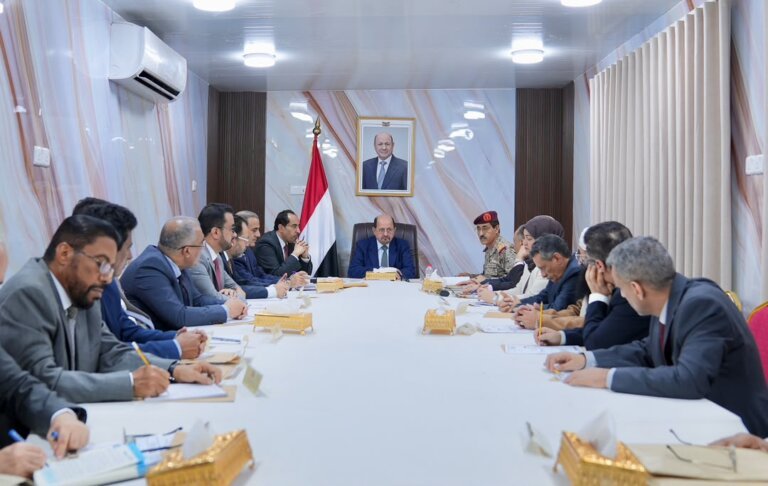
In its statement, the Yemeni ministry described the Iranian escalation as a deliberate policy of aggression that threatens not only the countries attacked but the stability of the entire region. It expressed Yemen’s full solidarity with the affected states, stressing that the government in Aden regards any threat to the security of Gulf and Arab nations as a threat to Yemen itself.
That message of connected security reflects Yemen’s own experience. The government has fought a war of more than a decade against the Houthi movement, which it says is armed and supported by Iran, and Yemeni officials have long argued that their country was the first casualty of the expansionist policy they now see directed at their neighbors. As the government presents it, the missile fire on Gulf capitals vindicates years of warnings that Iranian-backed proxies and Iranian weapons transfers would eventually endanger the wider region.
Yemen’s condemnation joins a chorus of regional responses. The United Arab Emirates condemned the attacks in the strongest terms after reporting injuries on its territory for the second time in a week, Qatar called the strikes a dangerous escalation, and Saudi Arabia denounced what it described as repeated Iranian violations of neighboring states’ sovereignty.
The escalation carries direct implications for Yemen’s own conflict. The government in Aden has recently accused Tehran of operating unauthorized flights into Houthi-controlled Sanaa airport, warning that such an air bridge could accelerate the supply of weapons to the group, and the dispute has already produced strikes on the airport’s runway and Houthi retaliation against an airport in southern Saudi Arabia. Yemeni officials fear that a broader regional war will entrench the Houthis militarily and politically just as international attention drifts from Yemen’s stalled peace process.
Maritime security is a further concern. The Red Sea and the Bab al-Mandab Strait, which run along Yemen’s coastline, carry a substantial share of global trade and energy shipments, and attacks on shipping in recent years have already forced costly diversions around Africa. Oil prices have surged as the confrontation has spread toward the Strait of Hormuz, and any widening of the fighting risks turning these corridors into an arena of sustained conflict, with consequences for economies far beyond the Middle East.
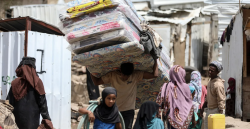
For ordinary Yemenis, the stakes are measured in humanitarian terms. More than 18 million people in the country need assistance, according to United Nations estimates, and around 4.5 million remain internally displaced. Aid agencies warn that regional escalation tends to disrupt supply lines, raise food and fuel prices and divert donor funding, all of which would deepen a crisis already among the world’s most severe.
The government coupled its condemnation with a call for the international community to confront what it called destabilizing Iranian behavior, including through greater scrutiny of weapons transfers and firmer enforcement of existing sanctions. Yemeni officials have pressed this case in recent weeks in meetings with Western and Arab partners, arguing that the credibility of international rules is at stake in how the region’s states respond.
Diplomatically, much now depends on whether the cycle of strike and retaliation can be interrupted. A strong and united international response, in the government’s view, could create the conditions for renewed dialogue and de-escalation; a muted one, it warns, would invite further attacks and a slide toward open regional war. Mediation efforts that preceded the latest strikes have suffered a setback, though none of the parties has formally closed the door to diplomacy.
Yemen thus finds itself at a familiar crossroads, its internal conflict entangled with a regional confrontation it cannot control. The country’s leadership knows that escalation anywhere in the Gulf reverberates in Yemen, aggravating the humanitarian emergency and complicating the search for peace. Its message this week was accordingly double-edged: solidarity with the attacked states, and a plea that the world not allow Yemen to become, once again, the forgotten front of a wider war.
About the Author