Houthi missiles and drones hit Marib and al-Makha as Yemen escalation deepens
 Yemen Herald News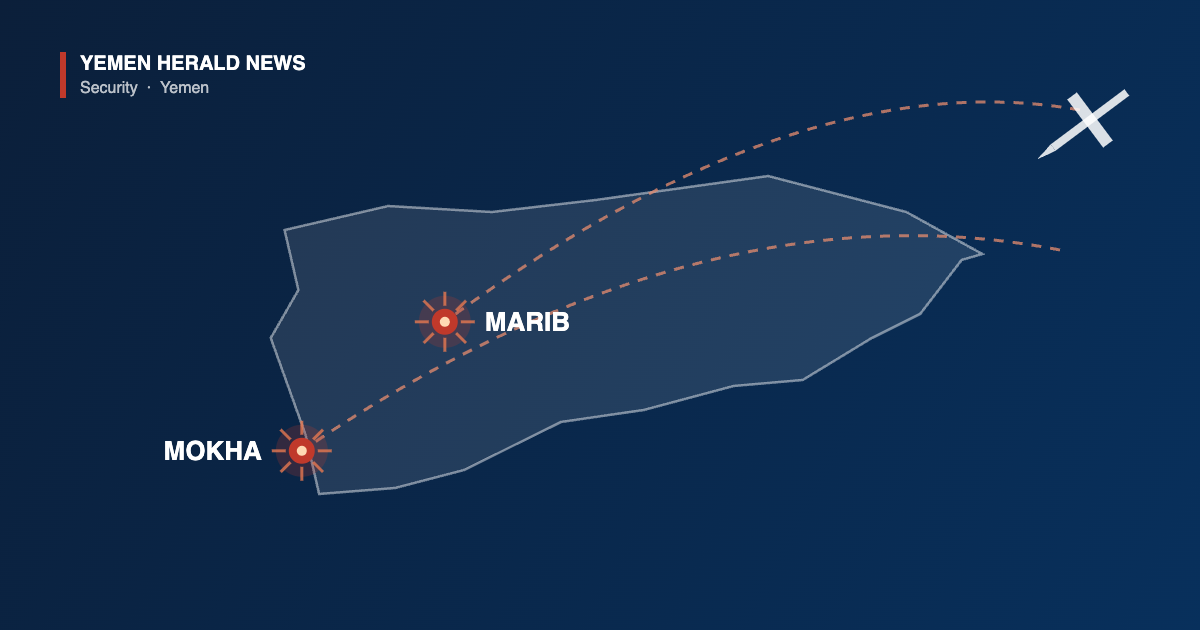
The Houthi movement launched a fresh wave of ballistic missiles and drones at the government-held city of Marib and the Red Sea port city of al-Makha, also known as Mokha, over the weekend of 15 and 16 August 2026, killing four people and wounding at least eight. The strikes hit residential areas and civilian infrastructure in two of the most strategically sensitive locations still controlled by Yemen’s internationally recognised government, and marked one of the sharpest phases of an escalation that has unsettled the country since early August.
Marib’s provincial authority said six ballistic missiles and four drones targeted residential neighbourhoods in the city on Saturday evening, wounding four people and damaging homes and civilian infrastructure. The figures come from the local authority; no neutral monitor has confirmed them. The Houthis, who have not published a detailed account of the Marib salvo, have in the past described their operations in the province as directed at military targets rather than residential districts.
In al-Makha, an attack on Sunday struck the outskirts of the port city, while a second hit a main road inside it. Four people were killed and eight wounded in the overnight attacks, according to Yemeni state media and the director of al-Makha airport. The city had already absorbed several days of strikes: Abdulmalik al-Sharabi, director general of the government-controlled port, said on Saturday that operations at the facility had been suspended.
The suspension matters well beyond the city. Al-Makha sits on Yemen’s Red Sea coast close to the Bab al-Mandab strait, one of the world’s most heavily used shipping chokepoints, and it is one of the few functioning ports available to the government and to aid agencies working in the south and west of the country. Extended closures push relief and commercial cargo onto longer overland routes at higher cost, a pattern repeated throughout the war whenever a Red Sea facility has been forced offline.
Marib carries a different kind of weight. The city lies east of the capital, Sanaa, and has been the government’s principal stronghold in northern Yemen since the Houthis took the capital in September 2014. It sits alongside the country’s main oil and gas infrastructure, and it has absorbed an enormous displaced population. Local authorities say more than two million of the roughly five million Yemenis forced from their homes during the war are sheltering in the province, which would make it the largest single concentration of displacement in the country. Aid organisations have warned that camps around the city sit close to areas that have come under fire.
Government forces have not been passive. The military said it carried out 181 operations against Houthi positions in several governorates on Saturday and Sunday; its spokesman, Majid al-Nuzaili, said drones, artillery and rocket launchers killed and wounded dozens of the group’s fighters. The Houthis acknowledged four deaths among their members but gave no further detail. Neither set of casualty claims has been independently verified, and battlefield tallies issued by the two sides have frequently diverged.
The weekend attacks followed a warning from the United Nations. Briefing the Security Council on 13 August, UN special envoy Hans Grundberg said Yemen faced a greater risk of a return to large-scale conflict than at any point since the truce brokered in April 2022. He said recent attacks had placed civilians at grave risk in Mokha, Marib and beyond, and called for the escalation to stop and for civilians and civilian infrastructure to be protected.
The current round began earlier in August, when Houthi strikes on military camps in Marib and Hadramout killed at least 30 government soldiers in what was described as the deadliest single episode of the conflict in years. Fighting has since resumed in several provinces, including al-Jawf, al-Dhalea and Taiz. An earlier attack on al-Makha, reported on 10 August, killed seven people, including four soldiers and three civilians, and wounded at least 30, according to the government’s army.
Yemen had seen a relative lull in fighting since April 2022, when the United Nations brokered a truce that was never formally converted into a durable settlement. The war itself is approaching its twelfth year. The Houthis have held Sanaa and much of the northern highlands since 2014, while the internationally recognised government, backed by a coalition led by Saudi Arabia, operates largely from Aden and the eastern provinces. Repeated rounds of talks have failed to resolve the central disputes over territory and revenue.
The humanitarian consequences of a renewed escalation would land on a population already close to the edge. The United Nations humanitarian response plan published in March 2026 estimates that more than 22 million people in Yemen need assistance, that 18.3 million are acutely food insecure and that more than 2.2 million children under five are acutely malnourished, including 516,157 with severe acute malnutrition. Some 5.2 million people are internally displaced. The plan seeks 2.16 billion US dollars to reach 12 million of those in greatest need.
Neither side has signalled a readiness to step back. Government officials have framed the strikes on Marib and al-Makha as evidence that the Houthis are preparing a broader offensive, while the group has cast its operations as a response to government and coalition activity. With mediation stalled and the 2022 truce already frayed, much now rests on whether pressure from the United Nations and regional states can interrupt the cycle before it widens.
About the Author