Pentagon Review Finds US Strikes Killed 153 Civilians in Yemen in 2025
 Yemen Herald News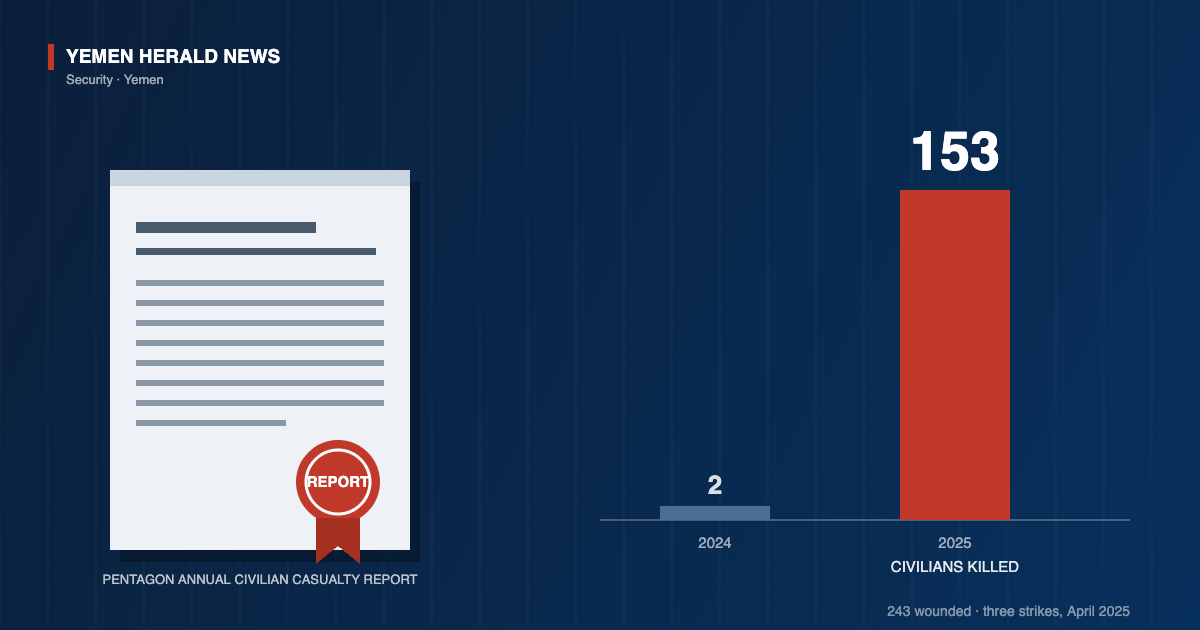
A Pentagon review has concluded that United States military strikes targeting Yemen’s Houthi movement killed 153 civilians and wounded 243 others during 2025, a toll drawn entirely from three air attacks carried out in April of that year. It is the most detailed official accounting yet of civilian harm caused by the American campaign in Yemen.
The figures appear in an unclassified assessment prepared for the United States Congress as part of the Pentagon’s annual report on civilian casualties. A US official disclosed the numbers on Tuesday, and the document was obtained by the Associated Press after NBC News first reported its contents. A Pentagon official, speaking anonymously because they were not authorised to discuss the report publicly, said the department would formally submit it to lawmakers in the coming months.
The 2025 total represents a steep rise on the previous year. For 2024, the Pentagon assessed that American military operations had killed two civilians and injured two others. Almost the entire increase is accounted for by Yemen, where the pace and scale of US strikes expanded sharply after President Donald Trump returned to office at the start of 2025.
The three incidents named in the assessment took place in and around the Houthi-held capital, Sanaa, and at the Ras Isa fuel port on the Red Sea coast. The attack on Ras Isa was the deadliest, killing 80 people and injuring 171. It sent fireballs into the night sky and left tanker trucks burning across the terminal, and Houthi-run Al-Masirah television later broadcast footage of the aftermath. A further strike near Saada in late April also caused casualties, although published per-incident tallies have varied between accounts.
US Central Command, which directs American military operations across the Middle East, said at the time that the Ras Isa strike was intended to cut off a source of fuel and revenue for the Houthis. “The strike was not intended to harm the people of Yemen,” CENTCOM said, adding that its forces had acted to deprive the group of illegal revenue it said had funded attacks across the region for more than a decade.
The review concluded that the three strikes had more likely than not caused civilian harm, a judgement it said rested on US intelligence, imagery and open-source reporting. That standard falls short of a formal confirmation of each individual death, but under Pentagon practice it is sufficient to record the casualties in the annual return to Congress.
The assessment also determined that condolence payments to victims or their families were not appropriate, without setting out the reasoning behind that conclusion. Such payments are not required under US law and do not constitute an admission of wrongdoing, but they have been offered after earlier incidents. Following a 2021 American drone strike in Kabul that mistakenly killed ten people, including seven children, the Pentagon said it was committed to offering payments to their relatives.
The Yemen toll may yet rise. As of February, CENTCOM was still reviewing a further 15 reported incidents in the country, prompted by submissions from non-governmental monitoring organisations. Any additional cases substantiated by that review would be added to future reporting to Congress.
American strikes on Houthi targets began in 2023 under President Joe Biden, after the group started launching drones and missiles at commercial vessels in the Red Sea. The Houthis said those attacks were intended to pressure Israel over its war in Gaza and to support Palestinians. The campaign widened considerably in 2025, with Washington saying its aim was to degrade Houthi military capabilities and protect shipping through one of the world’s busiest maritime corridors.
The disclosure lands amid broader scrutiny of civilian deaths from US operations. Defense Secretary Pete Hegseth has reduced the size of the Pentagon office responsible for limiting civilian harm, according to the Associated Press. Earlier this year, a US missile struck a primary school in Iran during the opening days of the war between the United States, Israel and Iran, killing as many as 168 people.
The assessment does not cover strikes on boats that the Trump administration accuses of trafficking drugs in the Caribbean and the eastern Pacific. Those operations have killed more than 200 people since September 2025, based on tallies announced after each strike. The administration has described those targeted as narco-terrorists, while Human Rights Watch and Amnesty International have characterised the strikes as unlawful extrajudicial killings, and the American Civil Liberties Union has said the government’s claims about who was hit remain unsubstantiated.
For Yemenis, the report adds a further layer to a humanitarian emergency already among the world’s most severe. United Nations agencies estimate that more than 18 million people in the country need some form of assistance and that roughly 4.5 million remain internally displaced, with recurrent outbreaks of cholera and measles compounding the strain on a health system fractured by more than a decade of war.
No independent international investigation into the April 2025 strikes has been announced. Aid organisations and Yemeni civil society groups have pressed for one, arguing that an assessment carried out by the same military that conducted the attacks cannot settle questions of accountability. The Pentagon has not indicated whether it intends to release further detail on how it reached its conclusions.
About the Author