Houthi military adviser says US interests will be targets if Washington backs Saudi strikes
 Yemen Herald News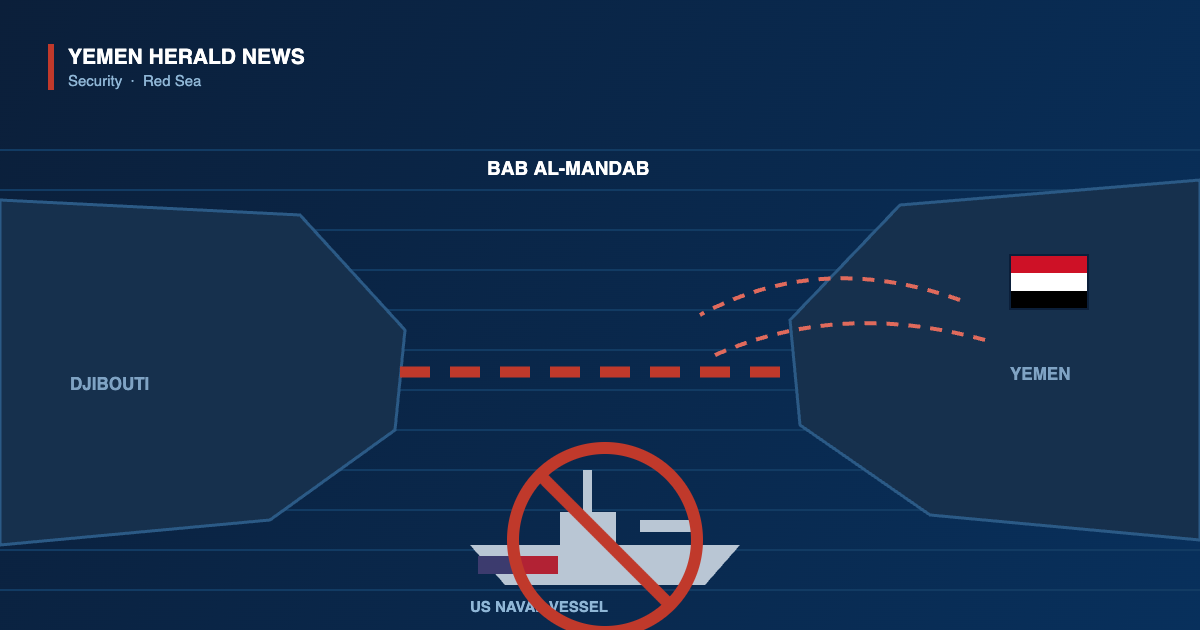
SANAA, Yemen — The Houthis will treat American interests in the region as targets if Washington backs Saudi strikes in Yemen, a Houthi military adviser said.
Abed Mohammed al-Thawr, a military adviser to the group, set out the position in an interview with Agence France-Presse on Tuesday.
“If America gambles on supporting Saudi Arabia with airstrikes or air support… We will consider any American interests around us to be targets and we will not exclude anything,” al-Thawr said.
He said the group would close Bab al-Mandab completely to American ships.
“If America dares to intervene militarily with its fleets or tries to take control of Bab al-Mandab, it is a red line for them and anyone else,” he said. “We will fight over it.”
The account of the threats rests on that interview with al-Thawr. Yemen Herald found no independent confirmation of the group’s intentions, and neither the United States nor Saudi Arabia has responded to the remarks publicly.
Houthi forces took the strait this month after pushing Saudi-backed government forces off Yemen’s Red Sea coast.
The waterway is the southern gateway to the Red Sea and one of the busiest shipping lanes in the world.
The group completed its takeover of the waterway after seizing the islands of Perim and Zuqar. It recaptured the port city of Mokha on 10 September.
Saudi Arabia has asked the United States and other governments for military help against the group, according to US media reports. Yemen’s government has made the same request, a source told Agence France-Presse.
President Donald Trump rejected the Saudi request, according to those reports. CNN reported this month that US personnel were in Saudi Arabia providing intelligence for strikes without joining them.
The New York Times reported that the administration prepared to launch airstrikes on Houthi targets on Sunday after further appeals from Crown Prince Mohammed bin Salman. It said Trump called the operation off while bombs were being loaded onto aircraft.
Al-Thawr denied that the group takes orders from Tehran.
“Iran is a friendly, allied, and brotherly country to us, but it does not direct us,” he said. “We are independent in our decisions and in our sovereignty.” He described the two as “one alliance and one body.”
Washington and its allies describe the group as Iranian-backed. The United States has designated it a foreign terrorist organisation since March 2025.
Renewed fighting in Yemen sets allies of Washington and Tehran against each other while the two governments remain deadlocked in the Gulf, Agence France-Presse reported.
The Houthis have held Sanaa since 2014. They marked the twelfth anniversary of that takeover on 20 September.
Al-Thawr also addressed the Saudi air campaign. “As long as Saudi Arabia insists on and continues killing our country and striking our people, we will strike with an iron fist,” he said.
“We possess sufficient capability to discipline Saudi Arabia, punish it, and force it out of the game in the fields of oil and the economy,” he said.
The group says Saudi Arabia has carried out hundreds of strikes in Yemen since fighting resumed in July, ending a four-year truce. Saudi Arabia has not published a count of its own.
Houthi drones and missiles have struck Saudi sites over the same period, including the capital Riyadh for the first time in years.
Al-Masirah, a television channel run by the group, said on Wednesday that Saudi airstrikes had killed 10 people and wounded 14 others in Taiz and al-Jawf governorates over 24 hours.
The channel said eight civilians were killed and 11 wounded in Taiz, and two killed and three wounded in al-Jawf. Yemen Herald found no second origin for those figures, and Saudi Arabia has not commented on them.
Saudi Arabia is the world’s largest oil exporter. The Houthi hold on Bab al-Mandab came while Iran was pressing on the Strait of Hormuz as part of its war with the United States.
Fighting on Yemen’s Red Sea coast left hundreds dead, according to Agence France-Presse.
The UN refugee agency said on Tuesday that the number of people displaced inside the country by the current fighting could rise from more than 130,000 to more than 230,000.
More than 3,000 people have crossed from Yemen to Djibouti during the current fighting, and hundreds more have reached Somaliland and Puntland, according to the agency.
The United Nations humanitarian plan for Yemen published in March counted more than 22 million people in need of aid and 18.3 million who are acutely food insecure.
It recorded 5.2 million people displaced before this round of fighting and sought $2.16 billion to reach 12 million people.
The March plan also counted more than 2.2 million children under five who are acutely malnourished, 516,157 of them severely.
Yemen’s civil war began more than a decade before the current confrontation between Washington and Tehran. The Saudi-led coalition entered it in March 2015.
A truce agreed in 2022 had held in varying form until July.
Al-Thawr spoke on the day Iranian and US envoys met on the sidelines of the United Nations General Assembly in New York, their first public meeting in months.
Al-Thawr did not say what the group would treat as American intervention. He gave no timeframe.
About the Author