Yemen joins Human Rights Council preparatory meeting as Arab Group plans Item 10 resolution
 Yemen Herald News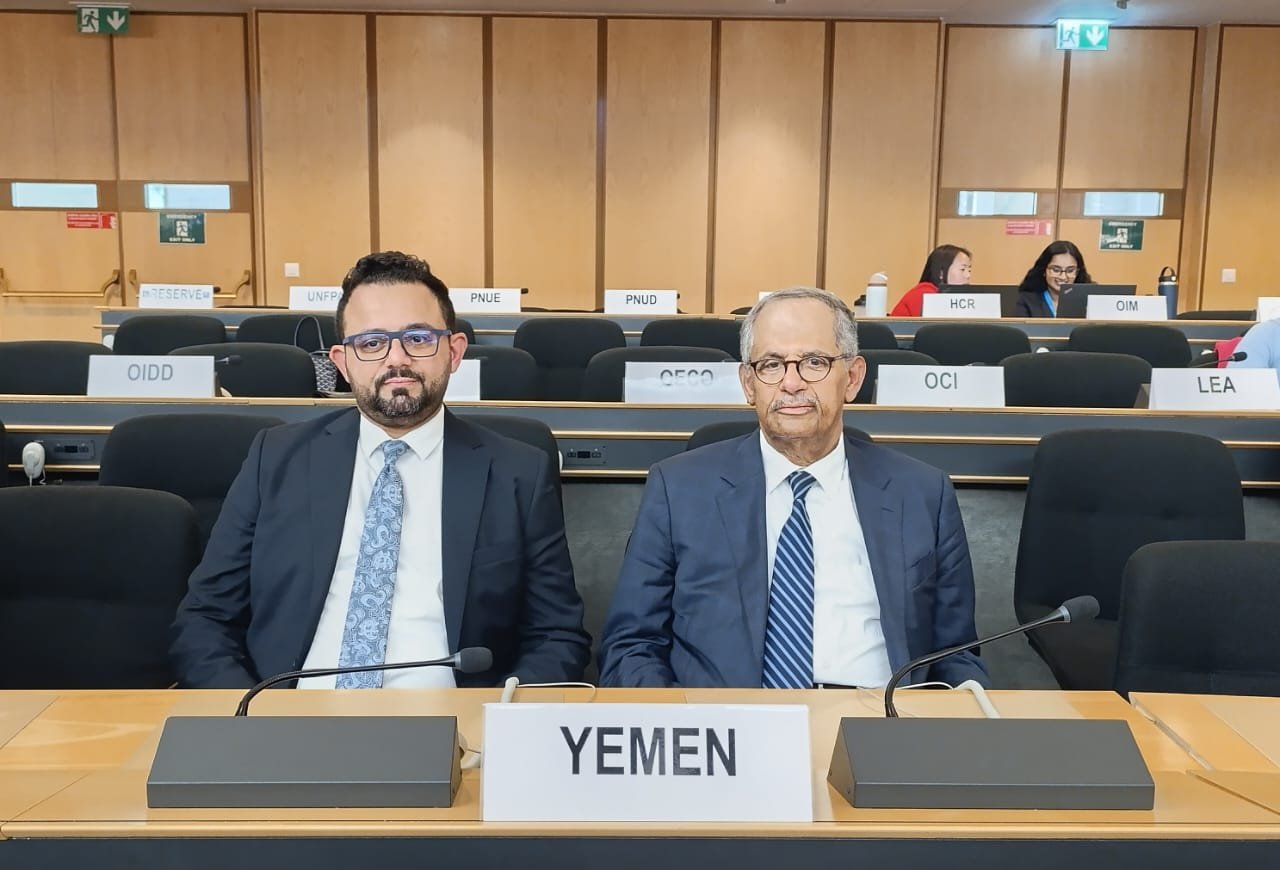
GENEVA, Switzerland — Yemen took part in the UN Human Rights Council’s organizational meeting in Geneva on Aug. 25, ahead of the Council’s 63rd regular session.
Ambassador Ali Mojawar, Yemen’s permanent representative to the UN Office and other international organizations in Geneva, headed the delegation, the state news agency Saba reported.
The session runs from Sept. 7 to Oct. 2.
The organizational meeting reviewed logistical arrangements and the programme of work for the coming session, Saba said.
Delegates also weighed measures to improve time and resource management, according to the agency. The UN Secretariat is working through a financial and liquidity crisis.
Sudan, speaking on behalf of the Arab Group, said it planned to submit a draft resolution on Yemen, Saba reported.
The text would be taken up under Item 10 of the Council’s agenda, which covers technical assistance and capacity-building.
It would extend support and technical assistance to Yemen, the agency said. The stated aim is to strengthen the capacities of national human rights institutions and of the National Commission to Investigate Alleged Violations of Human Rights.
Yemen Herald could not independently confirm Saba’s account of the meeting or of Sudan’s announcement, and no independent report of the proceedings has been published. The session dates are listed separately by the UN Library and Archives in Geneva.
The Arab Group has carried Yemen’s Item 10 resolution in recent years. The United Arab Emirates presented the text the Council adopted as resolution 57/37 on Oct. 11, 2024.
The Council adopted a further resolution, 60/31, on Oct. 9, 2025.
That text welcomed the extension of the national commission’s mandate by three years, under Presidential Decree No. 20 of July 8, 2025.
The commission was created by Republican Resolution No. 140 of 2012. Judge Ahmed al-Muflihi is its chairperson.
Its mandate covers alleged violations of human rights and international humanitarian law in Yemen since 2011, committed by all parties.
The commission’s legal framework also draws on the Gulf Initiative and its executive mechanism, and on UN Security Council resolutions 2051 of 2012 and 2140 of 2014, according to the commission.
The Office of the UN High Commissioner for Human Rights provides the commission with technical assistance under the Council’s mandate. That support covers investigation, monitoring and reporting.
OHCHR reported on the implementation of that assistance for the period from September 2024 to August 2025, under resolution 57/37.
The commission presented its 13th report at the UN in Geneva, and has met Mojawar there on earlier occasions, according to the commission.
Item 10 has framed the Council’s handling of Yemen for five years.
Resolution 36/31 was titled “Human rights, technical assistance and capacity-building in Yemen.”
Item 10 proceedings include a general debate, in which delegations deliver national statements on the countries under that heading.
OHCHR maintains a country office in Yemen.
The Council reviews Yemen through a second route as well. Its Universal Periodic Review examined Yemen’s human rights record in 2024.
The review is a peer process covering every UN member state in turn, and is handled separately from the Item 10 resolutions.
The Council created a Group of Eminent International and Regional Experts on Yemen in 2017, under resolution 36/31.
It renewed that mandate three times — in resolution 39/16 in 2018, resolution 42/2 in 2019 and resolution 45/15 in 2020.
The group was asked to examine alleged violations of international human rights law and international humanitarian law committed by all parties to the conflict since September 2014.
It was also asked to establish the facts and circumstances surrounding those alleged violations, and to identify those responsible.
The group issued its detailed findings for an earlier report as document A/HRC/42/CRP.1, covering the situation in Yemen since September 2014.
The group delivered its fourth report to the Council’s 48th session on Sept. 14, 2021, covering July 2020 to June 2021.
Kamel Jendoubi, the group’s chairperson, presented it. The report was titled “A nation abandoned: A call to humanity to end Yemen’s suffering.”
In October 2021 the Council declined to renew the mandate. Amnesty International had urged states to extend it.
Resolutions on Yemen have since been adopted under Item 10. The change moved the Council’s engagement from investigation toward technical assistance, a shift rights organizations opposed at the time.
The Human Rights Council holds three regular sessions each year at the UN Office in Geneva.
The 63rd session opens against the humanitarian assessment set out by the UN Office for the Coordination of Humanitarian Affairs in March.
That plan puts more than 22 million people in Yemen in need of assistance. It records 18.3 million as acutely food insecure.
More than 2.2 million children under five are acutely malnourished, according to the plan. It counts 516,157 of them as severely malnourished.
The plan also records 5.2 million internally displaced people. OCHA sought $2.16 billion to reach 12 million people over the year.
Yemen’s conflict dates to 2014, when Houthi forces took control of Sanaa. A Saudi-led coalition intervened the following March.
The internationally recognized government operates from Aden, which it uses as an interim capital. The Houthis administer Sanaa and much of the north.
Saba did not say when the draft resolution would be tabled.
About the Author