Yemen seeks debt rescheduling in talks with OPEC Fund on sidelines of Bangkok meetings
 Yemen Herald News
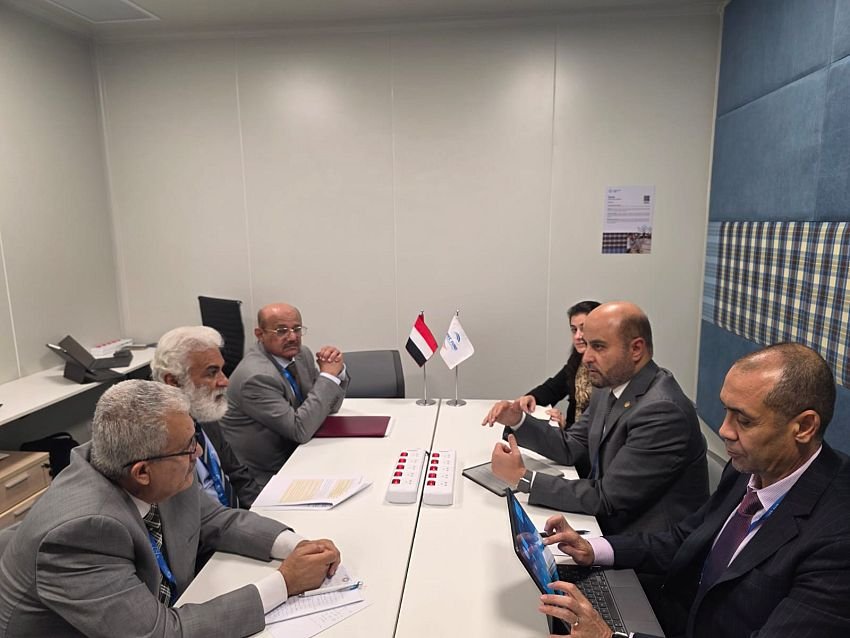
BANGKOK, Thailand — Yemen’s planning minister and central bank governor discussed rescheduling the country’s debt with the head of the OPEC Fund for International Development, the state news agency said.
Mohammed al-Faqmi and Ahmed Ghaleb al-Mabaqi met Abdulhamid al-Khalifa, who leads the fund, the agency, Saba, reported.
Al-Faqmi is minister of planning and international cooperation. He also serves as Yemen’s governor at the World Bank Group.
He was sworn in before the chairman of the Presidential Leadership Council on Aug. 29.
Al-Mabaqi has been governor of the Central Bank of Yemen since December 2021.
The account of the talks rests on Saba. No independent confirmation of what was said has been published.
The two sides examined options for rescheduling Yemen’s debt, the agency said.
Saba said the discussion took account of the circumstances the country is going through and its capacity to meet its commitments.
The talks also covered financing for the completion of the Hassan Dam in Abyan governorate.
Al-Faqmi and al-Mabaqi met separately with Abdulaziz al-Malla, an executive director at the World Bank, according to the agency.
That meeting looked at ways to speed up funding for priority projects, Saba said.
It also covered increased support for the humanitarian and economic effects of what the government describes as recent Houthi escalation.
The Houthi administration in Sanaa disputes government accounts of the fighting.
The meetings were held on the sidelines of the annual meetings of the International Monetary Fund and the World Bank Group.
Those meetings run in Bangkok from Oct. 12 to Oct. 18, according to the fund.
They bring together representatives of 191 member countries.
The fund and the bank hold the annual meetings outside Washington every third year, in a city of another member country.
Houthi forces took the port city of Mocha and Dhubab district on the Red Sea coast in early September, Al Jazeera reported.
Dhubab district lies at the Bab al-Mandab strait.
The Kahboub Mountains, which overlook roads running toward the strait, remain contested, according to The National.
Threats there could affect up to 15 per cent of global shipping, the newspaper reported.
Government forces, with Saudi backing, began a counteroffensive in early October and regained some ground, Al Jazeera reported.
The OPEC Fund for International Development is a development finance institution established by member countries of the Organization of the Petroleum Exporting Countries.
It lends to governments and to private borrowers in countries that are not members.
The World Bank’s executive directors represent member countries on its board and oversee its lending.
Yemen’s economy has contracted through a conflict that began in 2014, when Houthi forces took Sanaa.
Fighting between the group and the internationally recognised government resumed in September, according to reporting by The New Arab.
Houthi forces have taken the Red Sea coast and encircled Taiz since then, the outlet reported.
Al Jazeera reported that the group captured al-Turbah by Oct. 4, cutting the last main road between Taiz city and government-held areas.
The eastern crossing linking the city to Sanaa and to areas held by the group has also closed, according to the same report. That route had carried much of the city’s food.
It was reopened under an agreement reached in 2024.
The United Nations and other international organisations have withdrawn staff from the governorate because of security risks, The National reported.
About 2.8 million people live in government-held areas of Taiz governorate, according to the same report.
The United Nations has warned that wheat and flour in Taiz city could run out within three weeks, The National reported.
The World Food Programme said the situation there could become a humanitarian catastrophe if aid continued to be blocked.
The United Nations Office for the Coordination of Humanitarian Affairs said in its humanitarian needs and response plan for 2026 that more than 22 million people in Yemen need assistance.
It said 18.3 million were acutely food insecure.
More than 2.2 million children under five were acutely malnourished, including 516,157 severe cases, according to the plan.
Food prices in Taiz rose by more than 50 per cent after the escalation, according to Saeed Saif, a co-ordinator for Taiz and Yemen’s west coast at the United Nations Population Fund.
On the black market in the city, a 20-litre container of petrol rose from 30,000 Yemeni riyals to 90,000, Al Jazeera reported.
Around 200,000 people have been displaced recently by fighting on the coast and in rural Taiz, according to the same report.
About 800,000 residents of Taiz city were largely cut off, The National reported on Tuesday.
The plan recorded 5.2 million internally displaced people.
It sought $2.16 billion to reach 12 million of those in need.
Hassan Dam lies in Abyan, a governorate on Yemen’s southern coast east of Aden.
Saba did not say what figure was discussed for the dam, or over what period any rescheduling would run.
It did not report any commitment by the OPEC Fund or by the World Bank.
Houthi forces have also carried out attacks on Saudi Arabia, The New Arab reported.
They included a strike on Riyadh airport that killed 13 people and wounded hundreds, according to that account.
Neither institution had published an account of the meetings.
About the Author