Thousands rally in southern Yemen after exiled STC leader calls for mobilisation
 Yemen Herald News
ADEN, Yemen — Thousands rallied in cities across southern Yemen on Wednesday after the exiled leader of the Southern Transitional Council called for mobilisation against Houthi forces.
Crowds gathered in Aden, Mukalla, Seiyun and al-Ghaydah, The New Arab reported.
The news site Yemen Online reported that thousands also gathered in Shabwa governorate, in the country’s south-east.
It said participants came from several districts carrying flags and banners, citing local organisers. No other outlet has reported the Shabwa rally.
Aidarus al-Zubaidi made the call in a televised address on Tuesday, according to The New Arab.
It was his first address since he fled the country in January, the outlet reported.
He urged southern Yemenis to support the war effort of the internationally recognised government.
Al-Zubaidi stopped short of a specific call-up. He told southerners to prepare to meet the call to defend their homeland, according to the same report.
Saudi authorities say he fled to Abu Dhabi, where he is thought to have lived for about nine months.
The council he leads was dissolved inside Yemen in January, The New Arab reported.
Saudi Arabia launched a military intervention that month against the council and other militias backed by the United Arab Emirates, according to that account.
Saudi-backed groups then took control of the south.
The Yemeni government charged al-Zubaidi with treason, the outlet reported. He left the country afterwards.
The Emirati military has withdrawn from Yemen.
Al-Zubaidi has condemned Houthi attacks on Saudi Arabia, according to The New Arab.
He wants Riyadh to back the council’s push for independence in the south, the outlet reported.
The rallies fell on the anniversary of the revolution of Oct. 14, 1963, against British rule in the south.
Some demonstrators carried Emirati flags and portraits of the Emirati president, Sheikh Mohamed bin Zayed, according to The New Arab.
Yemen Online said speakers at the Shabwa gathering called for unity among southern communities.
It said they backed efforts to address political, economic and security problems in the region.
That account rests on the organisers of the event. Yemen Herald found no independent confirmation of it.
Fighting between Houthi forces and the government resumed in September, according to The New Arab.
The group has since taken the Red Sea coast and encircled Taiz, the outlet reported.
Houthi forces captured the port city of Mocha and Dhubab district in early September, Al Jazeera reported.
Dhubab district lies at the Bab al-Mandab strait.
They captured al-Turbah by Oct. 4, cutting the last main road between Taiz city and government-held areas, according to the same report.
Government forces, with Saudi backing, began a counteroffensive in early October and regained some ground, Al Jazeera reported.
About 800,000 residents of Taiz city were largely cut off, The National reported on Tuesday.
The United Nations has warned that wheat and flour there could run out within three weeks.
Food prices in the city rose by more than 50 per cent after the escalation, according to Saeed Saif, a co-ordinator for Taiz and Yemen’s west coast at the United Nations Population Fund.
On the black market there, a 20-litre container of petrol rose from 30,000 Yemeni riyals to 90,000, Al Jazeera reported.
About 2.8 million people live in government-held areas of Taiz governorate, according to the same report.
The eastern crossing linking the city to Sanaa and to areas held by the group has closed. That route had carried much of the city’s food.
It was reopened under an agreement reached in 2024.
The United Nations and other international organisations have withdrawn staff from the governorate because of security risks, The National reported.
Taiz was under a Houthi siege between 2015 and 2016. That closure was broken in 2016.
Nabil Jamil, director-general of the planning and development office in Taiz governorate, said the current closure was more comprehensive than the one imposed in 2015.
He said local authorities had written to the United Nations seeking help.
The World Food Programme said the situation could become a humanitarian catastrophe if aid continued to be blocked.
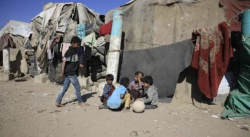
Around 200,000 people have been displaced recently by fighting on the coast and in rural Taiz, Al Jazeera reported.
Houthi forces have carried out attacks on Saudi Arabia during the same period, according to The New Arab.
They included a strike on Riyadh airport that killed 13 people and wounded hundreds, the outlet reported.
The Houthi administration in Sanaa disputes government accounts of the fighting.
The European Union called on the group this week to lift its siege of Taiz and allow food, water, medicine and fuel into the city.
The United Nations Office for the Coordination of Humanitarian Affairs said in its humanitarian needs and response plan for 2026 that more than 22 million people in Yemen need assistance.
It said 18.3 million were acutely food insecure.
The plan recorded 5.2 million internally displaced people and sought $2.16 billion to reach 12 million of those in need.
Shabwa governorate lies east of Aden and holds oil and gas facilities.
The Kahboub Mountains, which overlook roads running toward Bab al-Mandab, remain contested, according to The National.
Threats there could affect up to 15 per cent of global shipping, the newspaper reported.
About the Author