Taiz authorities call for investigation into shells suspected of carrying toxic substances
 Yemen Herald News
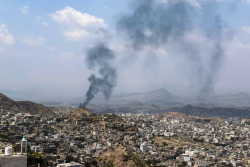
TAIZ, Yemen — Local authorities in Taiz called for a technical investigation into reports that Houthi forces fired shells suspected of carrying toxic substances.
The Taiz Governorate Media Office issued the appeal on Wednesday.
It said the authority had received consistent reports from several front lines that artillery shells and rockets contained prohibited gases or other toxic materials.
The office named al-Aqrud and Kahlan as the most recent locations. It said earlier incidents had been recorded elsewhere in the governorate.
Civilians and members of the Popular Resistance suffered severe breathing difficulties after the shelling, the office said. Some lost consciousness.
The nature of any substance remains unknown. No test results have been published.
The account rests on the media office’s statement and on reports carried by Arab News and Asharq Al-Awsat on Oct. 29. Neither the allegation nor the reported symptoms has been independently confirmed, and no laboratory finding has been made public.
The office asked government agencies to send specialists to the affected areas to inspect the sites and gather evidence.
It asked them to examine medical records and the testimony of witnesses, and to establish whether the symptoms were linked to anything released by the shells.
It asked the United Nations and other international organisations to support an independent investigation, and to help hold those responsible to account if the use of prohibited substances is confirmed.
Mostafa Noman, Yemen’s deputy foreign minister, said he would not rule out the use of chemical agents, according to Arab News.
He called for an independent international investigation team, and for an end to the siege of the city.
Moammar al-Eryani, the information minister, described the allegations as a dangerous development, the same report said.
He asked the United Nations and the Organisation for the Prohibition of Chemical Weapons to investigate.
Neither body has said it has opened an inquiry. The Houthis have not responded to the allegation.
Yemen ratified the Chemical Weapons Convention in October 2000, according to the OPCW. The convention bans the use of toxic chemicals as weapons and sets out how a member state may bring an allegation to the organisation.
Fighting around the city has continued.
Asharq Al-Awsat reported clashes on the al-Shaqab, al-Aqrud and Sameh fronts in eastern and southern Taiz, and on the al-Dhabab front, which takes in Jabal Han and the old airport.
Government forces repelled an attack on the villages of Kahlan and Hamma in al-Misrakh district, west of the city, the newspaper said. The Houthis have not commented on that account, and the claim could not be checked independently.
Health officials in Taiz said shelling struck an ambulance on Wednesday as it evacuated an injured civilian from the al-Awat area, west of al-Shaqab, in Sabr al-Mawadim district south of the city, according to the same report.
The vehicle was badly damaged and taken out of service, the officials said. Another ambulance was hit a week earlier.
The officials said Houthi forces had taken 15 ambulances from health offices and medical centres across several districts. The Houthis have not responded to that account either.
The fighting falls within Operation Dawn of Yemen, which Rashad al-Alimi, chairman of the Presidential Leadership Council, launched to recover territory held by the Houthis. The operation entered its 25th day on Thursday.
Amnesty International said on Oct. 22 that the Houthis must reopen roads in and around Taiz immediately.
Heba Morayef, the group’s regional director for the Middle East and North Africa, said thousands of civilians were at risk.
Amnesty also asked the Houthis to release everyone they are holding arbitrarily, including aid workers, and to let civilians leave the city freely and safely. It asked donors to fully fund Yemen’s humanitarian response plan.
Amnesty said the Houthis cut the main road between Taiz and Aden in October, and that other routes to nearby towns have been blocked at points since 2015. Civilians use mountain roads instead.
Citing the UN Human Rights Office, the group said 32 civilians were killed in Taiz governorate between Aug. 1 and Oct. 19, among them 14 children and nine women. It said 115 were injured, including 36 children and 34 women.
Amnesty said UN agencies had warned that medical facilities were low on fuel and oxygen, and that wheat and flour could run out within three weeks. It said food prices had risen about 50 percent and that cooking gas was largely unavailable.
The United Nations said last week that more than 800,000 people in Taiz had been cut off from food assistance after fighting closed major roads into the city.
The UN Office for the Coordination of Humanitarian Affairs said in its March humanitarian plan that more than 22 million people in Yemen need assistance. It put the number of people who are acutely food insecure at 18.3 million.
OCHA put the number of internally displaced people at 5.2 million. It recorded more than 2.2 million children under five as acutely malnourished, 516,157 of them severely.
The plan sought $2.16 billion to reach 12 million people.
The media office did not say how many people had reported symptoms, or when the earliest incident occurred.
About the Author