Yemen tells Moscow conference Iranian arms transfers strengthened Houthi forces
 Yemen Herald News
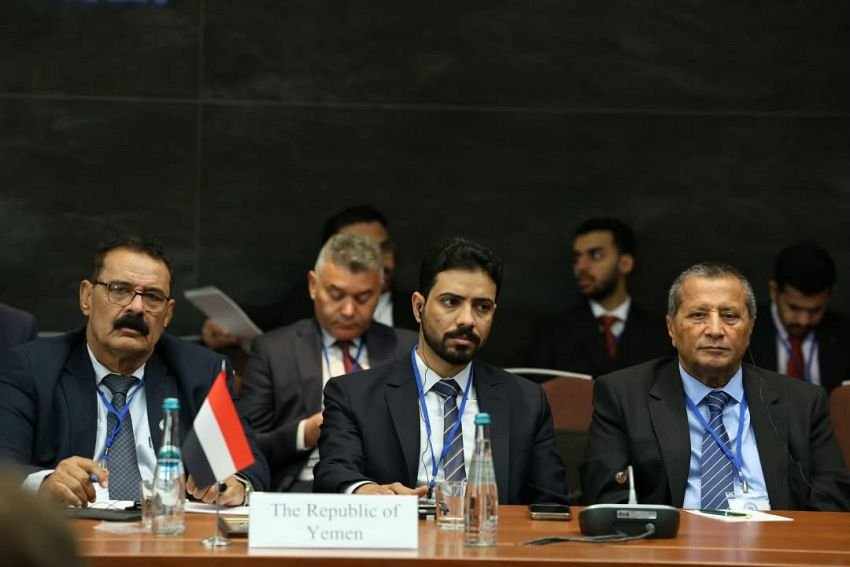
MOSCOW, Russia — Yemen told an international conference in Moscow that Iranian weapons and technology transfers had strengthened the Houthis and threatened Red Sea shipping, the state news agency Saba reported.
Major General Mohammed Musaed al-Amir delivered the address, Saba said in a report published on 2 October. He is undersecretary of Yemen’s Ministry of Interior for security and police affairs.
The ministry’s remarks were made at the Sixth International Conference on Countering the Spread of Extremist Ideas, according to the agency.
Al-Amir warned of the consequences of Iranian support for armed groups operating outside state institutions, Saba said.
The transfer of weapons and advanced technologies had strengthened the military capabilities of the Houthis, he said.
That posed a threat to regional security and to international maritime navigation, according to his remarks as reported.
Al-Amir described Yemen as an example of how extremism can move from ideas into armed projects supported by weapons, funding, modern technologies, recruitment networks and smuggling.
He said Iranian support had contributed to the Houthis’ development of drones and missiles.
The threats reached beyond Yemen to the Red Sea and the Bab al-Mandab Strait, and to global trade, he said.
Yemen called for stronger international cooperation to prevent transfers of advanced weapons and military technology to armed groups, Saba reported.
It also called for cutting their sources of funding, countering smuggling and terrorist financing, and addressing recruitment and radicalisation through digital platforms.
The Interior Ministry pressed for cooperation among security, financial and customs authorities, including information-sharing and joint work to protect borders, coastal areas, maritime routes and cyberspace.
Al-Amir said strengthening state institutions, upholding the rule of law and preventing the spread of weapons outside state control were needed to counter extremism and terrorism.
Those steps were needed to safeguard the security of Yemen, the Red Sea and international trade, he said.
The account of the address rests on Saba, the state news agency of the internationally recognised government. Yemen Herald found no independent confirmation of the speech, and Saba did not give the dates of the conference.
Iran denies supplying weapons to the Houthis. The Houthis say their missiles and drones are produced domestically.
Russia’s Interior Ministry has hosted an annual international conference in Moscow on the spread of extremist ideology, co-organised with the Collective Security Treaty Organisation. The 2023 edition was held on 26 and 27 September, according to listings published by the organisation and by Aseanapol.
Yemeni officials have made similar claims about Iran and the strait in recent weeks, to other audiences.
Major General Ibrahim Haidan, Yemen’s interior minister, told the newspaper Asharq Al-Awsat in remarks reported on 17 September that Iran’s Revolutionary Guard Corps was helping the Houthis build military infrastructure along Bab al-Mandab.
He said experts were helping the group strengthen its capabilities and build fortifications, operations rooms and facilities for missiles and other weapons systems.
Haidan said the Houthis could turn Bab al-Mandab into a militarised zone resembling Iran’s approach to the Strait of Hormuz.
He said Mayyun Island could take on a military role similar to that of Iran’s Larak Island, and raised the prospect of smuggling networks linking Yemen to al-Shabab in Somalia.
Those are the Yemeni government’s characterisations. Iran rejects them.
The Houthis took the Red Sea port of Mokha in the second week of September. International outlets reported the seizure as adding to the threat facing shipping in the approaches to Bab al-Mandab.
Fighting has since intensified further inland. The National reported on 2 October that the Houthis were pressing an offensive toward Taiz and that fighting had intensified around the city.
Hans Grundberg, the UN special envoy for Yemen, said on 1 October that Ansar Allah’s military operations in the Taiz area posed grave risks to the civilian population. Ansar Allah is the Houthis’ formal name.
He said he had received accounts of deaths, destroyed infrastructure and blocked roads restricting civilian movement, and repeated a call on Ansar Allah to halt its offensive.
The fighting has moved civilians in large numbers. The Executive Unit for the Management of Displaced Persons Camps, a Yemeni government body, said 146,943 people in 21,583 families were displaced between 1 and 18 September.
It put displacement in Taiz at 80,792 people across 15 districts and in Lahj at 38,304 across nine districts.
The International Organization for Migration gave a lower figure, saying on 17 September that 104,796 people in 17,461 households had been displaced. Its count reached close to 130,000 by 21 September.
The United Nations humanitarian plan for Yemen, issued in March, counts more than 22 million people in need of assistance and 18.3 million as acutely food insecure.
It records more than 2.2 million children under five as acutely malnourished, 516,157 of them severely, and seeks 2.16 billion dollars to reach 12 million people.
The Houthis hold Sanaa and much of northern Yemen. The internationally recognised government that al-Amir serves is based in Aden.
Saba is published by that government. A separate outlet using the same name operates from Sanaa under the Houthi authorities.
IOM said displacement was moving faster than humanitarian workers could track it, and recorded 2,776 people crossing from Yemen into Djibouti.
Saba did not say which other countries sent delegations to the Moscow conference.
About the Author