Yemen set to receive first French wheat cargo since 2022, shipping data show
 Yemen Herald News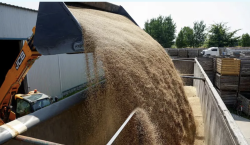
DUNKIRK, France — A bulk carrier is loading 60,000 tonnes of French wheat bound for Yemen, the first such cargo in four years, shipping data show.
The vessel is taking on 20,000 tonnes at Dunkirk after loading 40,000 tonnes at the northern French port of Rouen, according to maritime navigation data from the London Stock Exchange Group reported by Reuters on 25 September.
It would be the first French wheat delivered to Yemeni ports since September 2022, according to European Commission export records cited by Reuters.
Yemen Herald found no independent confirmation of the cargo beyond that report. Arabic-language outlets that carried the story attributed it to Reuters.
French wheat has been drawing buyers that normally source from the Black Sea.
Russia and Ukraine have intensified attacks on port infrastructure, grain terminals and vessels in the region since July, the Ecofin Agency reported on 7 September.
Restrictions on the Kerch Strait and the Don-Azov Canal disrupted a route carrying an estimated 28 percent of Russian wheat exports, it said.
The three grain terminals at the Russian port of Novorossiysk suspended operations in early August, according to the same report.
Attacks on Ukrainian port facilities cut that country’s grain export capacity by about a third, the agency said.
Combined Russian and Ukrainian wheat exports were projected to fall below 2.5 million tonnes in August 2026, against 6.3 million tonnes in August 2025.
Wheat on Euronext crossed 250 euros a tonne, its highest in two years, the agency said. Chicago futures climbed above $7.50 a bushel on 1 September, a three-and-a-half-year high.
Egypt is the most exposed importer, taking 8.8 million tonnes between July 2025 and January 2026, with Russia supplying 60 percent of that, according to Ecofin Agency. Libya, Algeria, Sudan and sub-Saharan African buyers are also affected.
Egypt and Sudan have both turned to French supply in recent weeks.
Two handysize vessels were expected at the French port of La Pallice to load about 60,000 tonnes of wheat for Egypt, the price reporting agency Fastmarkets said on 8 September. It attributed the sales to the trading houses Bunge and InVivo.
Sudan took its first French wheat in roughly 18 years over the same period, Fastmarkets said. Its previous French cargo loaded in August 2008.
That sale was executed by Invictus Trading and the DAL Group, according to the agency. Sudan imported about 2.7 million tonnes of wheat in the 2025-26 season.
Price movements have narrowed the gap that normally keeps Black Sea grain ahead on cost.
Russian wheat at 12.5 percent protein was quoted at $217 a tonne free on board on 26 August, against $280 a tonne for French wheat at 11 percent protein, Fastmarkets said.
French wheat sold to Egypt was priced at about $290 a tonne including cost, insurance and freight. Black Sea freight to Egypt stood at $60 a tonne on the same date, according to the agency.
Dry and hot weather in France this season improved grain quality, Reuters reported, making the crop more suitable for milling.
Wheat reaches Yemen through Hodeidah and Saleef on the Red Sea and through Aden and Mukalla in the south, according to the analysis group ACAPS.
The shipment is bound for a country where aid agencies report continued deterioration in the food supply.
More than 22 million people in Yemen need humanitarian assistance this year, including 10.95 million women and girls, according to the Humanitarian Needs and Response Plan published in March by the UN Office for the Coordination of Humanitarian Affairs.
The plan records 18.3 million people as acutely food insecure, and says its latest analysis showed conditions had deteriorated to emergency levels in some districts.
More than 2.2 million children under five are acutely malnourished, it says, including 516,157 cases of severe acute malnutrition.
The document counts 5.2 million internally displaced people.
Aid agencies sought $2.16 billion for the year to reach 12 million people, the plan says, with $1.6 billion of that designated for life-saving work.
It prioritises 9.4 million people for targeted assistance based on the severity of their needs.
The World Food Programme lists the same food insecurity and child malnutrition figures on its Yemen country page.
The rial traded at about 1,573 to the dollar in Aden during the second quarter, strengthening to about 1,562 in early June, according to the Sana’a Center for Strategic Studies.
Authorities in Aden raised the customs exchange rate for non-essential goods to 1,550 rials to the dollar from 750 in mid-May, the centre said.
In Sana’a, the old rial traded between 531 and 534 to the dollar over the same quarter.
The cost of the minimum food basket in government-held areas rose 3 percent between February and May, with vegetable oil up 7 percent, according to the centre.
Prices of key food items in Sana’a rose 13 percent in February.
Severe food deprivation affected 36 percent of households in May, up from 31 percent in April, the centre said. Inadequate food consumption stood at 62 percent nationwide.
The centre projected that 5.4 million people in government-held areas would face severe acute food insecurity by the end of 2026.
Reuters did not name the vessel or its operator.
It did not identify the Yemeni port of destination, and gave no expected delivery date.
About the Author