Yemeni ambassador asks Austria to widen humanitarian support for Taiz displaced
 Yemen Herald News
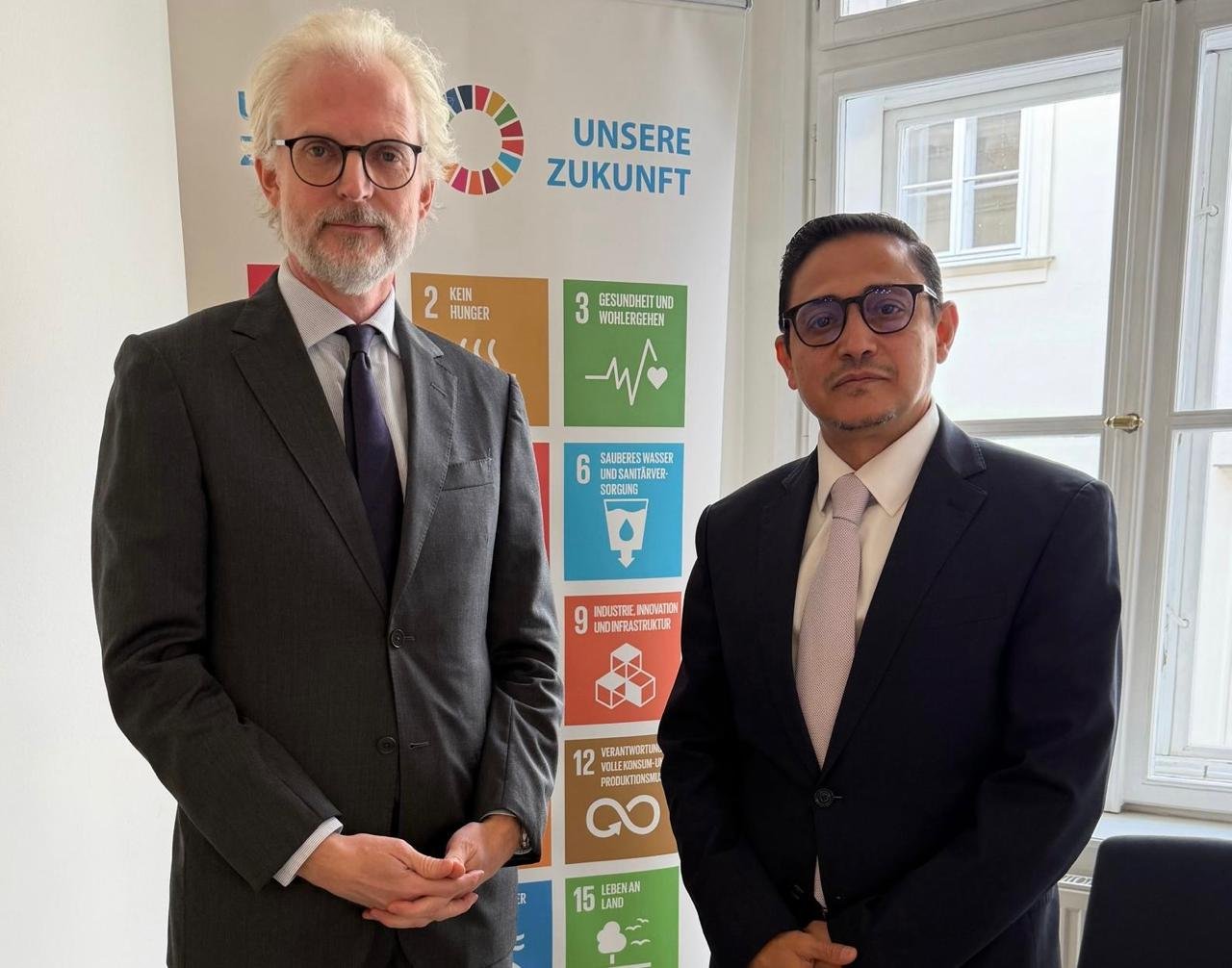
VIENNA, Austria — Yemen’s ambassador to Austria asked the Austrian foreign ministry on Wednesday to widen humanitarian support for people displaced by fighting in Taiz.
Ambassador Haytham Shoja’aadin met a director for international cooperation and humanitarian aid at Austria’s foreign ministry, the state news agency Saba reported. The meeting took place in Vienna.
Saba named the official as Nicholas Lauterotti. Yemen Herald could not confirm that spelling against Austrian government records.
The two discussed ways to strengthen cooperation between the two countries, the agency said.
Shoja’aadin briefed the Austrian official on military, security and humanitarian developments in Yemen, according to Saba.
He set out the government’s efforts to restore state institutions. He also described what he called the humanitarian consequences of the siege of Taiz governorate.
The ambassador said continued violations against civilians in Taiz amounted to a “humanitarian crime”, Saba reported. He attributed them to what he called the Houthi terrorist militia. The group rejects that characterisation.
He thanked Austria for its humanitarian assistance. He said Yemen hoped for a larger Austrian role in supporting people displaced by the escalation.
Saba reported no statement from the Austrian side. The account of the meeting rests on the Yemeni state news agency, and no independent confirmation of it has been published.
Austria gave 3 million euros to the International Committee of the Red Cross for its work in Yemen from the foreign ministry’s Foreign Disaster Fund in 2021. Chancellor Sebastian Kurz said at the time that Austria was fulfilling its humanitarian duty.
The request comes as UN agencies report worsening conditions in and around Taiz.
The UN Office for the Coordination of Humanitarian Affairs said in a report released on October 21 that almost 260,000 people had been displaced since August. About half of them took refuge in Taiz.
Humanitarian partners have reached more than 174,000 displaced people since August, the office said. It put that at nearly six in 10 displaced households.
The most pressing needs of newly displaced families are shelter, then food and cash, according to the report.
The UN human rights office has verified 251 civilian casualties in the fighting across the country, 57 of them deaths. Half of those killed were children.
Thirty-two civilians have been confirmed killed across Taiz governorate, among them 14 children and nine women.
Volker Turk, the UN High Commissioner for Human Rights, said on October 20 that the closure of the only supply route linking Taiz to Aden was placing civilians at grave risk. He attributed the closure to the Houthis.
Turk urged fighters who have encircled Taiz city to allow aid in immediately.
Akhil Iyer, the UNICEF representative in Yemen, called Taiz “the number one concern at the moment in an ocean of concerns”. He said newly arrived families “literally arrived with just the clothes on their backs”.
Iyer said pre-positioned therapeutic food could not reach health facilities because “all of the routes are closed”.
Water systems serving about 3 million people, among them at least 1.6 million children, are at risk, according to UNICEF. Trucked water costs about three times what it did before the latest escalation.
Diesel shortages threaten to bring water pumps to a halt, Iyer said.
UNICEF screened more than 168,000 children for malnutrition in Taiz this year. More than 52,000 were acutely malnourished, close to one in three of those screened.
Tarik Jasarevic, a spokesman for the World Health Organization, said 12 hospitals in Taiz had about four days of fuel left. He said 115 of 127 essential medicines had stock for about a week or less.
Those hospitals carry 1,110 dialysis patients, 192 intensive care patients and 154 newborns in incubators, Jasarevic said.
A 90-day emergency response for Taiz needs 31 million dollars, the WHO said. About 3.8 million has been secured, leaving a gap of 27.2 million dollars.
The World Food Programme said wheat flour stocks in affected parts of Taiz were nearly exhausted. Ten of the governorate’s 16 districts are classified at emergency levels of food insecurity.
Matthew Saltmarsh, a spokesman for the UN refugee agency, said access problems were keeping aid teams from the people in greatest need.
Yemen’s humanitarian response plan for 2026 seeks 2.16 billion dollars to reach 12 million people. It records more than 22 million people in need and 18.3 million who are acutely food insecure.
About 65,000 refugees and asylum seekers in Yemen, most of them from Somalia and Ethiopia, urgently need support, the UN said.
Vice-Chancellor Werner Kogler and Foreign Minister Alexander Schallenberg also requested that funding.
Yemen’s education ministry says more than 2.5 million children are out of school because of the conflict.
Weekly suspected cholera cases in Taiz rose from 221 to 683 between the 36th and 40th epidemiological weeks, according to the WHO.
Yemen is also carrying outbreaks of cholera and measles, with suspected diphtheria and dengue cases.
Iyer said hunger, unsafe water and disease were becoming “an increasingly dangerous combination” for children there.
The 2026 plan counts 5.2 million people displaced inside Yemen and more than 2.2 million children under five as acutely malnourished, 516,157 of them severely.
Fighting resumed last month, ending the calm that had followed the 2022 truce.
Clean water is almost unavailable for new arrivals in Taiz. Garbage is piling up in the city as sanitation services stop.
About the Author