Saudi aviation authority says two died in Dammam airport attack as Houthis claim four strikes
 Yemen Herald News
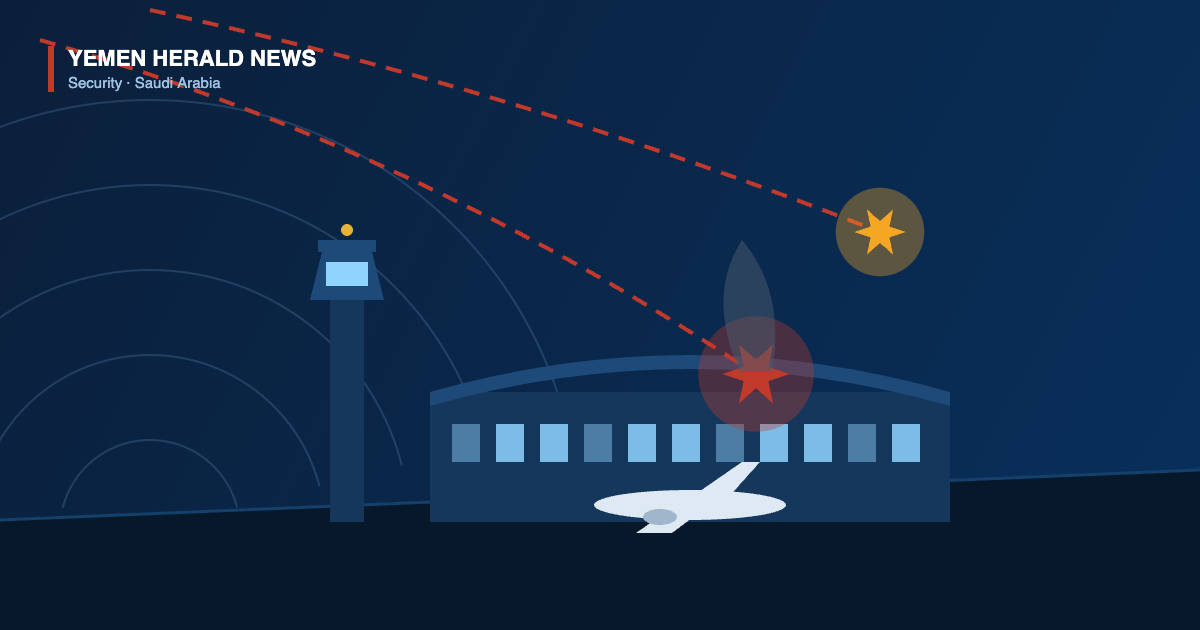
DAMMAM, Saudi Arabia — Saudi Arabia’s civil aviation authority said two people were killed and eight wounded in an attack on King Fahd International Airport on Wednesday evening.
The General Authority of Civil Aviation identified the dead as a Saudi citizen and an Indian national.
It said the eight wounded included a Saudi citizen and seven foreign nationals from India, Yemen, Bangladesh and Nepal. Their injuries ranged from minor to serious.
The authority said the airport sustained material damage. It said operations had resumed and air traffic had returned to normal.
Officials were still assessing the damage and coordinating security measures, the authority said.
Yemen’s Houthi movement claimed the attack the following day.
Yahya Saree, the group’s military spokesman, said on Thursday that Houthi forces had carried out four operations in Saudi Arabia over the previous 48 hours, using ballistic missiles and drones.
Saree named the Ministry of Defence headquarters in Riyadh, King Fahd International Airport in Dammam, Saudi Aramco facilities in the Red Sea port of Yanbu, and Abha International Airport in the southwest of the kingdom.
He claimed direct hits on the defence ministry building, the Yanbu facilities and Abha airport, and said the Yanbu strike started a fire. He said the Dammam attack disrupted air traffic.
Saudi authorities have confirmed only the Dammam attack.
They had not confirmed the claims on Riyadh, Yanbu or Abha, and no independent verification that those three sites were struck has been published. Yemen Herald found no Saudi denial of them either.
Saree said Houthi forces would continue attacks deep inside Saudi territory until military operations against Yemen stop and the blockade on the country is lifted.
He warned Saudi Arabia against targeting Yemeni tribes, saying such operations would bring severe consequences and further escalation.
Saree also said more than 2,900 Saudi air strikes and missile attacks on Yemen over the past 100 days had killed or wounded more than 562 people, most of them women and children. That figure rests on the Houthi military spokesman alone and has not been independently verified.
A separate incident was reported in Saudi Arabia’s Eastern Province on Wednesday.
Saudi air defences intercepted a drone aimed at a processing facility at Saudi Aramco’s Shaybah oil field, according to the Saudi energy ministry.
Two foreign workers, a Filipino and a Nepali, were killed in that incident. A Pakistani and an Indian national were wounded.
The ministry said debris caused a fire in a contractor’s vehicle outside the facility perimeter. It said oil field operations were unaffected.
The attacks form part of a campaign against Saudi airports that began earlier this month.
A combined missile and drone attack on King Khalid International Airport in Riyadh on October 6 and 7 killed one Sudanese national and wounded eight civilians. Abha International Airport was struck in the same period, killing two women, from Algeria and Morocco, and wounding 28 people.
Two further attacks hit the Riyadh airport on October 8. The civil aviation authority said three Saudi citizens were killed, among them the pilot of a Saudia aircraft destroyed on the ground.
Hundreds of flights were cancelled after that attack. Air India, Lufthansa and Pakistan International Airlines were among the carriers that suspended Riyadh services, and operations returned to normal the following day.
A ballistic missile struck a complex housing Terminals 3 and 4 at King Khalid International Airport on October 10. Authorities said 12 people were killed and more than 300 wounded. An Indian man died of his injuries the next day.
Bangladesh’s foreign ministry said a mufti was among those killed in that attack and that 24 of the wounded were Bangladeshi.
Terminal 4 was struck again on October 11, killing one Pakistani resident and wounding 11 people. King Fahd International Airport was attacked the same day, with no casualties reported.
Energy Minister Prince Abdulaziz bin Salman warned of a serious response at an energy conference in Riyadh on October 11.
The Houthis fired three ballistic missiles on October 12, one of them toward King Khalid International Airport. Saudi Arabia said it intercepted all three. The Saudi-led coalition said on October 14 that it had intercepted another missile launched toward Riyadh.
The civil aviation authority kept the Riyadh airport closed until October 17.
Saree warned airlines on October 12 against using Saudi airports other than those serving Makkah and Madinah.
Turki al-Maliki, spokesman for the Saudi-led coalition, described the October 10 attack as a full-fledged war crime.
UN Secretary-General Antonio Guterres condemned the attacks. Hans Grundberg, the UN special envoy for Yemen, called them a grave escalation.
US Secretary of State Marco Rubio condemned the attacks and said a US citizen was among those killed in the Riyadh airport strikes.
The United States ordered some government personnel out of the kingdom this week. Britain announced additional military assistance.
Mohammed al-Bukhaiti, a member of the Houthi political bureau, said earlier this month that the campaign was a response to Saudi strikes on civilian infrastructure in Yemen.
Iranian Foreign Minister Abbas Araghchi offered to mediate. Foreign ministry spokesman Esmail Baghaei said continued escalation would benefit only Israel.
Canada, Japan, Poland, South Korea, New Zealand, the United Kingdom and the United States have advised their citizens to exercise caution over travel to Saudi Arabia.
About the Author