Yemeni Army Repels Houthi Infiltration Attempt South-East of Taiz
 Yemen Herald News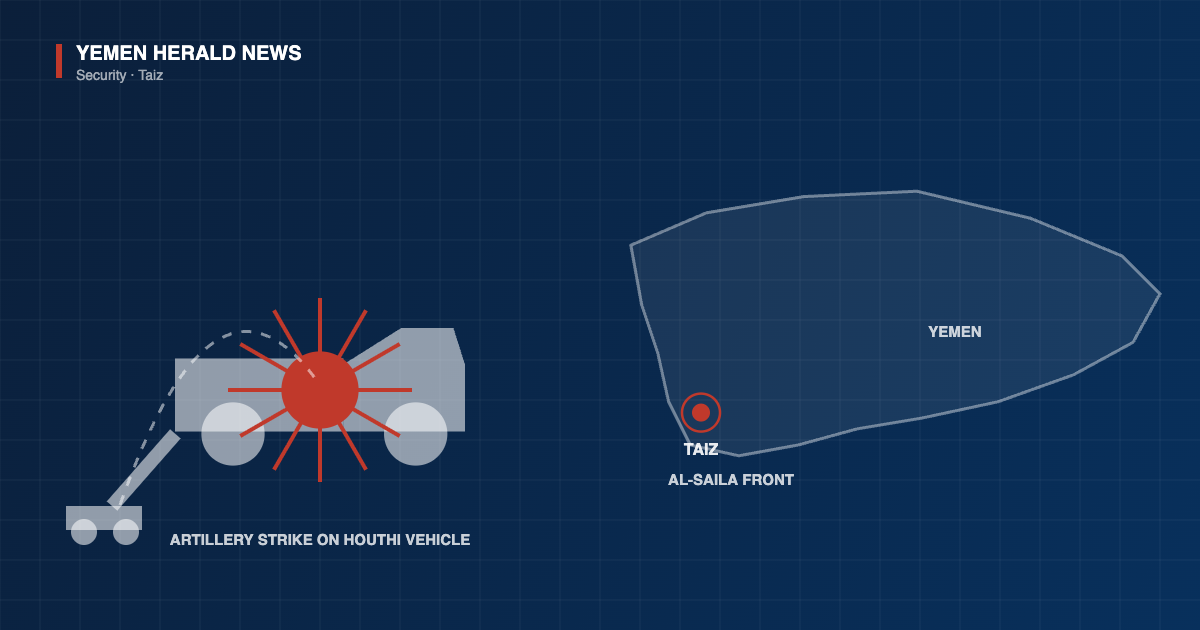
Yemeni government forces repelled an attempted Houthi infiltration in south-eastern Taiz on Sunday, destroying a vehicle carrying fighters with artillery fire before it reached forward army positions, according to statements issued by the military units involved. The engagement was one of several reported across the Taiz fronts over the same period, and it followed a familiar pattern in a province where the lines have barely moved in years but where probing attacks and artillery exchanges remain a near-daily occurrence.
The 35th Armoured Brigade said its units detected the vehicle as it approached army positions near the Al-Furqan School in the Al-Saila area, south-east of Taiz city, and engaged it with what the brigade described as precision artillery fire. The brigade said the strike destroyed the vehicle and inflicted casualties among the fighters on board. It did not give a figure, and the account has not been independently confirmed by other parties. The Houthi authorities, who rarely acknowledge losses in specific engagements, did not issue a public statement on the incident.
Military spokesmen said the vehicle never reached its intended objective, which they presented as evidence that forward observation and artillery coordination along that stretch of the line are working as intended. Units in the sector were placed on heightened alert afterwards in anticipation of further attempts, a routine precaution after any contact on the Taiz axis.
The same brigade reported a second action on the Al-Salw front, also in the south-east of the province, where its artillery targeted Houthi positions at the Ali Nasser camp and Sirih Hill in the Dimnat Khadir area. Separately, the Taiz Military Axis said government troops thwarted an infiltration attempt on the Jabal Han front west of Taiz city, in which it said five Houthi fighters were killed. In the Al-Barah sector, units of the 43rd Brigade were reported to have fought a roughly two-hour engagement involving heavy weapons and artillery before suppressing Houthi firing positions. As with the Al-Saila strike, these accounts come from the government side and have not been verified independently.
Taiz has been among the most consistently contested governorates of the war. The city sits in Yemen’s densely populated southern highlands, astride the road links that connect the interior to the Red Sea coast and to the southern port of Aden, and it has been partially encircled by Houthi forces since 2015. Supply routes into the city have been repeatedly cut, reopened and cut again, and the resulting detours have added hours to journeys that once took minutes and have pushed up the cost of food, fuel and medicine for residents.
The tactical picture in the province has been broadly static for several years. Neither side has been able to mount a sustained offensive capable of shifting the line, and the fighting has settled into localised infiltration attempts, sniper activity, mortar and artillery duels, and the laying of mines along approach routes. That pattern produces few territorial changes but a steady accumulation of casualties, including among civilians living close to the contact lines in the eastern and western outskirts of the city.
Landmines and unexploded ordnance remain one of the most persistent hazards in the governorate. Demining teams working under the government’s national programme have cleared large numbers of devices from farmland, roads and residential districts around Taiz, but clearance is slow, dangerous and chronically underfunded, and casualties among farmers, shepherds and children continue to be reported long after the fighting in a given area has stopped.
The military exchanges take place against a humanitarian backdrop that United Nations agencies describe as one of the most severe in the world. UN estimates put the number of Yemenis requiring some form of humanitarian assistance at more than 18 million, with several million displaced from their homes by the conflict. Aid agencies have repeatedly warned that funding shortfalls are forcing them to cut food rations and scale back health programmes, and that access constraints imposed by the parties to the conflict complicate delivery in contested governorates such as Taiz.
Public sentiment in the city has hardened in recent weeks. Local reports described a mass armed gathering in Taiz organised in support of the army and in response to what participants characterised as renewed Houthi escalation, an expression of the tribal and popular mobilisation that has periodically supplemented regular forces on this front. Government commanders have used such gatherings to argue for more resources for the Taiz axis, which they say has been under-supplied relative to other fronts.
Diplomatically, there has been no comprehensive ceasefire since the UN-brokered truce of 2022 lapsed, and successive rounds of talks have not produced a durable framework. Mediators have continued to press for a roadmap covering salaries, the reopening of roads and airports, and a political process, but the parties remain far apart on sequencing and on the fate of state revenues. In the absence of an agreement, commanders on both sides describe their posture as defensive while continuing to probe.
For residents of the districts around Al-Saila and Al-Salw, the immediate consequence of Sunday’s exchange is another day in which farmland close to the line is unsafe to work and roads are unsafe to travel. Whether the engagement marks the beginning of a wider escalation or simply another entry in a long ledger of contacts along a frozen front will only become clear over the coming weeks.
About the Author