
Yemen’s al-Alimi Thanks Departing South Korean Ambassador and Urges Tougher Houthi Sanctions
 Yemen Herald News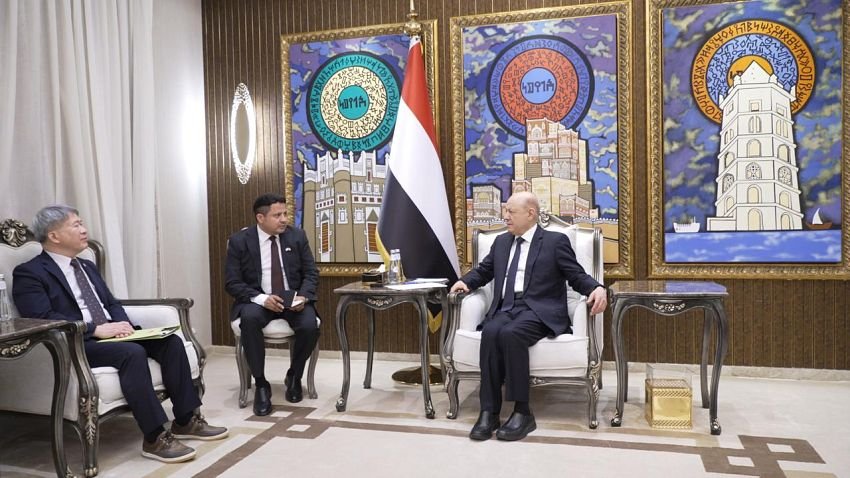
Yemen’s Presidential Leadership Council chairman, Rashad al-Alimi, held a farewell meeting in early July 2026 with the outgoing ambassador of the Republic of Korea to Yemen, Do Bong-ki, whose diplomatic posting has come to an end. Al-Alimi used the occasion to thank the departing envoy for his efforts to deepen relations between the internationally recognised government and Seoul, and to wish him success in his next assignment. The meeting was one of several farewell calls the council chairman has hosted as foreign missions rotate senior staff, and it offered a moment to take stock of a partnership both governments describe as steady despite Yemen’s turmoil.
During the talks, al-Alimi praised South Korea as a reliable partner in Yemen’s development, singling out cooperation in the energy and oil sector as an area of particular value. He also acknowledged Seoul’s humanitarian and developmental assistance, which the Yemeni government credits with helping to sustain basic services and support efforts to rebuild state institutions. According to the president’s office, the chairman highlighted what he called the mutual trust and respect underpinning the relationship, and expressed hope that Korean engagement would continue under the ambassador’s successor.
The bilateral discussion unfolded against the backdrop of one of the world’s most severe humanitarian emergencies. United Nations agencies estimate that more than 18 million Yemenis require some form of assistance, and that over four million people remain internally displaced after years of war. For a government that controls only part of the country and operates largely from the southern port city of Aden, foreign support of the kind provided by South Korea has become an important lifeline. Al-Alimi framed continued international attention as essential to preventing further deterioration.
Al-Alimi devoted part of the meeting to South Korea’s work at the United Nations Security Council, where Seoul recently served as an elected member. He commended Korea’s role on the council body that deals with Yemen sanctions, which is tasked with monitoring the arms embargo and other measures aimed at armed groups. The chairman expressed hope that Seoul would keep pressing for full implementation of Security Council resolutions on Yemen even after leaving the council, arguing that consistent international enforcement is needed to curb the flow of weapons to fighters on the ground.
The council chairman also renewed his government’s long-standing appeal for tougher measures against the Houthi movement, which controls the capital, Sanaa, and much of the north. Yemeni officials say the group has repeatedly breached UN resolutions and international sanctions, and al-Alimi described such conduct as a challenge to the authority of the Security Council. These are the government’s characterisations: the Houthis reject the legitimacy of the internationally recognised administration and describe their own campaign as resistance to foreign intervention, so the competing claims remain contested.
Yemen’s conflict escalated into full-scale war in 2015, when the Houthis seized Sanaa and a Saudi-led coalition intervened on behalf of the government. The fighting has since settled into an uneasy stalemate punctuated by periods of relative calm, UN-brokered truces and renewed escalation. The government accuses Iran of arming and financing the Houthis, a charge Tehran denies while acknowledging political sympathy for the movement. The result has been a fractured state in which competing authorities, a battered economy and collapsing public services shape daily life for millions of ordinary Yemenis.
South Korea has maintained relations with Yemen for decades and has contributed to humanitarian appeals and development programmes even as security conditions forced many embassies to operate from outside the country or on a reduced footing. Seoul’s interest in Gulf energy supplies and the safety of shipping lanes near Yemen’s coast gives it a practical stake in the country’s stability. Yemeni officials have repeatedly thanked Korea for aligning with international positions on the conflict and for supporting efforts to restore functioning institutions across the areas the government controls.
With the ambassador’s tenure ending, attention now turns to the continuity of that engagement under his successor. Al-Alimi’s remarks suggested the government hopes to preserve the momentum of recent years, particularly on development cooperation and on diplomatic backing at the United Nations. For the internationally recognised leadership, sustaining relationships with partners such as South Korea is part of a broader strategy of courting international support while it contends with military pressure, economic strain and the day-to-day challenge of governing amid an unresolved conflict.
The farewell meeting, though largely ceremonial, underscored how heavily Yemen’s leadership leans on foreign partnerships at a moment of acute vulnerability. As the country navigates a fragile balance between conflict and the search for a political settlement, its officials continue to frame ties with countries like South Korea as central to both immediate humanitarian relief and the longer task of rebuilding. Whether that cooperation deepens will depend in part on the priorities of the incoming ambassador and on the trajectory of a war that has defied repeated attempts at resolution.
The government’s push for stricter enforcement is closely tied to maritime security. Yemen sits alongside the Red Sea and the strategic Bab al-Mandab strait, a corridor for a large share of global trade, and Houthi attacks on commercial shipping in the area have drawn international naval responses. Yemeni officials argue that curbing weapons transfers is essential not only to the war on land but also to protecting these waterways, and they have urged council members such as South Korea, a major trading and shipping nation, to keep the issue high on the international agenda.
About the Author




