Yemen’s Ambassador to Germany Briefs Konrad Adenauer Foundation on Houthi Threat to Red Sea Shipping
 Yemen Herald News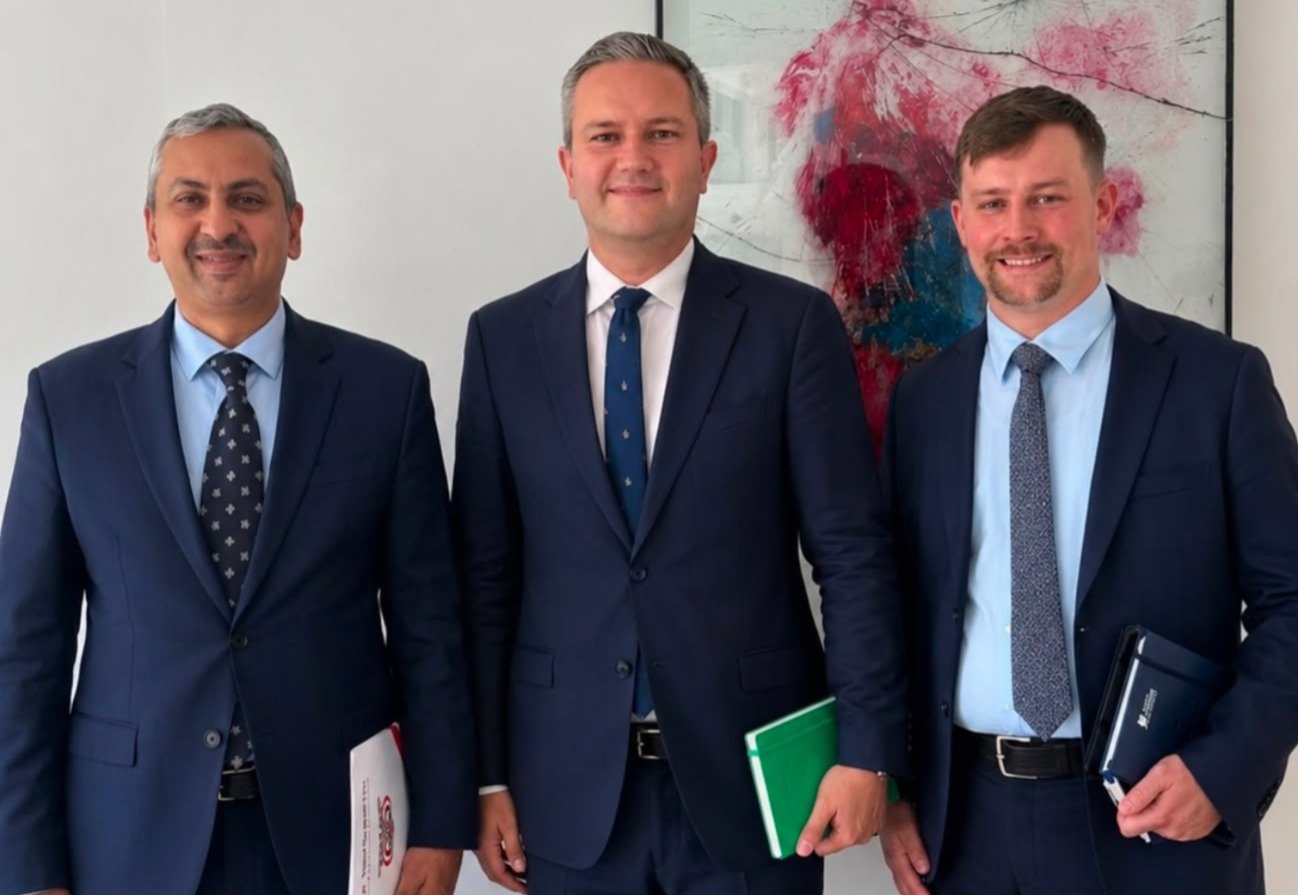
Yemen’s ambassador to Germany has used a meeting in Berlin with one of the country’s most influential political foundations to argue that the Houthi movement poses a long-term structural threat to regional and maritime security rather than a passing crisis. Ambassador Louay al-Eryani met Dr Thomas Volk, who heads the Middle East and North Africa department at the Konrad Adenauer Foundation, for talks centred on the group’s impact on stability inside Yemen and on shipping through the Red Sea and the Bab al-Mandab strait.
The Konrad Adenauer Foundation is one of Germany’s largest political foundations, affiliated with the Christian Democratic Union, and runs research programmes and policy dialogues across the Middle East and North Africa from its Berlin headquarters and a network of regional offices. Volk, who holds a doctorate in Near and Middle Eastern studies and previously ran the foundation’s office covering Senegal and the Gambia between 2016 and 2020, took charge of its regional department in 2024. Briefings of this kind are a routine but consequential part of how governments try to shape the way their conflicts are understood in Berlin, where foundation-run events frequently draw parliamentarians, ministry officials and journalists.
According to the ambassador, the threat from the Iran-backed militia is sustained rather than episodic, and its consequences reach well beyond Yemen’s borders. He told the foundation that treating each attack or escalation as an isolated incident has left the international response persistently one step behind, and that policymakers in Europe should view the group’s maritime capability as a durable feature of the security landscape rather than a temporary disruption tied to any single regional conflict.
Al-Eryani also pressed the case for strengthening the internationally recognised government’s authority as the most practical route to reducing the threat. Sustained international backing, he said, is what would allow the government to restore functioning administration across the territory it controls, meet its obligations to citizens and act as a reliable partner abroad. That argument reflects a long-standing position of the government, which has struggled with fragmented control, a weakened currency and an acute fiscal shortfall since the loss of oil export revenue.
The ambassador further argued that the Houthis have answered peace proposals and de-escalation efforts with military escalation, and that the group is using the conflict to serve agendas set outside Yemen. Those are the government’s characterisations; the Houthis reject them, presenting their operations as a response to external aggression and to the war in Gaza. What is not in dispute is that repeated rounds of United Nations-mediated diplomacy, including the roadmap negotiated with Saudi mediation, have yet to produce a signed nationwide settlement.
Volk, for his part, said the foundation intends to keep following developments in Yemen closely and to convene discussions in Germany that draw attention to the regional security dimensions of the conflict, alongside its humanitarian consequences. That reflects the foundation’s broader model of using seminars, published analysis and closed-door briefings to feed regional expertise into German and European policy debate.
The maritime dimension has grown sharper through 2026. The Houthis suspended attacks on shipping linked to Israel after the October 2025 Gaza ceasefire, then resumed operations during this year’s confrontation involving the United States, Israel and Iran. In late July the group announced restrictions on Saudi-linked maritime traffic near Bab al-Mandab, warning international shipping companies that vessels loading or discharging cargo at Saudi ports could be targeted even if they were not Saudi-owned. The announcement followed strikes on airports inside Yemen and Saudi Arabia that each side has blamed on the other.
The commercial effect was immediate. Traffic through Bab al-Mandab fell to its lowest level in months, with only a handful of cargo vessels transiting the strait on some days, and insurers again repriced the corridor. Reports in late July also described a Houthi proposal to levy transit fees on shipping, a model echoing Iran’s approach to the Strait of Hormuz, which would convert a security threat into a revenue stream. Saudi Arabia has responded by seeking to assemble an international coalition to secure the Red Sea route, an effort that would deepen outside military involvement in the conflict.
The humanitarian picture underlying all of this remains severe, and the figures cited in Berlin have moved sharply in recent years. The United Nations estimates that 22.3 million people in Yemen need humanitarian assistance and protection in 2026, including 5.2 million internally displaced people. Some 18.3 million face acute food insecurity, and more than 2.2 million children under five are acutely malnourished. Aid agencies have appealed for 2.16 billion dollars to reach 12 million people this year, prioritising 9.4 million in the areas of greatest severity, and that appeal remains substantially underfunded.
For Germany, the meeting sits within a wider pattern of cautious engagement. Berlin has supported United Nations mediation, contributed to humanitarian funding and taken part in European maritime security discussions, while stopping short of the direct military posture adopted by some allies. Whether briefings like this one shift that calculation is uncertain. What the exchange illustrates is the effort by Yemen’s diplomatic missions to keep a conflict that competes for attention with several others on the European agenda, and to frame it as a question of shipping lanes and regional order as much as one of aid.
About the Author