Yemen’s Ambassador to Washington Discusses Cooperation with Arab Gulf States Institute
 Yemen Herald News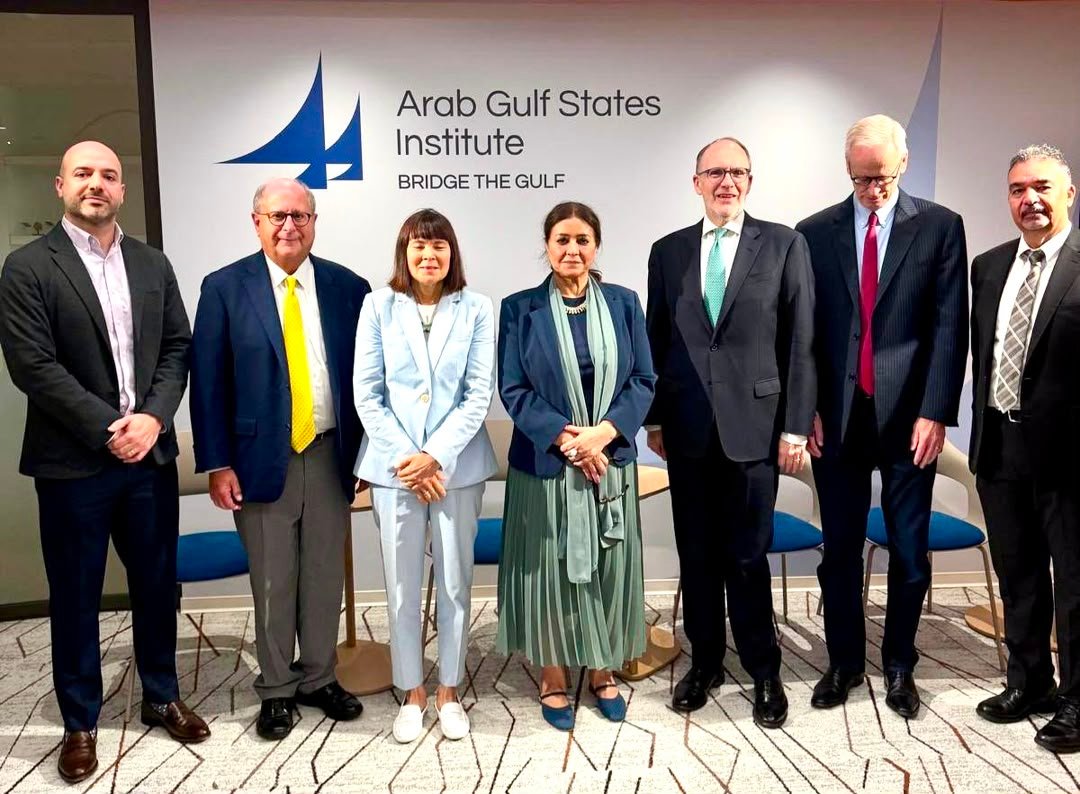
Yemen’s ambassador to the United States, Jamila Ali Raja, has held talks with officials at the Arab Gulf States Institute in Washington, discussing how the embassy and the research body might work together more closely and reviewing the political, security and humanitarian developments shaping Yemen and the wider region. The state news agency Saba reported the meeting, which brought the ambassador together with the institute’s leadership and resident scholars at its offices in the American capital.
The Arab Gulf States Institute in Washington, widely known by its initials AGSIW, is an independent non-profit research centre launched in 2015. It produces analysis on the economic, security, social, cultural and political dynamics of the Gulf Arab states, and hosts public and private policy discussions in the American capital. Its output is followed closely by congressional staff, administration officials and the diplomatic community, which makes it one of the venues where Yemen’s case is argued in front of an American policy audience.
Raja is the first Yemeni woman to serve as her country’s ambassador to the United States. She took the oath of office before Rashad al-Alimi, chairman of the Presidential Leadership Council, at Yemen’s embassy in Riyadh, and presented her credentials to President Donald Trump at a White House ceremony on 23 May 2026. At that ceremony she said the Yemeni government was committed to strengthening its strategic partnership with Washington and to widening cooperation across political, economic, security and development files.
She came to the post from a career that mixes journalism, civil society and track-two diplomacy rather than the conventional foreign ministry route. Born in Taiz, she holds a master’s degree in journalism from the American University in Cairo and a bachelor’s degree in English literature from Cairo University. She previously served as deputy head of Yemen’s Consultation and Reconciliation Commission, advised the German and British governments and the United Nations on Yemen peace efforts, and is a founding member of the Yemeni Women’s Pact for Peace and Security.
Much of the discussion concerned practical cooperation. The two sides examined ways to bring Yemeni officials into the institute’s programming, so that ministers, diplomats and technical specialists can put the government’s case directly to researchers and policy practitioners. They also discussed convening dedicated sessions on Yemen’s political transition, its economy and its security situation, rather than leaving the country as a footnote to broader Gulf and Red Sea discussions.
A second strand of the conversation dealt with the research pipeline. Both sides raised the need to support younger scholars working on Yemen, a field that remains small relative to the scale of the country’s crisis. The reasoning is that durable policy attention depends on a supply of analysts able to read Yemen’s politics, economy and society with precision, and that thin expertise leaves decision-makers reliant on a narrow set of interpretations.
The ambassador also restated the government’s position on the Houthi movement, which Yemeni authorities and Washington describe as aligned with Iran. She condemned the group’s operations and argued that they threaten regional stability and freedom of navigation. The government says Houthi forces have struck commercial shipping in the Red Sea and the Bab al-Mandab strait and have targeted infrastructure beyond Yemen’s borders, while the group has generally framed such operations in political terms. Those accounts are contested, but the strategic stakes of the corridor are not. The waterway is one of the busiest trade routes in the world, and sustained disruption there pushes shipping around the Cape of Good Hope, lengthening voyages and raising costs.
The humanitarian picture gives that argument its urgency. According to the United Nations Office for the Coordination of Humanitarian Affairs, more than 22 million people in Yemen will need humanitarian assistance and protection during 2026, among them 5.2 million internally displaced people. Some 18.3 million people are acutely food insecure, and more than 2.2 million children under five are acutely malnourished. Aid agencies have appealed for 2.16 billion dollars to reach 12 million people this year, but the plan has been funded at roughly 13 percent of its requirements, forcing agencies to ration what they deliver.
Against that backdrop the government has presented its economic and administrative reform programme as a precondition for recovery, and officials have used engagements in Washington to argue that the institutions under its control can absorb and account for external support. Whether those reforms deliver measurable improvement remains an open question, and one that independent research bodies such as the institute are well placed to test.
The meeting forms part of a broader pattern of engagement by the embassy since Raja took up the post. She has also met Representative Joe Wilson, chairman of the Yemen Caucus in the United States Congress, to discuss strengthening Yemeni-American relations and to review recent political and security developments in Yemen and the region. Taken together, the meetings suggest an approach that treats Washington’s research institutions and legislative offices as parallel channels alongside formal contacts with the administration.
No formal agreement was announced at the conclusion of the talks, and the reported outcome was an understanding to continue working together on events, dialogue and research. For a mission operating with limited resources and competing for attention in a crowded policy environment, that kind of incremental access is itself a measure of progress, and it sets a baseline against which the embassy’s next year in Washington can be judged.
About the Author