Yemen’s civil service minister and UN envoy’s economic adviser discuss public pay and pension reform in Aden
 Yemen Herald News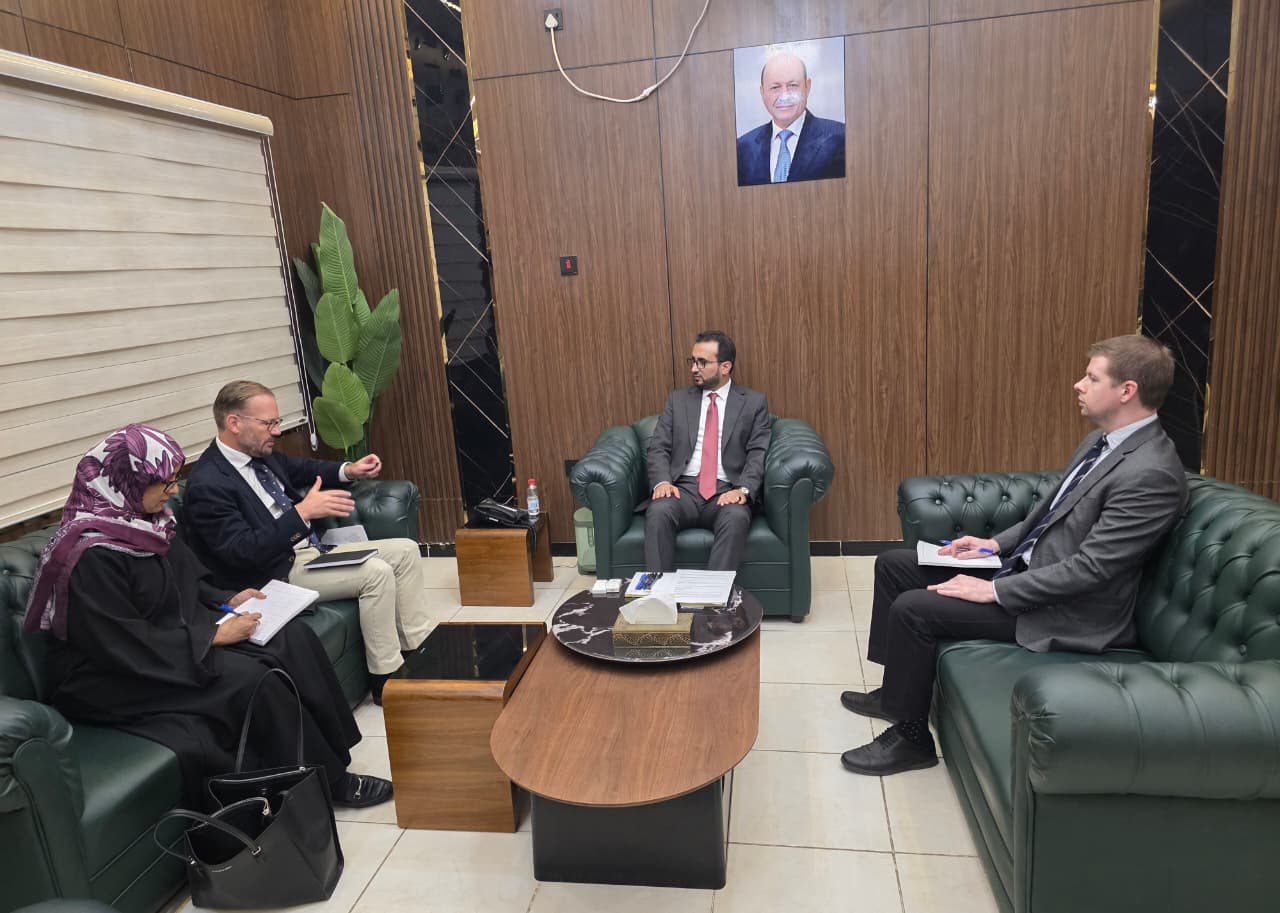
Yemen’s Minister of Civil Service and Insurance, Salem al-Awlaqi, met in Aden on Tuesday with an economic adviser attached to the Office of the UN Special Envoy for Yemen, in talks the ministry said were devoted to the condition of the public administration and the government’s economic reform agenda. According to the ministry’s readout of the meeting, the two sides reviewed the management of government human resources, the structure of public sector pay, the state of the pension and social insurance systems, and the administrative reforms the cabinet has approved.
The civil service file sits close to the centre of Yemen’s fiscal problem. Public sector salaries are the largest recurring claim on the state budget, and the Ministry of Civil Service and Insurance is responsible for the employee registry that determines who sits on that payroll and at what grade. Successive governments and international lenders have argued that no durable stabilisation of public finances is possible until that registry is accurate and the pension funds are sustainable.
Al-Awlaqi said the ministry’s work had been complicated by the way public employment is handled in areas outside government control, telling the meeting that pension contributions and payroll processes had been disrupted. Those are the government’s characterisations. The Houthi authorities in Sanaa dispute that account and blame the salary crisis on the relocation of the central bank and on restrictions they say Aden imposes.
Yemen’s public administration has been split since the Houthis took Sanaa in late 2014 and the internationally recognised government relocated to Aden, which now functions as the temporary capital. The central bank divided into two competing institutions, the currency in circulation in the two zones diverged sharply in value, and salary payments to large parts of the civil service became irregular or stopped altogether. Teachers, health workers and pensioners have been among the groups most exposed, and salary protests have recurred in both zones.
The government has taken a series of steps on public pay over the past year. Al-Awlaqi and Finance Minister Marwan bin Ghanem issued joint ministerial circulars instructing state institutions to pay the annual salary increments owed to government employees for the years 2021 through 2025 under the civil service regulations, alongside measures covering outstanding job settlements. The cabinet has also approved a cost-of-living allowance for public employees. Delivery of those decisions depends on revenue the treasury does not reliably control.
Approval of a state budget for 2026, described by officials as the first in roughly seven years, was presented by the government as a step towards restoring ordinary budgetary discipline. Whether it changes conditions for civil servants depends on whether the projected revenues materialise. Yemen’s crude oil exports, once the government’s principal source of hard currency, have been suspended since late 2022 following attacks on the southern export terminals.
The Office of the UN Special Envoy, headed since August 2021 by the Swedish diplomat Hans Grundberg, has increasingly treated economic questions as part of its mandate rather than as a technical afterthought. Salary payments, the currency split, and the reopening of roads and ports have all featured in the envoy’s engagement with the parties, on the argument that economic de-escalation is a realistic precondition for wider political progress.
Grundberg’s office has held a series of meetings with the economic ministries in Aden this year, including discussions with the finance and oil ministries on the 2026 budget and the government’s strategic plan. The envoy has consistently framed the economy as the area in which measurable improvements to ordinary life are most achievable in the absence of a comprehensive agreement, though no negotiated economic package between the parties has been announced.
The backdrop remains difficult. Briefing the Security Council in August, the United Nations humanitarian chief, Tom Fletcher, set out the scale of need across the country, where a large share of the population continues to depend on assistance and where funding for the relief operation has fallen well short of what agencies say is required. Aid organisations warn that such shortfalls force abrupt cuts to food, water and health programmes.
Analysts have also grown more cautious about the security outlook. The Security Council Report’s assessment for August described Yemen as facing a greater risk of a return to large-scale fighting than at any point since the truce brokered by the United Nations in April 2022. Front lines have been largely static for several years, but localised escalation and attacks on shipping have periodically threatened the informal calm that replaced the expired truce.
Civil service reform in this environment is less a matter of policy design than of basic administrative capacity. Verifying who is actually employed, removing duplicate and non-existent entries from the payroll, restoring contribution flows into the pension funds and rebuilding records fragmented since 2014 are tasks that require functioning offices, working data systems and money to pay the officials doing the work. Each has been in short supply for the better part of a decade.
Neither the ministry nor the envoy’s office announced a timetable, a funding commitment or a specific programme arising from Tuesday’s meeting, and the readout described the discussion in general terms. The ministry said the exchange would continue. For Yemen’s civil servants and pensioners, the measure of that engagement will be whether salaries and entitlements begin to arrive more reliably than they have at any point over the past decade.
About the Author