Nearly 200 Yemeni Organisations Issue Marib Statement Backing Gulf States and Jordan
 Yemen Herald News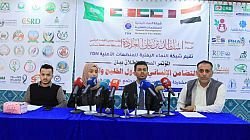
Close to 200 Yemeni civil society organisations and institutions issued a joint statement in April 2026 condemning what they described as repeated Iranian attacks on the Gulf Cooperation Council states and the Hashemite Kingdom of Jordan. The statement was read out at a press conference in Marib governorate and released in both Arabic and English, a choice the signatories said was intended to carry their message beyond a domestic audience.
The organisations said the attacks had used missiles and drones against civilian facilities and vital infrastructure, and argued that they formed part of a pattern of direct Iranian targeting of Yemen itself. They described Tehran’s escalation against the Gulf states, led by Saudi Arabia, as a threat to the security of the region as a whole. These are the characterisations of the signatory organisations; Iran has consistently rejected descriptions of its regional role in such terms, and the Houthi authorities in Sanaa hold a sharply different position.
The statement singled out Saudi Arabia as what the signatories called a fundamental pillar of support for Yemen, and said that attacks on the kingdom would not weaken Yemeni backing for Riyadh’s role but would instead reinforce commitment to the partnership with Saudi Arabia and the other Gulf states. The signatories said their aim was to demonstrate that Yemenis stand alongside the Gulf states and Jordan and support efforts to protect regional security and stability.
The bilingual release also points to the intended audience. Yemeni organisations seeking international attention face a crowded field, and material published only in Arabic rarely reaches donor governments or the wider press. Issuing the text in English alongside the original was a deliberate attempt to place the signatories’ position in front of the same governments and institutions that fund much of their work, at a moment when regional security was drawing sustained international coverage.
The choice of Marib as the venue was itself significant. The governorate is the largest population centre under the control of the internationally recognised government and hosts the single biggest concentration of internally displaced people in the country. It has been a focus of sustained fighting during the war and remains closely associated with the government and with tribal formations opposed to the Houthis, making it a natural setting for a statement of alignment with the Gulf.
The declaration came during a period of unusually sharp regional escalation. Conflict monitors recorded a marked deterioration across the Gulf from late February 2026, following strikes on Iran, with subsequent Iranian fire directed at facilities in several Gulf countries. Regional bodies responded with a series of collective statements: the Arab League condemned attacks on Gulf states in March 2026, and the Gulf Cooperation Council issued a joint condemnation with Jordan later in the year over the continuation of strikes on their territory.
Yemen’s position within that wider confrontation is complicated by its own division. The Houthi movement, which controls Sanaa and much of the north-west, has publicly aligned itself with Iran, while the internationally recognised government and the forces associated with it depend on Saudi and Emirati backing. Public statements issued from each side of the line during the 2026 escalation broke cleanly along those lines, with rallies in Houthi-held territory expressing solidarity with Tehran and gatherings in government areas expressing the opposite.
Civil society in Yemen occupies a constrained and often precarious space. Thousands of local organisations are registered, ranging from small community associations to established humanitarian implementers, and many depend on international funding channelled through United Nations agencies or international non-governmental organisations. Their room for independent political expression varies sharply by geography, and joint statements of this kind are more readily issued in government-held areas than in territory under Houthi administration.
That context shapes how such declarations should be read. A statement carrying nearly 200 signatures represents a substantial coordinated effort, but it reflects the views of organisations operating within one part of a divided country rather than a national consensus. No comparable mechanism exists for testing opinion across Yemen as a whole, and independent polling has been effectively impossible for years.
The practical stakes for Yemen in the regional confrontation are considerable regardless of political alignment. The country imports the large majority of its food and fuel by sea, and the shipping routes affected by regional tension run directly past its coastline. Disruption in the Red Sea and the Bab al-Mandab Strait raises freight and insurance costs, which feed through to prices in local markets already strained by currency depreciation and irregular public salary payments.
Saudi Arabia’s role in Yemen has been contested throughout the war. Riyadh led the military coalition that intervened in March 2015 on behalf of the government, a campaign that drew sustained criticism from human rights organisations over civilian casualties, while also providing budget support, fuel grants and deposits to Yemen’s central bank. The statement issued in Marib emphasised the latter dimension, framing the relationship in terms of economic and political support rather than the military intervention.
The signatories did not announce any follow-up mechanism, and no further joint action by the group has been reported. Statements of this kind function primarily as political signalling, intended for regional governments and international partners as much as for Yemeni audiences, and their effect is generally diffuse rather than immediate.
About the Author