Yemen’s foreign minister meets French aid groups in Paris over access and operating conditions
 Yemen Herald News
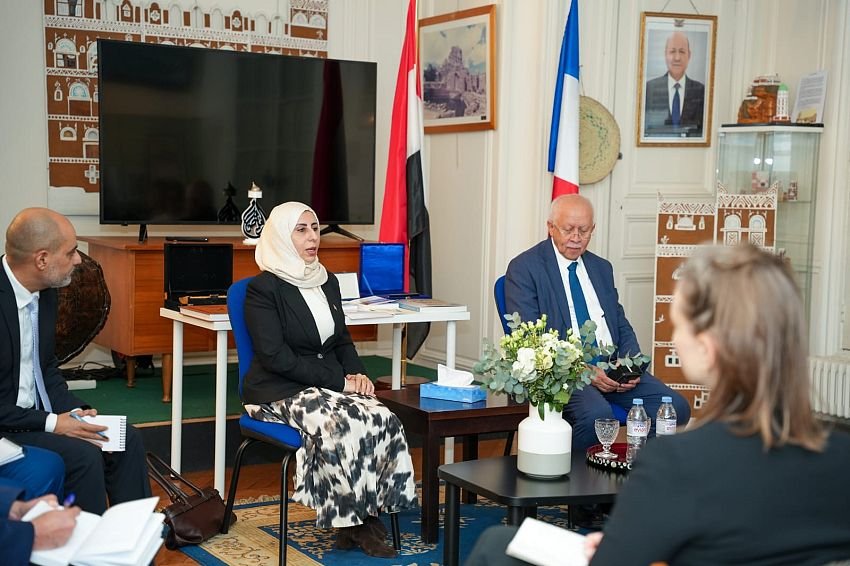
PARIS, France — Yemen’s foreign minister met representatives of French organisations working in Yemen on Monday to discuss humanitarian aid and the obstacles facing their operations, the state news agency Saba reported.
Afrah Abdulaziz al-Zouba, minister of foreign affairs and expatriates, held what the agency described as an expanded meeting in Paris.
Saba did not name the organisations that attended. It named no individual representatives.
Al-Zouba reaffirmed the government’s commitment to facilitating the work of humanitarian organisations, the agency said.
She said the government would improve coordination with the relevant authorities and work to ensure aid reaches people in need.
Representatives of the French organisations set out the main challenges facing their operations, according to Saba. The agency did not say what those challenges were.
They reaffirmed their commitment to continuing relief and development work across Yemen, it said.
No figures for funding, staffing or caseloads were given.
Al-Zouba gave the meeting her account of the humanitarian situation. She described the consequences of what she called the Houthi takeover, and the siege of Taiz.
She said restrictions were limiting access to essential supplies. She cited child recruitment and the detention of United Nations and humanitarian workers.
Those are the government’s characterisations. The Houthis reject accusations that they recruit children and dispute government accounts of responsibility for restrictions on aid.
The account of the meeting rests on Saba, which is controlled by the internationally recognised government. No independent confirmation of what was said at the meeting has been published.
Al-Zouba held a separate meeting in Paris during the same visit. Yemen Monitor reported that she met Yaël Menache, who chairs the French-Yemeni Friendship Group in the National Assembly, together with several members of the group.
Menache said the group planned to step up parliamentary consultations on Yemen, according to that account.
That account said the discussion covered what the minister described as Houthi attacks on civilians and infrastructure in Yemen and neighbouring states, and threats to shipping in the Red Sea and the Bab al-Mandab strait.
Saba filed a further report on a meeting with the head of the Yemeni-French friendship group in the French Senate.
Al-Zouba was appointed foreign minister on July 23. She is the first woman to hold the post.
She succeeded Shaya al-Zindani, who had held the portfolio since March 2024. Al-Zindani became prime minister on Jan. 15 this year, after Salem Saleh bin Braik resigned.
Before moving to the foreign ministry, al-Zouba served as minister of planning and international cooperation.
In that role she met representatives of Vision Hope, CARE, Save the Children and Oxfam on the sidelines of the Hamburg Sustainability Conference in 2026.
She also met Carl Skau, acting executive director of the World Food Programme, to discuss food access for vulnerable groups, particularly children and mothers.
In Berlin she met officials of the Friedrich Ebert Foundation to discuss social and economic policy, peacebuilding and aid effectiveness. She thanked the foundation for continuing to operate from Aden.
She argued then for a shift from humanitarian response towards resilience and development, and for linking World Food Programme work with national safety nets and school feeding.
She called for stronger advocacy to raise funding for Yemen, and for fragile states to be placed on the agenda of the Group of 20.
Al-Zouba has led similar meetings in Aden since taking the foreign affairs portfolio. On Sept. 15 she and the minister of planning and international cooperation met United Nations agencies, international organisations and non-governmental groups working in Yemen, according to the foreign ministry.
Laurent Bukera, the acting United Nations resident and humanitarian coordinator for Yemen, attended.
Walid al-Abara, a minister of state, presented the government’s consolidated report on the most recent displacement.
The ministry said 12,597 displaced families had been registered across six governorates. It said they needed shelter, food, safe water, health care and protection services.
That meeting discussed threats to ports and supply routes on the western coast and around Bab al-Mandab, which the ministry said were raising food-security risks and the cost of essential goods.
The ministry said the government was committed to protecting civilians and displaced people, and to facilitating impartial aid delivery across all governorates.
Participants called for expanding the presence and operations of aid organisations from Aden, and for protecting their premises, vehicles and resources.
The ministry said that meeting ended with calls for continued consultation and stronger coordination. It listed no specific commitments.
The International Development Association, part of the World Bank Group, approved a $101.8 million cash for nutrition and livelihoods project for Yemen.
It targets households with pregnant or breastfeeding women and mothers of children under two in the governorates with the highest rates of malnutrition.
The United Nations humanitarian needs and response plan published in March put the number of people in Yemen requiring assistance at more than 22 million.
It recorded 18.3 million people as acutely food insecure and 5.2 million as internally displaced.
The plan put the number of children under five who are acutely malnourished at more than 2.2 million, of whom 516,157 are severely malnourished.
Aid agencies appealed for $2.16 billion under the plan to reach 12 million people.
Saba did not say how long al-Zouba’s visit to Paris would last, or whether further meetings were scheduled.
About the Author


 Adel Haddad