Yemen’s Leadership Council Rejects Iranian Flight to Return Houthis to Sana’a
 Yemen Herald News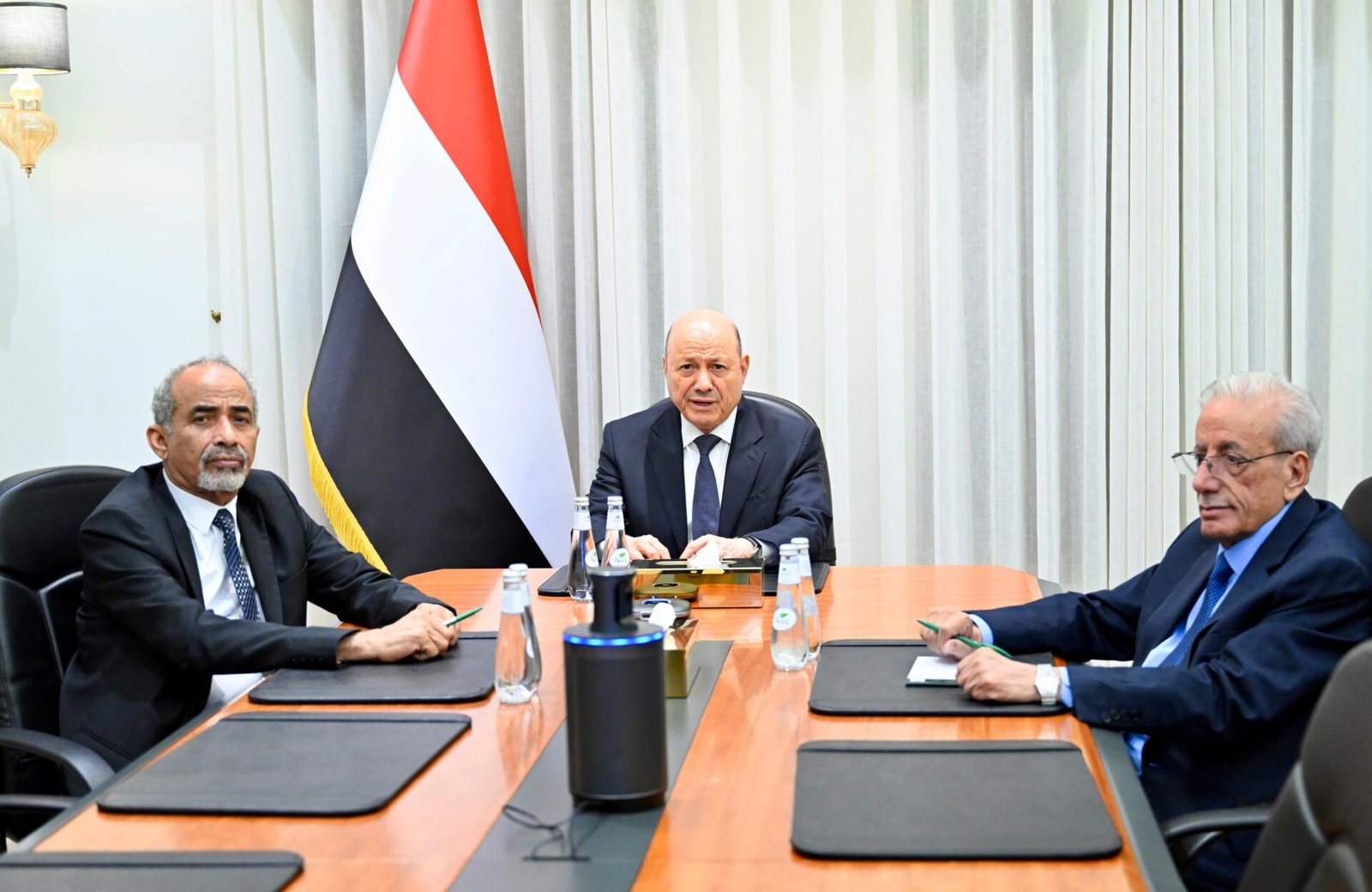
Yemen’s Presidential Leadership Council held an extraordinary session in the Saudi capital, Riyadh, chaired by President Rashad al-Alimi, to review a series of pressing national and regional developments. All members of the council attended, among them Sultan al-Aradah and Tariq Saleh, alongside Prime Minister Shaya al-Zindani, who also serves as foreign minister. Officials devoted much of the meeting to sovereignty concerns surrounding Sana’a International Airport and to the humanitarian pressures bearing on ordinary Yemenis, weighing proposed responses to each and coordinating positions with the states that sponsor the Yemeni political process. The council, formed in April 2022 to unify the anti-Houthi camp under a single executive body, has repeatedly cast the status of the capital’s airport as a test of the state’s authority, since Sana’a has remained under Houthi control since the group overran the city in late 2014.
At the center of the discussion was a request submitted by Iran through the Coalition to Support Legitimacy in Yemen to operate a flight by the Iranian carrier Mahan Air from Tehran to Sana’a. According to the council, the flight was intended to return Houthi members and leaders who had earlier been flown out of Sana’a Airport. The government said the proposal fell outside approved legal channels and treated it as an attempt to normalize direct Iranian access to an airport that lies under Houthi control, rather than as a routine civil aviation matter.
The request followed an earlier flight that the government says belonged to Iran’s Islamic Revolutionary Guard Corps and landed at Sana’a in early July. Al-Alimi has pressed the ambassadors of the sponsoring states to support an international investigation into that landing, describing it as a violation of Yemeni sovereignty and a defiance of United Nations Security Council resolutions. Yemeni officials framed the sequence of events as part of a wider effort by Tehran to entrench its influence over the Houthi movement and to build a direct air corridor between Iranian territory and the Yemeni capital.
The council stated that any Iranian flight to Sana’a outside recognized frameworks would amount to a breach of the sovereignty of the Republic of Yemen, of international law, and of Security Council resolutions. It insisted that all arrangements concerning Sana’a Airport must pass through the national carrier and the legitimate civil aviation authority. Members affirmed that the government and the armed forces would take the political, diplomatic, and military measures necessary to prevent any steps that undermine national sovereignty, while stressing that the airport should serve civilians rather than the movement of armed factions.
Council members also reviewed government efforts to keep genuine civilian air travel available to residents of the north. Officials pointed to work aimed at facilitating commercial flights from Sana’a, including attempts to sustain regular services on the Sana’a to Amman route operated by the national carrier, Yemenia. That corridor has offered a rare lifeline for Yemenis seeking medical treatment, study, or family reunification abroad, and the council presented its restoration as a humanitarian priority distinct from the politically charged Iranian request.
In its criticism of the Houthis, the council recalled that the group seized several of the national carrier’s aircraft at Sana’a Airport in 2024, a move that disrupted the Amman service and stranded travelers before Omani mediation secured the planes’ release. Yemenia’s operations have since suffered further setbacks; the airline has said flights on the Sana’a to Amman route were halted after Israeli airstrikes on Sana’a Airport in May 2025 destroyed several of its aircraft and inflicted heavy losses. The council argued that repeated interference has hollowed out the national carrier and deepened the isolation of civilians in Houthi-held areas.
The humanitarian backdrop framed much of the session. United Nations agencies estimate that well over 18 million Yemenis require some form of assistance, and years of conflict have displaced millions more from their homes. Council members argued that restoring dependable, lawful flight operations could ease part of that burden, but cautioned that continued fighting and outside interference complicate any relief. The struggle over Sana’a Airport, they said, cannot be separated from the broader contest over Yemen’s transport routes and the security of the Red Sea and the strategic Bab al-Mandab Strait, a corridor through which a large share of global shipping passes and where months of Houthi attacks on commercial vessels have already rattled international trade.
The council directed pointed criticism at Tehran, calling on Iran to respect Yemen’s territorial integrity and to stop using the country as an arena for regional rivalries. In the government’s account, such interference has prolonged the war, sharpened the suffering of civilians, and undercut peace efforts led by the United Nations. Officials tied the airport dispute to a pattern of external involvement that, in their view, has made a negotiated settlement harder to reach and has drawn Yemen more deeply into confrontations that extend well beyond its borders.
Looking ahead, the council expressed cautious hope that renewed dialogue and cooperation with international partners could widen humanitarian access and ease tensions over the coming months. That outlook, members acknowledged, depends on a real reduction in outside interference and on a willingness among local factions to choose negotiation over further escalation. Rebuilding national institutions, sustaining lawful air links, and maintaining the backing of the states sponsoring the peace process were described as decisive tests of whether Yemen can steady its governance and begin to relieve one of the world’s gravest humanitarian crises.
About the Author