Yemen’s parliament approves general mobilisation at al-Alimi’s request
 Yemen Herald News
ADEN, Yemen — Yemen’s House of Representatives approved a general mobilisation on Monday, granting a request by Rashad al-Alimi, chairman of the Presidential Leadership Council.
Speaker Sultan al-Barakani chaired the session, which was held virtually and described by the chamber as an expanded meeting, the state news agency Saba reported.
Al-Alimi, who is also supreme commander of the armed forces, asked the chamber to declare the mobilisation in what he called a response to Houthi escalation.
The Houthi authorities have not commented on the decision, and they dispute the government’s characterisation of the fighting.
The chamber said the measure is intended to protect civilians, defend the republican system and constitutional legitimacy, and safeguard Yemen’s sovereignty and territorial integrity.
It cited Article 37 of the constitution, which governs general mobilisation, alongside provisions on national defence, emergency measures and civil defence.
The decision also invokes the General Reserve Law, the law establishing the National Defence Council, the Civil Defence Law and the power-transfer declaration, according to Saba.
The mobilisation takes effect on its announcement and remains in force until the circumstances prompting it cease to exist, the agency said.
The chamber called for national unity and for coordination among political forces.
It reaffirmed support for the Saudi-led coalition and condemned Houthi attacks on Saudi Arabia, which it described as a threat to regional security.
The account of the session rests on Saba, the news agency of the internationally recognised government. No independent account of the proceedings has been published.
Asharq Al-Awsat reported the decision on Tuesday. It said the stated aim was to strengthen the capabilities of state institutions and the armed forces, and quoted no Houthi response.
That report described fighting on fronts in Taiz, Lahj, Marib, al-Jawf and al-Bayda, and in northern areas.
Al-Alimi also proposed what he called a safe return initiative, offering guarantees to fighters who leave Houthi ranks, according to the newspaper.
He described the mobilisation as covering human, material and moral resources.
Al-Barakani was elected speaker on 13 April 2019, at a session held in Seiyun. It was the first sitting of the chamber loyal to the internationally recognised government since the war began in 2015.
UNICEF dated the current escalation to 3 September.
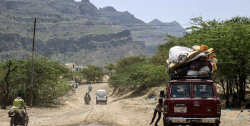
Fighting since then has displaced large numbers of people. The International Organization for Migration said more than 145,000 people had been displaced across eight governorates, putting the figure at 145,308 people, or 24,218 families.
The United Nations said in mid-September that 93,864 people had been newly displaced, with clashes reported in Aden, Hodeidah, Abyan and Taiz, and separately in Marib.
More than 2,400 people crossed to Djibouti within four days of the escalation, the organisation said. It said more than 60 per cent of those arriving were women, children and elderly people.
Tom Fletcher, the United Nations emergency relief coordinator, released 9 million dollars from the Central Emergency Response Fund for the response.
UNICEF said on 16 September that 243 schools had closed or suspended learning, affecting more than 137,000 students, and that more than 57,000 children were among those displaced.
The agency said 12.2 million children in Yemen need humanitarian assistance.
The UN Office for the Coordination of Humanitarian Affairs said its response plan for 2026, issued in March, identified more than 22 million people in the country as needing assistance.
That plan recorded 18.3 million people as acutely food insecure and more than 2.2 million children under five as acutely malnourished, of whom 516,157 were severely malnourished.
It counted 5.2 million internally displaced people and sought 2.16 billion dollars to reach 12 million of those in need.
The World Bank said in May that the plan was funded at 28 per cent of assessed needs, down from 56.5 per cent in 2024. It estimated that about 75 per cent of Yemenis live below the poverty line.
Yemen’s internationally recognised government is based in Aden. The Presidential Leadership Council has held executive authority since April 2022 under the power-transfer declaration the chamber cited on Monday.
The Houthi movement controls Sanaa and much of the north-west, including the Red Sea port of Hodeidah.
UNICEF said 26 health facilities it supports had disrupted services, and that only 60 per cent of health facilities in Yemen were fully functional. It put the number of people without adequate access to health care at 17.8 million.
The World Bank’s Yemen Economic Monitor, published on 21 May, said the economy contracted by 1.5 per cent in 2025 and was projected to shrink by a further 0.5 per cent this year. It put government revenues at 5.6 per cent of gross domestic product.
Yemen’s planning minister took part in the fourth Yemen-European Union Partnership Days in Amman on Monday, Saba reported.
The European Union mission to Yemen said on 24 September it had signed three projects worth 24 million euros for the country’s farming and fisheries sectors.
The European Commission says the bloc has provided about 1 billion euros in humanitarian aid to Yemen since 2015, alongside roughly 500 million euros in development assistance.
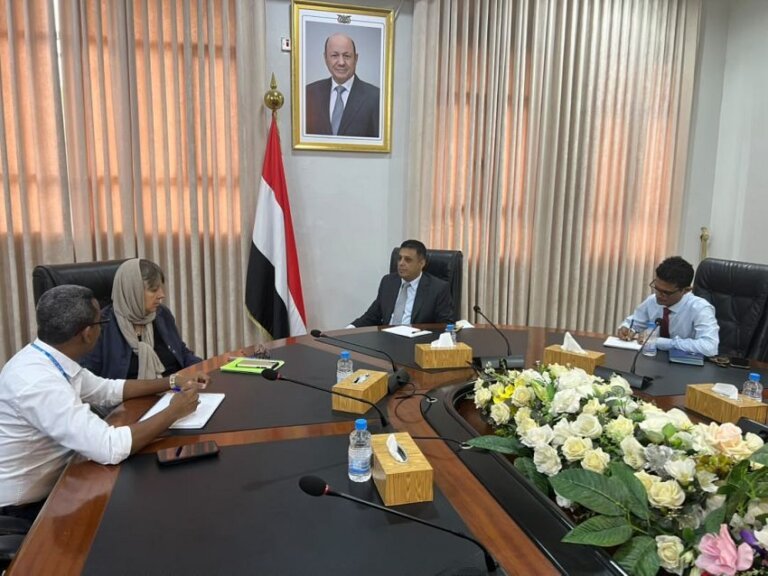
Yemen’s displacement minister asked the UN humanitarian office on Monday to relocate families sheltering in seven schools in Lahj governorate, according to Saba.
Saba did not say what units or age groups the mobilisation would cover, or when it would begin.
About the Author