Yemeni army reports Houthi missile and drone attacks as fighting widens west of Taiz
 Yemen Herald News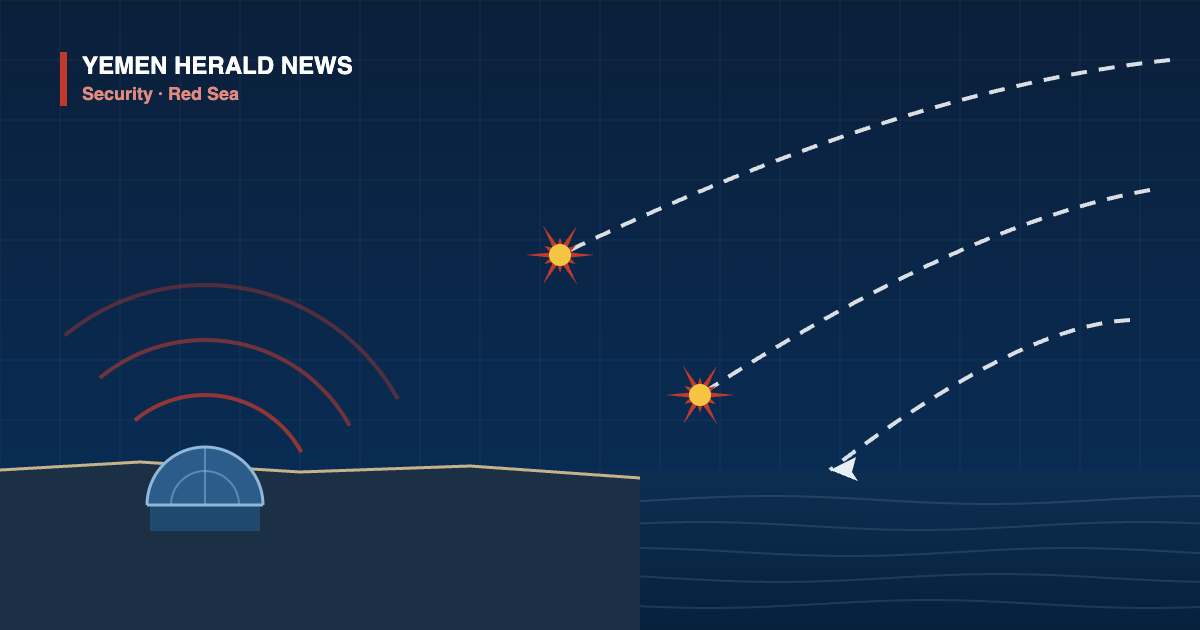
TAIZ, Yemen — Yemen’s Army Media Centre said Houthi fighters fired 14 ballistic missiles and launched drones at populated districts in Taiz and Hodeidah provinces on Thursday.
The claim rests on the army’s own media centre. The Houthis have not published an account of the launches, and no independent confirmation of the number of missiles has been reported.
Several drones were shot down over Taiz using air defences the government acquired recently, the armed forces said.
The army said the ballistic missiles caused no impact on the combat operations theatre of its forces stationed on the western coast. Ground battles were continuing, it added.
The media centre said the Houthis attacked army positions in the Maqbanah Mountains, west of Taiz province.
It said they tried to infiltrate the areas of al-Ahtoub, al-Tuwair, al-Kadha and Jabal Ghabari.
The fighting formed part of a wider Houthi push along front lines on the western Red Sea coast, Al Jazeera reported.
Houthi fighters tried on Thursday to reach and cut the road linking Taiz to al-Makha, according to the same report. The aim was to sever Taiz city from the coast.
Al Jazeera correspondent Yousef Mawry, reporting from Sanaa, said taking the port city of al-Makha would cut government forces off from a supply route.
It would also give the Houthis a foothold on the Red Sea, a route used for oil exports and other trade, Mawry said.
“In order to do that, they must drive out Yemeni government forces,” he said.
Mawry said government officials had reported regaining control of some areas that fell to the Houthis.
Casualty figures for the day differ by source and none has been independently verified.
The Army Media Centre said more than 18 Houthi fighters were killed and others wounded or captured in the clashes. That figure comes from one side of the fighting.
An unnamed military source told the AFP news agency that 13 government soldiers were killed.
Another military source told AFP that most of those killed died on the front lines between al-Makha and Taiz, and the rest in clashes near the Red Sea coast.
Both AFP sources spoke on condition of anonymity.
A field officer in al-Makha told AFP his men were “fighting fiercely to repel the massive Houthi offensive”.
“We also thwarted an attack with two booby-trapped boats that exploded near the port,” the officer said, also requesting anonymity.
The state news agency Saba reported that the army shot down three Houthi drones in the Jabal Habashi district of Taiz governorate.
Saba said the army was engaged in clashes with Houthi fighters on the al-Barah front, west of Taiz city.
Moammar Eryani, Yemen’s information minister, wrote on X that the country faced “a cross-border network that exchanges weapons, expertise, training and technology with terrorist groups”.
That network sought to widen its operations on both sides of the Gulf of Aden, Eryani wrote, putting Bab al-Mandab, trade routes and global energy supplies at risk.
“The Houthi threat is no longer confined to Yemen and international shipping in the Red Sea, but rather to regional and international security,” the minister wrote. He asked the international community to give the government political, military, security and intelligence support.
The Houthis reject that characterisation and present their operations as a response to government and foreign action.
The National reported that the Houthis have built up their military capability and extended a smuggling network into the Horn of Africa, working with the Somali armed group al-Shabab.
Riyadh Aldubai, a Yemeni political activist, told the same newspaper the current attacks were not a passing escalation but a war aimed at destroying economic institutions and infrastructure.
He pointed to the targeting of the government-held Mokha port in Taiz.
Yemen experts told the US Congress on Tuesday that Washington should back the Yemeni government against the Houthis.
Exchanges of fire and drone attacks have been reported across nearly the whole front line in recent weeks, Al Jazeera said.
Mawry said the Houthis’ ability to enter government territory and hold it for several hours pointed to the failure of efforts to resume talks.
“Both sides are now scrabbling to gain territory and gain control not just on land, but at sea,” he said.
He said it remained to be seen whether government forces could hold their positions.
The Houthis have attacked shipping linked to the government in recent weeks. Al Jazeera reported an attack on a Saudi vessel on Aug. 24.
Yemen has been in conflict since the Houthis seized Sanaa in 2014. A Saudi-led coalition intervened the following year.
The Houthis and the internationally recognised government agreed a UN-mediated truce in 2022. It formally lapsed within months, but large-scale fighting between the two sides had largely stopped until recently.
Progress toward a lasting settlement stalled in 2023, after Israel began its war on Gaza and tensions across the region rose.
The United Nations warned in August that Yemen faced its highest risk of a return to war since that truce, Al Jazeera reported.
Each side gives a different account of who has broken it. The government describes the current offensive as Houthi aggression, while the Houthis have framed recent operations as responses to government attacks.
The districts named by the army lie in government-held territory on Yemen’s western coast.
That strip runs from Hodeidah province south toward the Bab al-Mandab strait, at the southern entrance to the Red Sea.
About the Author