Al-Alimi Discusses Yemen-UK Cooperation With Senior British Official in London
 Yemen Herald News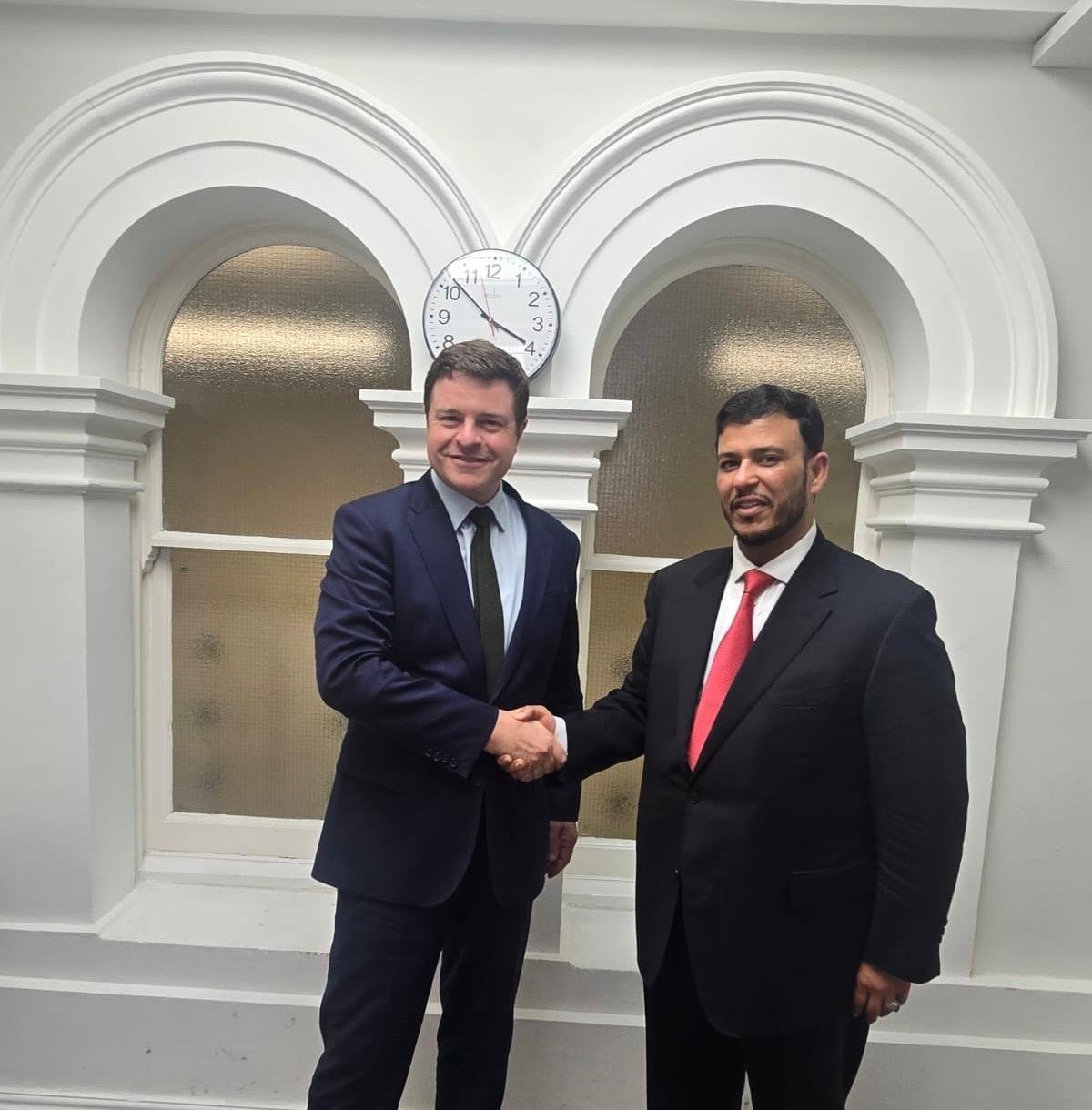
Dr. Abdullah Al-Alimi Bawazir, a member of Yemen’s Presidential Leadership Council, met in London on Friday with Dr. Rob Dixon, the director for the Middle East and North Africa at the British Foreign, Commonwealth and Development Office. The talks reflected a continuing effort to deepen ties between Yemen’s internationally recognised government and the United Kingdom, one of the country’s longstanding political and humanitarian partners, at a moment of renewed diplomatic activity surrounding Yemen’s stalled peace process.
Their conversation ranged across Yemen’s political, security and economic situation, which remains fragile after more than a decade of conflict. The war escalated in 2015, when a Saudi-led coalition intervened against the Houthi movement that had seized the capital, Sanaa, the previous September. Successive rounds of fighting, shifting front lines and a collapsing currency have left the country effectively divided between the Houthi-controlled north and the areas held by the government and its allies, with millions of civilians bearing the cost of the stalemate.
Al-Alimi Bawazir, who previously headed the office of former president Abdrabbuh Mansur Hadi, sits on the eight-member Presidential Leadership Council that was formed in April 2022 and is chaired by Rashad al-Alimi. The council was created to unify anti-Houthi factions and to consolidate political, military and economic decision-making under a single body. During the London meeting he outlined the steps the council and the government say they are taking to rebuild state institutions and to work toward what he described as a just and durable peace.
He argued that the Houthis have used periods of relative calm, including internationally brokered truces, to strengthen their military capabilities rather than to advance negotiations, a pattern the government says threatens any lasting settlement. Al-Alimi Bawazir also pointed to what he characterised as Iranian support for the group, saying such backing undermines Yemeni sovereignty and complicates efforts to de-escalate. Tehran denies arming the Houthis, although United Nations experts have repeatedly reported transfers of weapons and components that they say violate an arms embargo.
The humanitarian dimension featured prominently in the discussion. According to the United Nations Office for the Coordination of Humanitarian Affairs, more than 22 million Yemenis, roughly two-thirds of the population, will need humanitarian assistance and protection in 2026, including about 5.2 million people who remain internally displaced. Aid agencies have appealed for close to 2.16 billion dollars to fund this year’s response. Food insecurity is especially acute, with the United Nations estimating that around 18.3 million people face crisis levels of hunger, while recurring outbreaks of cholera and measles continue to strain a weakened health system.
Al-Alimi Bawazir expressed appreciation for the United Kingdom’s long record of political, economic and humanitarian support for Yemen, and he stressed the importance of strengthening the capacity of state institutions in order to restore governance and stability. For his part, Dr. Dixon reaffirmed Britain’s commitment to backing the Presidential Leadership Council and the government, and he signalled an interest in expanding cooperation on both immediate relief needs and longer-term development and reconstruction.
The meeting was attended by Dr. Yassin Saeed Noman, Yemen’s ambassador to the United Kingdom since 2015 and a former prime minister and parliamentary speaker, who has played a central role in maintaining diplomatic contact and channelling international assistance. His presence underscored the embassy’s function as a bridge between the Yemeni government and British officials, aid organisations and the sizeable Yemeni community across Britain.
The talks formed part of a wider round of engagements during Al-Alimi Bawazir’s stay in London. Yemeni state media reported that he also met the UK Minister of State for the Middle East and North Africa, Hamish Falconer, who reiterated Britain’s support for the leadership council and encouraged continued reform. According to the same reports, Al-Alimi Bawazir additionally took part in an international conference in the British capital convened by the Royal Institute of International Affairs, the London policy institute widely known as Chatham House, which drew senior officials, diplomats and policy specialists from a range of countries.
Britain occupies a particular position in the diplomacy surrounding Yemen. As the so-called penholder on the file at the United Nations Security Council, the United Kingdom drafts resolutions and helps shape the international response to the conflict, giving meetings such as Friday’s an added significance beyond bilateral relations. London has also been among the larger donors to the humanitarian response over the course of the war, funding food, health and water programmes delivered by UN agencies and non-governmental organisations operating inside the country.
The path toward peace in Yemen remains difficult. United Nations-led mediation has produced partial gains, including agreements on the release of conflict-related detainees, but a comprehensive settlement has proved elusive as the parties disagree over security guarantees, revenue-sharing and the future shape of state institutions. British and other Western officials have framed sustained diplomatic engagement, combined with humanitarian funding and support for governance, as essential to preventing further deterioration and to keeping a political track alive.
How Yemen’s situation evolves in the months ahead is likely to continue shaping international aid strategies and diplomatic priorities across the region. Officials on both sides presented the London discussions as a step toward closer coordination, while acknowledging that translating renewed commitments into tangible progress on the ground will depend on developments far beyond any single meeting, and on whether the fragile calm of recent months can be preserved.
About the Author