
Yemen’s Planning Minister and IOM Discuss Aligning Interventions With Government Priorities
 Yemen Herald News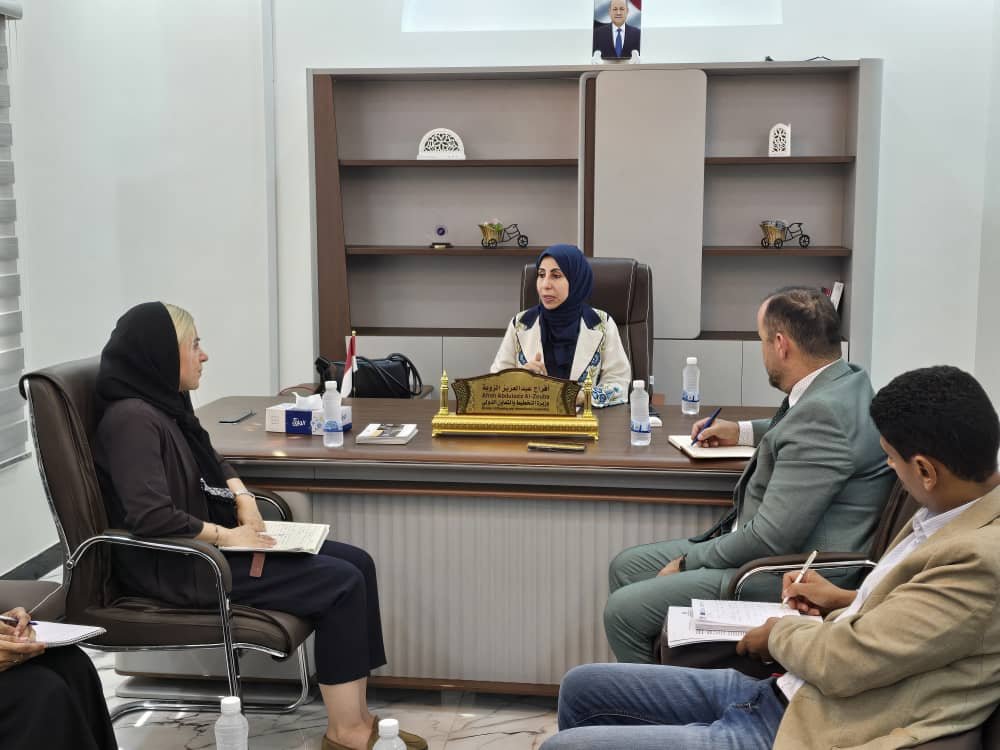
Yemen’s Minister of Planning and International Cooperation, Dr. Afrah Al-Zuba, met on Monday in Aden with Abdul Sattar Issyov, Chief of Mission of the International Organization for Migration in Yemen, to review the organization’s recent work in the country and its priority plans for 2026, in talks centred on aligning international interventions with the government’s own development agenda.
According to Yemen’s state news agency Saba, the two sides examined mechanisms for enhancing coordination and partnership between the ministry and the IOM in humanitarian action, recovery programmes, resilience building and migration management. The discussions covered a wide range of projects intended to assist communities affected by the conflict that has devastated Yemen for more than a decade.
Al-Zuba emphasised the importance of a collaborative partnership between her ministry and the organization, and pressed the case that international interventions deliver the most value when they are aligned with national priorities rather than designed in parallel to them. She expressed appreciation for the working relationship between the government and the IOM, and commended the organization’s contribution to addressing the population’s most significant challenges.
The minister also stressed the necessity of integrating humanitarian action with development initiatives, arguing that emergency relief alone cannot produce lasting improvements in essential services for the most affected communities. That position reflects a broader shift in the government’s approach, which increasingly frames Yemen’s needs in terms of recovery and resilience rather than open-ended emergency response.
In that context, Al-Zuba briefed the IOM chief on preparations for the National Development Plan covering 2027 to 2029, a framework intended to organise the contributions of development partners around government priorities. Aligning donor programmes with the plan, she argued, would maximise the efficiency of implementation and produce tangible results for the country’s recovery.
Issyov affirmed the IOM’s commitment to advancing multi-sectoral interventions spanning development, rehabilitation and humanitarian response, and underlined the importance of a cooperative approach with the Yemeni authorities to ensure that projects serve national recovery and development goals, according to the Saba account of the meeting.
The IOM occupies a distinctive position among the agencies operating in Yemen. Beyond conventional relief work, it manages programmes for displaced Yemenis and carries particular responsibility for migrants transiting the country, tens of thousands of whom continue to arrive from the Horn of Africa each year en route to Gulf states, often falling into acute danger and exploitation along the way. Yemen’s location on one of the world’s busiest mixed-migration corridors means the organization’s mandate touches both the country’s internal displacement crisis and a regional movement of people that the conflict has made far more perilous.
The scale of need remains immense. United Nations agencies estimate that more than 18 million Yemenis require humanitarian assistance, with some 4.5 million internally displaced since the conflict escalated in 2015. Displacement is frequently protracted and repeated, with families uprooted multiple times by shifting front lines, flooding and economic collapse, and camps in areas such as Marib and Al-Jawf remain vulnerable to both violence and extreme weather.
The internationally recognised government, led by the Presidential Leadership Council under President Rashad al-Alimi, has sought to position itself as a credible partner for international organizations, arguing that strengthening state institutions is itself a form of humanitarian action. Ministries in Aden have pressed donors to channel more of their programming through government-endorsed priorities, contending that parallel systems entrench fragmentation and weaken the state’s capacity to eventually assume responsibility for services.
International agencies, for their part, must balance that engagement with the reality that millions of Yemenis in need live in areas outside government control, where humanitarian access is negotiated separately and often obstructed. The IOM’s country-wide operations make coordination with all authorities a persistent and delicate task, and its dialogue with Aden forms one part of a wider set of relationships that keep programmes running across front lines.
Funding pressures give the alignment agenda added urgency. Yemen’s humanitarian appeals have been persistently underfunded, forcing agencies to prioritise ruthlessly among competing needs. In that environment, both the government and its partners have an interest in demonstrating that every dollar produces measurable results, an argument that alignment with a coherent national plan is intended to strengthen.
The ministry has pursued the same message with other partners in recent weeks, holding talks with United Nations officials on humanitarian coordination, with the World Bank on development projects planned for 2026, and with European foundations and bilateral donors on longer-term cooperation. Taken together, the meetings sketch a consistent strategy: positioning the 2027-2029 plan as the organising document for everyone who funds or implements programmes in government-held Yemen.
Monday’s meeting produced no new agreements, and neither side announced specific commitments. Its significance lies instead in the continuing effort to knit international programming into a government-led framework ahead of the 2027-2029 development plan, a process that will test both the ministry’s capacity to lead and the willingness of donors to follow.
For communities enduring the crisis, the stakes of that institutional question are concrete: whether clinics, water systems and livelihoods programmes arrive as isolated projects or as parts of a durable recovery. The government and the IOM both argue that the second path is the only one that leads out of permanent emergency, and their cooperation in the months ahead will show how far that shared conviction can be turned into practice.
About the Author




