Yemen’s al-Alimi Says Iranian Flights Violate Sovereignty and Houthis Are Weaker Than Ever
 Yemen Herald News
Dr. Abdullah al-Alimi Bawazeer, a member of Yemen’s Presidential Leadership Council, has denounced Iranian flights into Yemen as a violation of the country’s sovereignty, saying in a recent interview that the aircraft were carrying military supplies intended for the Houthi movement and warning that the group has evolved from a local insurgency into a threat to international security and commerce.
His remarks come at one of the most volatile moments Yemen has seen in years. The government says an Iranian aircraft attempted to land at Sanaa International Airport, in Houthi-controlled territory, carrying a Houthi delegation returning from the funeral of Iran’s late supreme leader, and that the episode prompted strikes on airport infrastructure intended to deny Tehran a re-established air corridor into the capital. The aircraft was ultimately diverted to Hodeidah, the strategic Red Sea port city, and the Houthis answered with missile attacks on Saudi Arabia, effectively collapsing a fragile truce that had held in large measure for roughly four years.
The escalation has reached the United Nations Security Council, where members have called urgently for de-escalation. The Houthis, for their part, have cast their actions as legitimate self-defence, with the head of their negotiating delegation asserting that defending the homeland is both a moral duty and a right grounded in Islamic and international law. Each side, in short, claims the mantle of the aggrieved, and the space for diplomacy has narrowed accordingly.
Al-Alimi argued that the flights were not opportunistic but strategic, an effort to reinforce Houthi capabilities under the cover of condolence diplomacy. Government officials have separately said that intelligence pointed to Iranian personnel and equipment aboard flights into Sanaa, including specialists in drones and missile systems, claims that could not be independently verified but that align with long-standing UN findings on Iranian arms transfers to the group in violation of Security Council resolutions.
Despite the gravity of the moment, al-Alimi offered a notably confident assessment of the balance of power. The Houthis, he said, are weaker than at any point in recent years, pressed by the erosion of Iran’s regional network, by internal divisions within their own ranks and by the financial strain of sustaining a war economy. A return to legitimate governance, he argued, would serve not only Yemen’s stability but the region’s.
He was equally clear about the government’s terms for any settlement: recognition of the state’s exclusive authority over weapons and the restoration of its institutions across the country. Negotiation remains the preferred path, he indicated, but the government is preparing for the possibility of renewed full-scale conflict, a dual posture that reflects the precarious realities on the ground.
The economic dimension of the war weighs heavily on that calculus. Houthi attacks on oil facilities have throttled the government’s main source of revenue since 2022, deepening a budget crisis that has left public sector salaries chronically in arrears. Al-Alimi acknowledged candidly that without Saudi support the government could not meet its obligations to civil servants, and he defended the relationship with Riyadh as indispensable, rooted in geography, culture and history, and expressed across humanitarian, developmental and political domains.
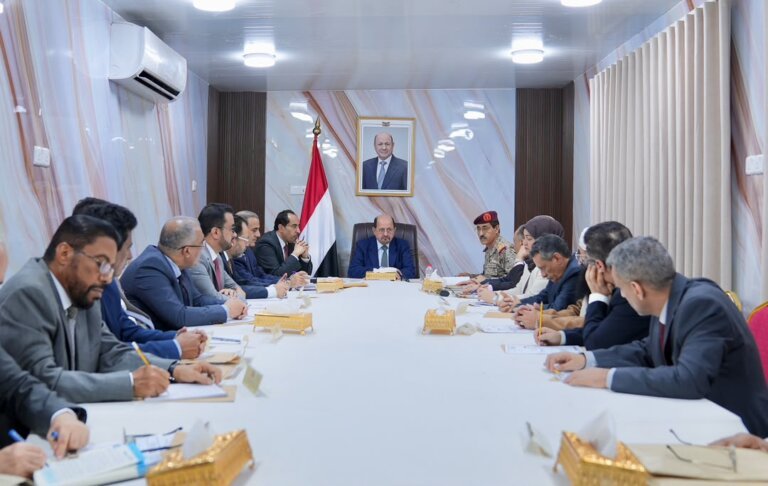
That dependency has costs as well as benefits, tying the government’s fortunes to its backers’ priorities and exposing it to criticism from rivals. Yet al-Alimi pointed to what he described as a newfound coherence within the Presidential Leadership Council, the eight-member body that has exercised presidential powers since 2022. Even the Southern Transitional Council, which has historically pursued independence for southern Yemen, remains integrated within the government framework, he noted, suggesting an opportunity to consolidate a united front against the Houthis despite the factions’ divergent long-term aims.
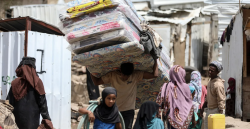
The humanitarian backdrop lends urgency to every calculation. More than 18 million Yemenis need assistance and some 4.5 million are displaced, according to UN estimates, while recurrent outbreaks of cholera and measles compound the toll of widespread malnutrition. A return to full-scale war would deepen all of it, and aid agencies have warned that even the current escalation is disrupting operations.
International attention is sharpened by geography. Yemen sits astride the Bab al-Mandab Strait, through which a substantial share of global trade passes, and Houthi attacks on shipping in recent years demonstrated the group’s capacity to impose costs on the world economy. Al-Alimi’s argument that the Houthis now endanger international security as much as Yemeni sovereignty is calculated to resonate with Western governments weighing their response to the wider confrontation between Iran and the Gulf states.
The government has also moved to institutionalise its response. Officials in Aden have announced a crisis management mechanism coordinating military, diplomatic, legal and media measures against unauthorised flights, alongside formal complaints through the Arab League and the United Nations. The aim, al-Alimi and his colleagues have suggested, is to establish that access to Yemeni airspace and airports runs through the state alone, a principle they regard as inseparable from any credible peace process.
Whether the moment tips toward negotiation or renewed war may depend on factors outside Yemeni hands: the trajectory of the Iran crisis, the willingness of regional powers to underwrite either path, and the Houthis’ own reading of their position. What al-Alimi’s interview makes plain is the government’s bet that time, for once, is on its side, and that firmness now, on sovereignty, on weapons and on institutions, will translate into leverage whenever the parties next sit down.
About the Author