Al-Alimi Offers Yemen’s Condolences to Qatar Over Former Emir’s Death
 Yemen Herald News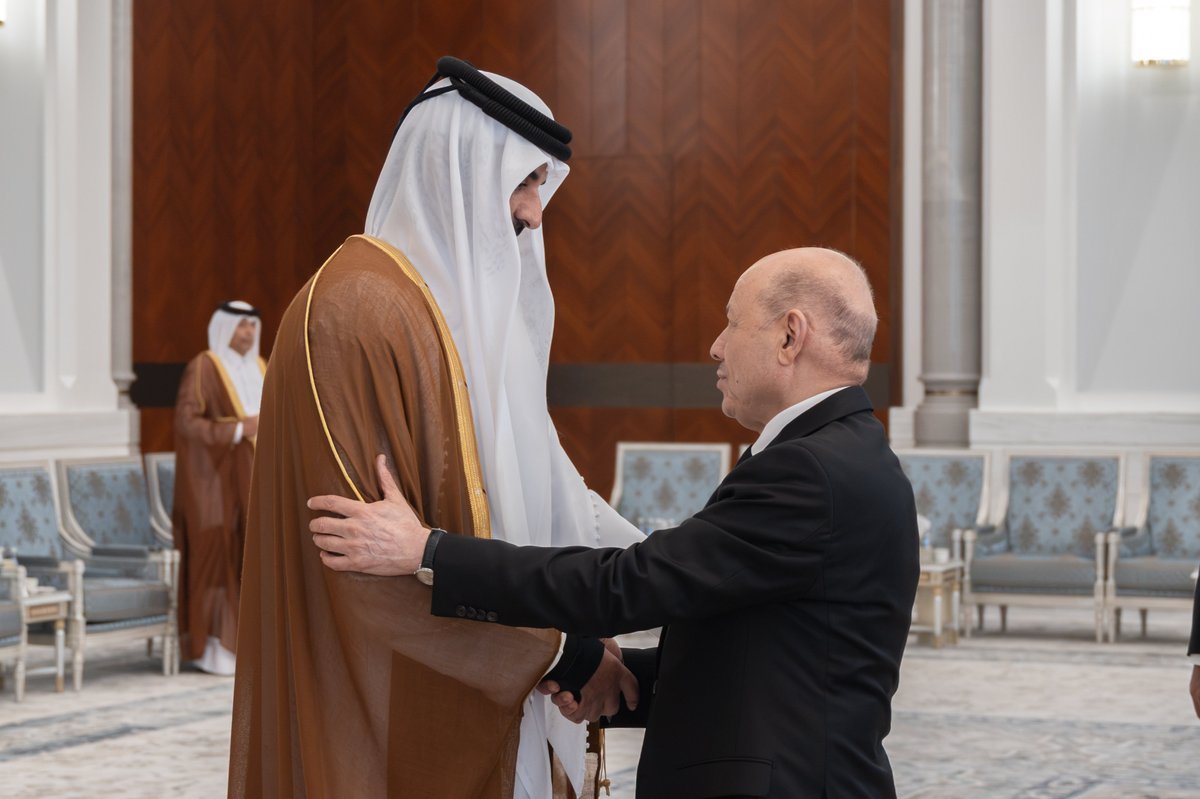
Dr. Rashad al-Alimi, chairman of Yemen’s Presidential Leadership Council, has offered his condolences to Sheikh Tamim bin Hamad Al Thani, the Emir of Qatar, following the death of the country’s former ruler, Sheikh Hamad bin Khalifa Al Thani. Sheikh Hamad, who governed Qatar for nearly two decades before handing power to his son, died on 12 July 2026 at the age of 74. Al-Alimi conveyed his sympathies during a formal visit to Doha at the head of a senior Yemeni delegation.
The delegation was received at Lusail Palace by the Emir and by the Deputy Emir, Sheikh Abdullah bin Hamad Al Thani, along with the Personal Representative of the Emir, Sheikh Jassim bin Hamad Al Thani, and other members of the Al Thani family who had gathered to mark the loss. The reception underscored the ties between Yemen and Qatar at a moment when the Gulf state has been receiving condolences from across the region; Qatar declared four days of official mourning after the announcement of Sheikh Hamad’s death.
Al-Alimi was accompanied by several prominent figures, among them Lt. Gen. Mahmoud al-Subaihi, a member of the Presidential Leadership Council, and Sheikh Sultan al-Barakani, speaker of the House of Representatives. The delegation also included Akram al-Amiri, deputy chairman of the Consultation and Reconciliation Commission, and the parliamentarians Abdulwahab Muawadah and Ensaf Mayo. Their presence signalled the weight Yemen’s leadership attached to the visit and to the broader relationship with Doha.
In his meeting with the Emir, Al-Alimi relayed the condolences of the Yemeni government and people and spoke of the long history shared by the two nations. He described the death of the former emir as a loss felt well beyond the Al Thani family, noting the mark Sheikh Hamad had left on Qatar and the wider Gulf. Such gestures, Yemeni officials suggested, reflect the importance the internationally recognised government places on maintaining close bonds with Gulf partners.
Sheikh Hamad ruled Qatar from 1995 until 2013, when he stepped aside in favour of his son Tamim in a rare voluntary transfer of power among Gulf monarchies. During his roughly eighteen years in office he oversaw a period of rapid economic expansion and a marked rise in Qatar’s international profile, helping to shape the small state’s outsized role within the Gulf Cooperation Council and on the global stage. His decision to abdicate at a relatively young age was widely seen as an effort to secure an orderly succession.
Sheikh Hamad is widely remembered as the architect of modern Qatar’s international rise. During his rule the country rapidly expanded its liquefied natural gas exports to become one of the world’s wealthiest states per capita, launched the Al Jazeera media network in 1996 and pursued an assertive foreign policy that gave Doha influence far beyond its size. That legacy, analysts note, continues to shape Qatar’s regional posture under his son, including its recurring role as a mediator in conflicts across the Middle East.
For Yemen, the visit carried significance beyond protocol. The country, mired in conflict for more than a decade, continues to depend on the support of Gulf states as it seeks to restore a measure of stability and governance. Qatar has positioned itself at various points as a supporter of mediation and relief efforts, and Yemeni officials have been keen to keep channels of dialogue open even as the war grinds on. The condolence visit offered an occasion to reaffirm that relationship.
Yemen’s civil war, which escalated in 2015, has left the country deeply divided. The confrontation between the Houthi movement and the internationally recognised government led by the Presidential Leadership Council has hardened political fault lines and repeatedly frustrated efforts at a settlement. Against that backdrop, engagement with Gulf capitals remains a central plank of the government’s diplomacy, both for the political backing it provides and for the humanitarian assistance that flows through such partnerships.
The humanitarian picture inside Yemen remains grim. United Nations agencies estimate that more than 18 million people need assistance and that roughly 4.5 million have been displaced within the country, while deteriorating conditions have fuelled recurrent outbreaks of cholera and measles. Relief support from Gulf states, including Qatar, has played a role in easing some of the pressure on civilians caught in the fighting, even as needs continue to outstrip the aid available.
The strategic geography of the Red Sea and the Bab al-Mandab strait adds a further dimension to the relationship. The waterway is vital to global trade and has become a focus of military and political competition, with several regional actors seeking influence over its security. For Gulf states, developments along Yemen’s coastline are bound up with their own economic and strategic interests, giving added importance to the diplomatic ties reaffirmed during visits such as Al-Alimi’s.
As Yemen looks toward eventual reconstruction and reconciliation, its leaders have signalled that relationships with regional partners will be central to any recovery. The condolences offered in Doha, officials suggested, reflect a wider commitment to cooperation in difficult times. Whatever the immediate political calculations, the legacy of Sheikh Hamad bin Khalifa Al Thani — and the partnerships forged during his years in power — is likely to continue shaping the Gulf’s political landscape for some time to come.
About the Author