Al-Alimi Tells US Envoy Foreign Aircraft Need Government Approval to Land in Yemen
 Yemen Herald News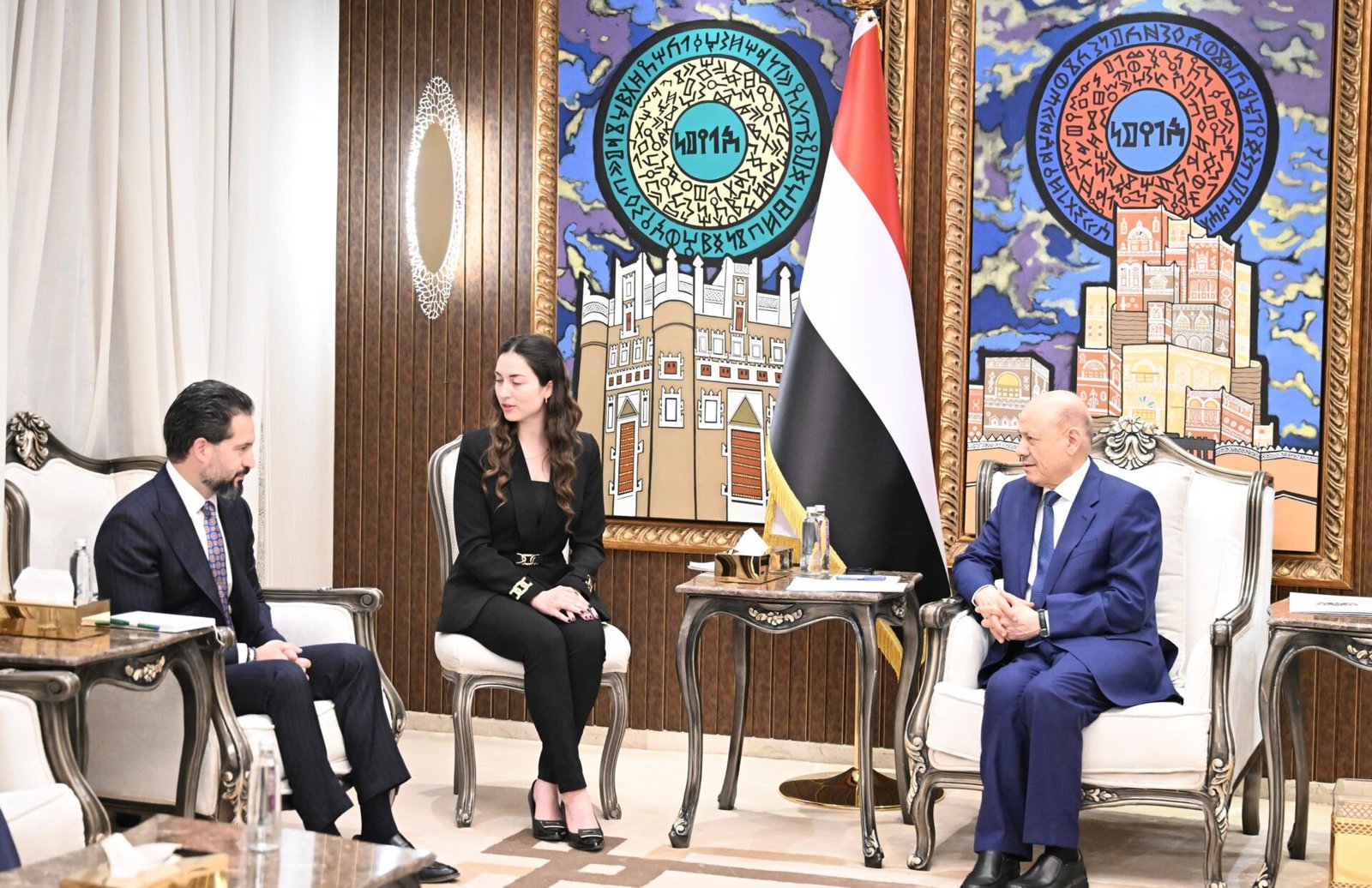
President Rashad al-Alimi, chairman of Yemen’s Presidential Leadership Council, has told a senior American diplomat that no foreign aircraft will in future be permitted to enter Yemeni airspace or land at any of the country’s airports without the prior and direct approval of the internationally recognized government. The message came during a meeting on Thursday with Jonathan Peccia, the chargé d’affaires of the United States embassy to Yemen, held in the Saudi capital Riyadh, where the Yemeni leadership is based.
The two men reviewed the latest political and security developments inside Yemen alongside regional and international issues of shared concern. Al-Alimi used the meeting to underline the importance his government attaches to its relationship with Washington, describing the United States as a central partner in protecting Yemen’s security, combating terrorism and safeguarding the maritime routes that pass the country’s shores.
Al-Alimi also thanked the international community for what he called its firm stand in support of Yemeni sovereignty, pointing to the recent United Nations Security Council session at which member states criticized unauthorized Iranian flights into Yemen. Britain, the United States, France and Bahrain requested that emergency session after two Iranian aircraft arrived in the country without the government’s clearance, the first landing at Houthi-controlled Sana’a airport on July 3 and a second diverting to Hodeidah on July 13 after government forces struck the Sana’a runway to prevent it from touching down.
The government says the flights breached Yemen’s sovereignty and defied Security Council resolutions, including Resolution 2216, which underpins an arms embargo on the Houthi movement. Officials have warned that if the aircraft carried military personnel, experts or equipment for the group, the episode would amount to a further violation of the embargo. The Houthi authorities have rejected that account, describing the first flight as a civilian service carrying stranded travellers and patients. Iran denies arming the Houthis.
In his conversation with Peccia, al-Alimi drew a sharp distinction between restraint and weakness. The government’s measured response, he said, should not be misread as a surrender of sovereignty but understood as the conduct of a responsible state that acts within its rights and obligations as a member of the United Nations. Yemen, he added, remains committed to avoiding a slide into a wider military confrontation even as it insists on control of its own skies.
The president also pushed back against Houthi claims that the government has closed Sana’a airport to civilian traffic. The airport has never been shut by government decision, he said; rather, the authorities have offered legal pathways and facilities to keep it operating through Yemenia Airways, the national carrier, so that ordinary Yemenis can continue to travel. It is the Houthis, he argued, who have refused those alternatives in order to exploit the airport for political leverage.
The dispute over the airport carries real weight for civilians. Sana’a’s air link, restored on a limited basis under the truce arrangements of recent years, has been one of the few routes out of northern Yemen for medical patients and stranded families, and each interruption narrows options for a population with few to spare.
Behind the diplomatic exchanges lies a humanitarian emergency that remains among the world’s most severe. United Nations agencies estimate that more than 22 million people in Yemen need humanitarian assistance in 2026, including some 5.2 million who are internally displaced, while 18.3 million face acute food insecurity. Aid organizations have appealed for 2.16 billion US dollars this year, warning that funding shortfalls are already forcing cuts to food rations and health programmes.
Yemen’s geography magnifies the stakes. The country overlooks the Bab al-Mandab Strait, the narrow passage linking the Red Sea to the Gulf of Aden through which a substantial share of world trade and energy shipments moves. Threats to shipping from Yemeni territory in recent years have drawn international naval deployments and kept the conflict high on the agendas of governments far beyond the region, including in Washington.
For the United States, the relationship with Aden’s government combines counterterrorism cooperation, support for freedom of navigation and backing for a negotiated end to the civil war that began after the Houthis seized Sana’a in 2014. American officials have repeatedly condemned Iranian support for the group, which United Nations expert panels have documented through recovered Iranian-origin weapons and components, and have coupled that pressure with calls for de-escalation.
Al-Alimi signalled that his government intends to keep working through international institutions rather than seek escalation. He has called for the Iranian flights to be investigated through established UN channels, including the Security Council’s panel of experts, so that responsibility can be fixed on the basis of verified evidence rather than competing claims.
The meeting with Peccia fits a wider pattern of Yemeni diplomacy in recent weeks, as the leadership has briefed ambassadors, party leaders and international organizations on what it describes as a coordinated Iranian effort to reinforce the Houthis. Whether that campaign yields firmer international action remains to be seen, but the president’s message in Riyadh was unambiguous: control of Yemen’s airspace, in his government’s view, is not negotiable, and the era of unauthorized landings is over.
About the Author