Yemen and Libya Explore Industrial and Mining Cooperation at Arab Assembly in Tripoli
 Yemen Herald News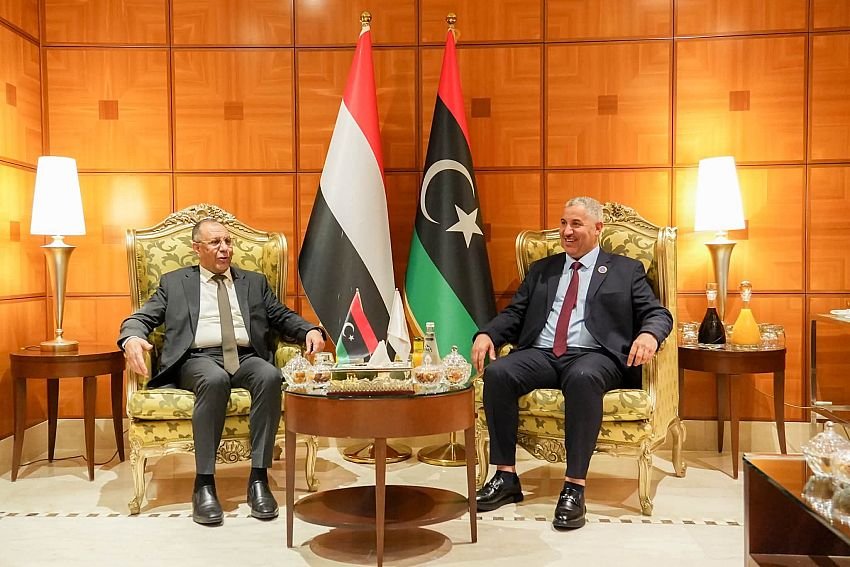
Yemen’s minister of industry and trade, Mohammed al-Ashwal, has met his Libyan counterpart, Mohammed Abdelkader, to discuss ways of deepening cooperation between the two countries in the industrial and mining sectors. The talks took place in Tripoli on the sidelines of the 29th General Assembly of the Arab Industrial Development, Standardization and Mining Organization, a pan-Arab body that promotes industrial coordination across the region.
According to Yemen’s official account of the meeting, the two ministers explored avenues for joint work in industry and mining, with both governments looking to make better use of their resources and expertise for mutual benefit. The discussion came at a moment when many states in the Middle East and North Africa are seeking closer economic ties as they navigate overlapping regional pressures.
Al-Ashwal and Abdelkader also focused on the exchange of technical knowledge and expertise, an area both sides described as important to modernising their industrial bases. Training and the development of human resources emerged as a shared priority, with the ministers underlining the need for skilled professionals capable of driving industrial progress in each country.
The two sides pointed to investment opportunities in the industrial sector as a further avenue for cooperation, expressing optimism that closer collaboration could support economic growth in both Yemen and Libya. Each faces its own set of difficulties, shaped by local conditions and wider regional dynamics, but officials suggested that pooling effort could help offset some of those challenges.
For Yemen, whose industrial base has been badly damaged by a civil war that began in 2015, the prospect of renewed industrial partnership carries particular significance. Years of conflict have left millions of people dependent on humanitarian aid and constrained access to basic services, and any expansion of industry that generated employment would mark a modest step toward economic recovery.
Libya, still working to stabilise after its own prolonged period of conflict and political division, has been keen to revive its industrial capacity. By pursuing joint projects with partners such as Yemen, Tripoli hopes to strengthen its economic position and create conditions more welcoming to foreign investment and development initiatives.
The meeting unfolded against the backdrop of a substantial regional gathering. The assembly, held in the Libyan capital from 14 to 16 July under the patronage of Prime Minister Abdul Hamid Dbeibeh, brought together Arab industry ministers and heads of delegation to review the organisation’s work programme and its budget for 2027 and 2028.
Delegates at the session considered a slate of 19 projects aimed at strengthening industrial integration across the Arab world, promoting sustainable development and expanding the use of artificial intelligence in industry and mining. The assembly also marked the official launch of an Arab Industrial Indicators Platform intended to improve data-sharing among member states.
Yemen’s participation in the assembly, and al-Ashwal’s bilateral talks alongside it, signalled the government’s interest in remaining engaged in regional economic forums despite the constraints imposed by the war. Attendance at such meetings allows officials from the internationally recognised government to pursue practical cooperation and maintain diplomatic visibility on the Arab stage.
Both ministers framed industrial cooperation as carrying benefits beyond economics. In a region marked by shifting alliances and rivalries, they suggested, stronger bilateral ties could offer a measure of resilience against external pressures. Yemen’s position near the Bab al-Mandab Strait, a strategic maritime chokepoint, adds a further dimension to how its partnerships are viewed.
The talks also fit a broader pattern across the Arab world, where governments increasingly emphasise collaboration in industry and trade rather than isolated responses to shared crises. By combining resources and know-how, officials argue, countries such as Yemen and Libya can position themselves to compete more effectively in global markets and attract international interest.
Turning the discussions into concrete results, however, will depend on follow-through. Analysts note that memoranda and ministerial meetings often outpace implementation, and the two ministries will need to translate broad commitments into actionable plans. Sustained communication and monitoring of progress, both sides acknowledged, will be essential to keep any initiative on track.
The organisation hosting the assembly, one of several specialised Arab institutions promoting economic coordination, drew participation from across the region, with countries including Jordan sending delegations. That breadth underscored the extent to which industrial policy has become a vehicle for cooperation among Arab states, and provided a ready setting for the kind of bilateral outreach that Yemen and Libya pursued on its margins.
For the Yemeni ministry, engagement of this kind is as much about the long game as immediate gains. Rebuilding the country’s manufacturing and mining capacity will require investment, expertise and stable institutions that remain in short supply, and forums such as the Tripoli assembly offer a channel to build the relationships and technical partnerships that any recovery would depend on. The newly launched indicators platform, officials suggested, could over time help member states benchmark their industries and identify areas ripe for joint ventures.
For now, the outlook remains cautiously optimistic. If Yemen and Libya can manage the obstacles ahead, officials suggested, both stand to gain from advances in their industrial sectors that could feed into wider economic development. The commitment shown in Tripoli, at the least, points to a willingness on both sides to keep the conversation going.
About the Author