Japan Signs $1.9 Million Grant With WFP to Deliver Emergency Food Aid to 700,000 People in Yemen
 Yemen Herald News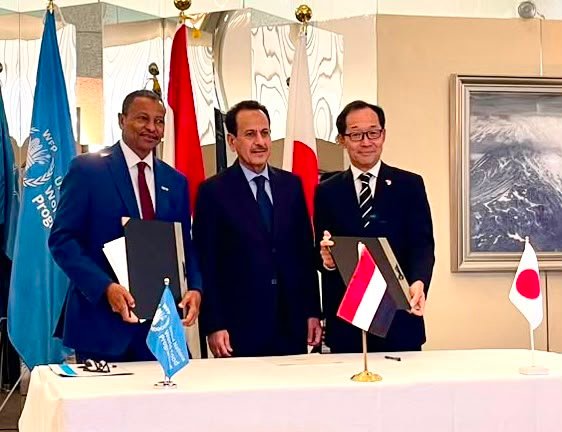
Japan has signed a $1.9 million grant agreement with the World Food Programme to strengthen food security in Yemen, with the funding expected to provide emergency food assistance to nearly 700,000 vulnerable people across the country. The agreement was formalized in Riyadh this week at a moment when aid agencies are warning that shrinking budgets and rising needs have left millions of Yemenis with less support than at almost any point since the war began.
The grant will pay for the distribution of more than 700 metric tons of vegetable oil to families experiencing emergency levels of food insecurity. WFP Yemen Country Director Al Khadir Daloum said the contribution comes at a critical time, noting that millions of Yemenis continue to struggle with rising food prices, falling incomes and a steady decline in humanitarian assistance as donor funding tightens worldwide.
Japanese Ambassador to Yemen Yoichi Nakashima and Daloum signed the agreement in the presence of Yemen’s Chargé d’Affaires in Saudi Arabia, Jamal Awadh. The signing took place in the Saudi capital, where much of Yemen’s internationally recognized government and its diplomatic corps has operated during the conflict, and it underscored the three-way coordination between Tokyo, the United Nations agency and the Yemeni authorities that has characterized Japanese aid to the country.
Speaking on behalf of the Yemeni government, Awadh thanked Japan for its continued humanitarian support and described the grant as a reflection of the longstanding partnership between the two countries. He said the contribution demonstrates Japan’s commitment to supporting the Presidential Leadership Council, the government and the Yemeni people, and noted that it builds on years of sustained Japanese assistance delivered through both emergency relief and the long-term technical cooperation provided by the Japan International Cooperation Agency, known as JICA.
For his part, Nakashima reaffirmed Tokyo’s commitment to helping Yemen confront its humanitarian challenges and said Japan will keep supporting efforts to deliver food assistance to the country’s most vulnerable communities. He observed that years of conflict, economic decline and climate-related pressures have sharply increased humanitarian needs, particularly in food security and nutrition.
The new funding lands in the middle of one of the world’s most severe humanitarian emergencies. United Nations agencies estimate that more than 22 million people in Yemen, over two-thirds of the population, require some form of humanitarian assistance in 2026, including some 5.2 million people displaced from their homes. The war, which escalated in 2015, has shattered the economy, degraded public services and left much of the country’s infrastructure in disrepair.
The phrase used by aid agencies, emergency levels of food insecurity, is not rhetorical. On the classification scale employed by humanitarian organizations it describes households facing large gaps in food consumption, very high rates of acute malnutrition or rising mortality, one step short of famine. Families in that category are the intended recipients of the vegetable oil funded by the Japanese grant. Assessments by United Nations agencies and their partners have repeatedly placed large numbers of Yemenis in that emergency category, concentrated in districts where incomes have collapsed and aid pipelines are thinnest.
Vegetable oil may seem a modest commodity, but it is a core component of the standard WFP food basket, alongside wheat flour, pulses, salt and sugar. Because it is calorie-dense and essential for everyday cooking, oil shortages hit poor households quickly, forcing families to cut back on meals or fall deeper into debt to cover basic needs.
The World Food Programme has repeatedly warned in recent years that funding shortfalls have forced it to reduce rations and narrow the number of people it can serve in Yemen, prioritizing those in the most acute need. Contributions such as Japan’s allow the agency to keep commodities moving through its supply pipeline while it appeals for broader donor support.
Yemen’s vulnerability is compounded by its dependence on imports, which by most estimates account for around 90 percent of the country’s staple food supply. Currency depreciation in government-held areas has eroded household purchasing power, while insecurity along Red Sea shipping lanes has at times raised the cost and complexity of moving goods into Yemeni ports. Aid officials note that even when food is available in local markets, many families simply cannot afford it.
Japan has been a consistent donor to humanitarian operations in Yemen throughout the conflict, channeling support through United Nations agencies for emergency food assistance, nutrition programs and longer-term development work. Officials on both sides presented the latest grant as a continuation of that record rather than a one-off gesture. In 2025, Tokyo provided a separate $2 million contribution to help the agency prevent worsening hunger in Yemen, one in a series of annual grants supporting its emergency operation in the country.
The stakes of sustained assistance are stark. UN agencies have long warned that malnutrition rates among Yemeni children are among the highest in the world, and that any interruption in aid deliveries risks pushing already fragile communities closer to catastrophic hunger.
Looking ahead, humanitarian officials say the outlook for food security in Yemen depends on predictable, sustained international funding and on effective coordination among donors, UN agencies and local authorities. Japan’s contribution will not close the funding gap on its own, but aid workers hope it will encourage other governments to follow suit at a time when competing global crises have stretched humanitarian budgets thin.
About the Author