
Yemen’s Cabinet Steps Up State Readiness and Approves 2027-2029 Development Plan Committee
 Yemen Herald News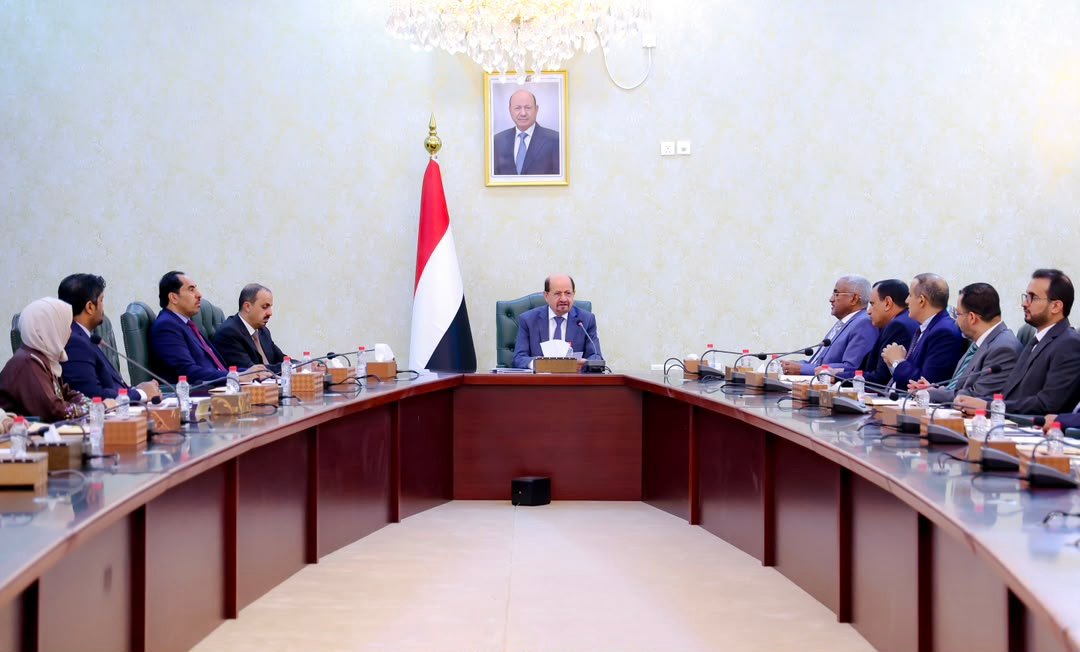
Yemen’s cabinet met in Aden on Sunday under Prime Minister and Foreign Minister Dr. Shaya Mohsin al-Zindani to review the state’s response to what the government describes as Iranian violations of national sovereignty, taking stock of the measures adopted across the political, military, security, diplomatic, economic and media tracks in coordination with the Presidential Leadership Council.
The session, reported by the state news agency Saba, focused on the operational readiness of state institutions at a moment of exceptional tension. Ministers reviewed the executive steps taken to ensure a rapid response to a range of scenarios, unify government performance, safeguard national sovereignty, preserve security and stability, and keep essential public services flowing to citizens.
Al-Zindani said the government was addressing the situation with the responsibility and discipline of a sovereign state rather than reacting emotionally. He set out its foremost priorities: protecting Yemen’s sovereignty, safeguarding the interests of its citizens, and preventing the Houthi movement and its backers from exploiting the population’s suffering for political gain or imposing faits accomplis that erode the authority of the state.
The prime minister directed all ministries, government institutions and local authorities to intensify their efforts and tighten coordination with the military, security and intelligence agencies. He called for the protection of strategic facilities, ports and sovereign border crossings, continued action against terrorism, smuggling and corruption, and sustained improvement of essential services in order to strengthen citizens’ confidence in state institutions.
Economic protections featured prominently. Al-Zindani ordered the authorities to enforce strict market oversight to prevent anyone from exploiting the exceptional circumstances through price increases, hoarding of goods or other practices that damage household livelihoods. The government’s responsibility, he said, extends beyond defending sovereignty to protecting people’s daily lives and reinforcing public trust in the institutions that serve them.
Addressing the international community, the prime minister argued that protecting Yemen’s sovereignty is not solely a Yemeni concern but a shared responsibility tied directly to regional security and respect for international law. He warned that leniency toward Iranian violations, or toward Houthi attempts to impose facts on the ground, would invite further escalation rather than advance peace.
The meeting caps one of the most volatile weeks in Yemen’s skies in years. On July 13, the armed forces said they struck the runway of Sanaa International Airport to prevent an Iranian passenger aircraft carrying a senior Houthi delegation from landing in the Houthi-held capital without state authorization. The government briefly closed every airport under its control that day before reopening them, and its civil aviation authority has since reiterated that all operators must obtain prior permission before entering Yemeni airspace.
In an extraordinary session convened as the crisis broke, the cabinet had already decided to remain in continuous session and approved the formation of a governmental crisis management team charged with coordinating military, political, diplomatic, legal and media efforts, monitoring developments and submitting periodic reports. Sunday’s meeting reviewed the work of that machinery.
The cabinet restated its welcome for humanitarian initiatives that ease the suffering of Yemenis, including the plan Jordan announced on July 17 under which Royal Jordanian Airlines is to resume regular commercial flights between Amman and Sanaa. At the same time, ministers insisted that the state holds exclusive authority over the management of Yemen’s airspace and airports, and that humanitarian considerations must not become a pretext for bypassing the country’s legitimate institutions.
The cabinet again held what it called the Iranian-backed Houthi militias fully responsible for the continued escalation, for obstructing peace efforts and humanitarian initiatives, and for diverting state resources in support of their takeover, and it urged the group to put the interests of the Yemeni people first and abandon policies of escalation and coercion. The Houthis, who seized Sanaa in late 2014, prompting a Saudi-led coalition intervention the following year, reject the government’s characterization and have blamed Saudi Arabia for the strike on the airport runway.
The session also unfolded against intensive diplomacy. President Rashad al-Alimi, chairman of the Presidential Leadership Council, received United Nations Special Envoy Hans Grundberg on Saturday for talks on reviving the stalled peace process, and the envoy has urged all parties to avoid a new cycle of violence and return to dialogue under United Nations auspices.
The stakes for civilians are considerable. More than 18 million people in Yemen need humanitarian assistance and some 4.5 million remain internally displaced, according to United Nations estimates, while a long-running currency crisis in government-held areas keeps pressure on prices and public salaries. Aid agencies have warned that renewed escalation would deepen the suffering of civilians on every side of the front lines.
Beyond crisis management, the cabinet took a step toward longer-term planning by approving the formation of the Supreme Supervisory Committee for the Preparation of the 2027-2029 Economic and Social Development Plan. The committee will be chaired by the prime minister and will include several ministers, the governor of the Central Bank of Yemen, and representatives of the private sector and civil society organizations, based on a proposal submitted by the Minister of Planning and International Cooperation.
That pairing of emergency readiness with a three-year development framework captures the balance the government in Aden is trying to strike: confronting an immediate challenge to its authority over Yemen’s skies while signaling that it still intends to plan for recovery and reconstruction. Its room to do both will depend largely on how the confrontation is resolved.
About the Author




