
President al-Alimi and UN Envoy Grundberg Discuss Reviving Yemen’s Stalled Peace Process
 Yemen Herald News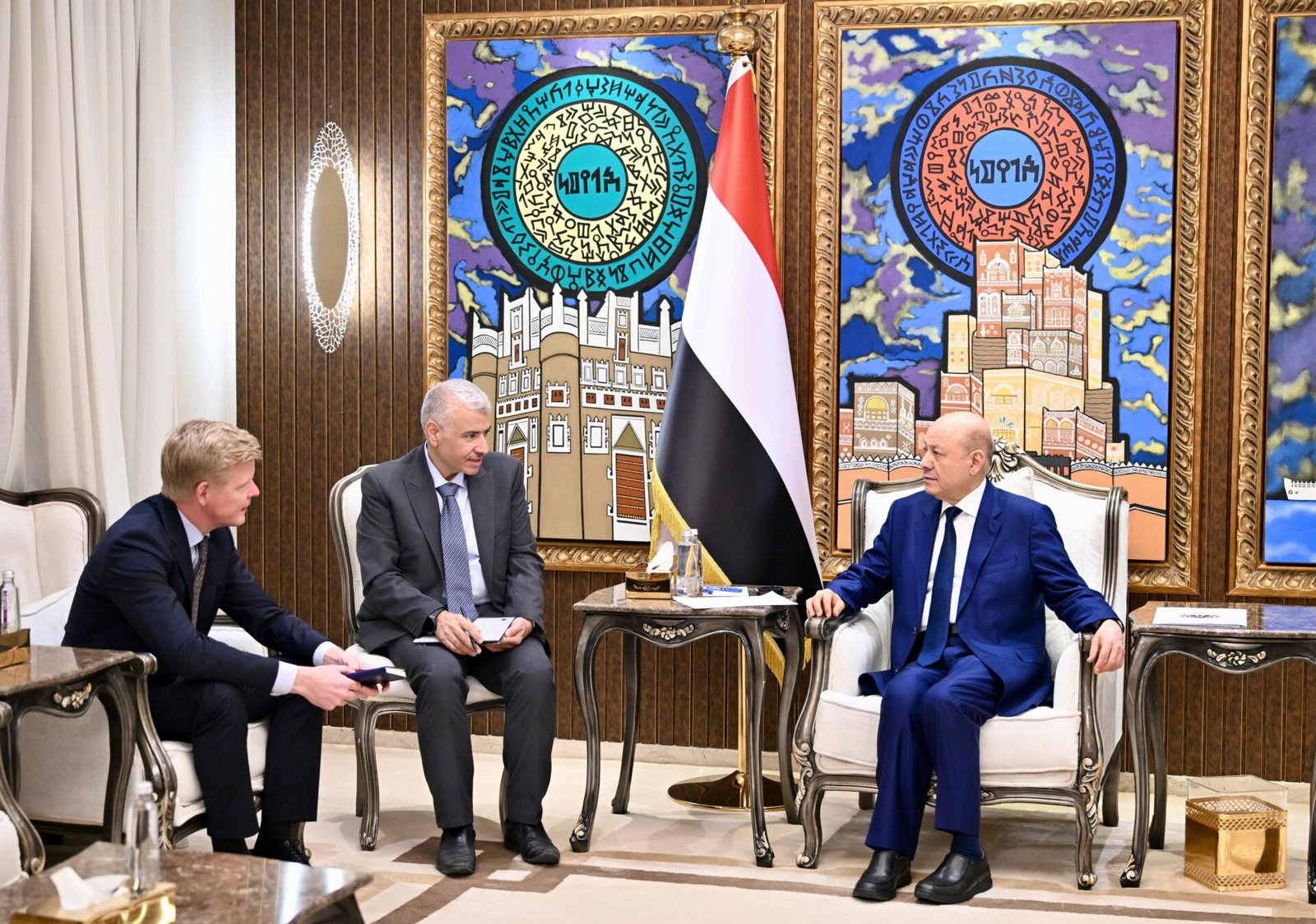
President Rashad al-Alimi, chairman of Yemen’s Presidential Leadership Council, met on Saturday with Hans Grundberg, the United Nations Special Envoy for Yemen, for talks focused on reviving a peace process that has been stalled for months. The envoy briefed the president on the outcomes of his recent consultations with the parties and on his coordination with the international community aimed at restoring momentum toward a political settlement of the decade-long conflict.
Al-Alimi praised the envoy’s continuing commitment to fostering calm and building the foundations for peace in Yemen, and he reaffirmed the government’s full support for the United Nations effort. At the same time, he voiced frustration at what he described as a consistent pattern of Houthi obstruction, saying the militia evades its obligations whenever the international community comes to believe that progress is within reach.
In the president’s assessment, these maneuvers are not tactical accidents. He argued that the Houthi movement’s conduct reveals its alignment with Iran’s broader regional agenda, a linkage that, he said, complicates every attempt to stabilize Yemen and turns domestic negotiations into an extension of a wider geopolitical contest.
Al-Alimi also addressed the crisis that unfolded in Yemen’s skies in the preceding week, when the armed forces said they struck the runway of Sanaa International Airport to prevent an Iranian aircraft carrying a senior Houthi delegation from landing without the state’s authorization, and the government briefly closed the airports under its control. The president insisted the latest tensions were never about Sanaa Airport or what he called an alleged blockade. The real issue, he said, is the violation of Yemen’s sovereignty and the attempt to impose Iranian influence outside the authority of the state.
He went further, characterizing the militia’s narratives and threats as blatant extortion designed to drag the country deeper into humanitarian catastrophe. Yemen’s crisis is already among the world’s most severe: according to United Nations estimates, more than 18 million people need humanitarian assistance and some 4.5 million remain internally displaced.
Turning to the economy, al-Alimi recalled the Houthi drone attacks on oil export facilities in Hadramout and Shabwa, which halted crude exports from government-held areas and stripped the state of its most important source of revenue. Those attacks, he said, were intended to prevent residents of the liberated provinces from achieving better living conditions, and he drew a parallel with what he described as Iran’s long-standing effort to undermine prosperity across the region. The loss of oil income has fed a currency crisis and made it harder for the government to pay salaries and keep basic services running.
On the shape of any future settlement, the president set out clear conditions. A durable peace, he argued, must rest on the sovereign authority of the Yemeni state: no group can be permitted to challenge the government’s exclusive authority, to retain weapons outside official state institutions, or to claim political, religious or tribal rights that stand above the will of citizens and the rule of law. Dr. Yahya Al-Shaibi, director of the Presidency Office, also attended the talks between the two men.
The meeting forms part of a broader push by the UN envoy to prevent the current escalation from burying what remains of the political track. Grundberg has continued his shuttle diplomacy across the region, and in recent days he called for de-escalation and a resumption of negotiations, warning against a slide into a new cycle of violence. He also welcomed a Jordanian initiative, announced on July 17, to resume regular commercial flights between Amman and Sanaa, describing it as a positive step toward expanding civilian air travel for Yemenis. His office has repeatedly urged the parties to return to dialogue under United Nations auspices, arguing that the alternative is a return to open warfare that would deepen the suffering of civilians on every side of the front lines.
The UN Security Council has echoed that concern. In its July briefing on Yemen, council members called for the relaunch of an inclusive political process and warned that heightened violence threatens the hard-won gains of recent years, including the sharp reduction in front-line fighting that followed the truce first brokered in 2022.
The diplomatic backdrop remains difficult. In late 2023 the parties publicly committed to a UN roadmap envisaging a nationwide ceasefire, measures to ease living conditions and the resumption of an inclusive political process. That roadmap was never implemented, as regional escalation, attacks on shipping in the Red Sea and mutual distrust pushed the file down the international agenda. Diplomats have since searched for a way to revive its core elements under changed circumstances.
The current regional environment complicates the task further. The confrontation between Iran and the United States, and the recent Iranian strikes on Gulf states condemned by Yemen’s government, have sharpened the polarization around the Yemeni file at precisely the moment the United Nations is trying to insulate the peace process from regional shocks.
What happens next will depend in large part on whether the parties can be brought back to the table at all. The government has framed its position around the restoration of state authority, while the United Nations continues to argue that only an inclusive political process can end the war sustainably. For millions of Yemenis living through a twelfth year of crisis, the distance between those positions, and the will to close it, remains the decisive question.
About the Author




