
Yemen’s Agriculture Minister Presses CARE International to Fund Climate-Smart Farming Projects
 Yemen Herald News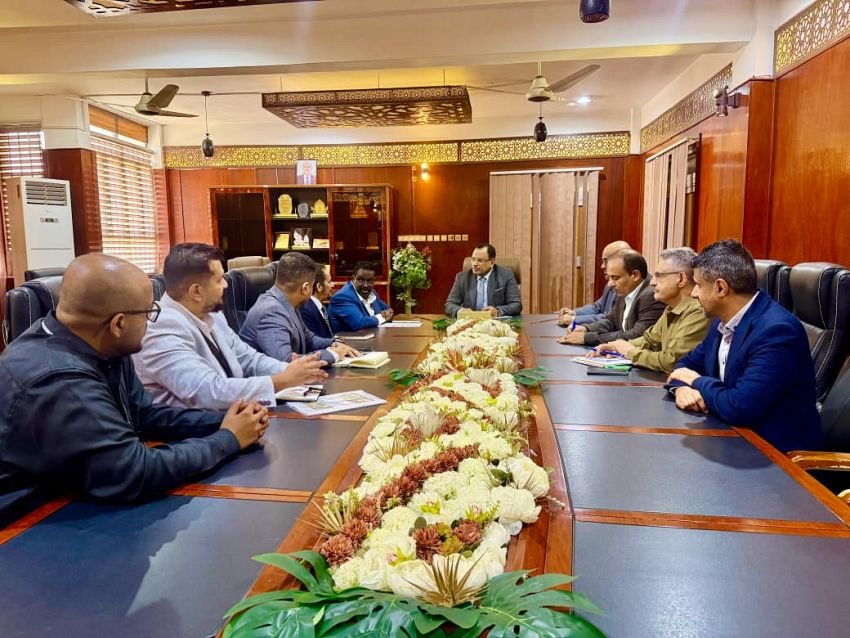
Yemen’s Minister of Agriculture, Irrigation and Fisheries, Salem Abdullah Issa al-Soqotri, met a delegation from CARE International in the interim capital Aden to discuss strategic projects in the farming and fishing sectors, the state news agency Saba reported. The talks covered support for food security, water resources management and adaptation to climate change — three pressures that have converged on Yemen after more than a decade of war and that now shape almost every conversation between the government and its international partners.
Al-Soqotri used the meeting to argue for a change of approach. He told the delegation that the current phase requires a shift away from humanitarian relief and emergency response programmes and towards sustainable development projects, and he set out an agenda built on climate-smart agriculture, integrated water resources management, modern irrigation systems, rainwater harvesting and soil conservation. Each of those elements addresses a specific weakness in Yemeni agriculture: erratic rainfall, inefficient flood irrigation, degraded terraces and the steady loss of topsoil on slopes that farmers have cultivated for centuries.
The distinction the minister drew is not merely rhetorical. Emergency assistance keeps families alive but does little to restore the productive capacity that once fed them, and a food basket delivered to a rural household does not repair the irrigation channel or the cold store that would allow that household to feed itself.
The minister said his ministry is working to defined strategies and plans that identify development priorities for the sector, and he urged international partners and organisations to align their interventions with those priorities so that results can be measured.
Financing dominated much of the discussion. Al-Soqotri highlighted the opportunities offered by the Green Climate Fund, the largest dedicated climate finance mechanism established under the United Nations Framework Convention on Climate Change, which channels money to developing countries for both adaptation and emissions reduction. He said such financing is essential to support climate adaptation projects, protect natural resources and improve the sustainability of agricultural and fisheries production.
Reaching that money is itself a technical challenge. Green Climate Fund proposals must be submitted through accredited entities and require detailed evidence of climate rationale, feasibility and safeguards, a standard that is demanding for any government and particularly so for one whose institutions have been strained by conflict. That is the gap the CARE International delegation addressed when it presented an overview of the organisation’s main programmes and future plans in Yemen, including the development of a Project Preparation Facility initiative designed to connect emergency assistance with longer-term recovery.
According to the account of the meeting, CARE said it intends to prepare project proposals for the Green Climate Fund in cooperation with Yemeni government institutions and international partners, aimed at strengthening climate adaptation, protecting vulnerable coastal areas and supporting agricultural and fisheries activity. Building a pipeline of fundable projects is unglamorous work, but without it climate finance rarely reaches the countries that need it most.
The stakes in the fisheries sector are considerable. Yemen has a long coastline on the Red Sea, the Gulf of Aden and the Arabian Sea, and artisanal fishing has traditionally supported coastal communities in governorates including Hadramawt, Shabwah, Abyan and al-Hudaydah, as well as on Socotra. Landing sites, ice plants and boats were damaged during the war, and warming and more acidic seas add a further layer of risk to catches that families depend on for both food and income.
Water scarcity is the deeper constraint on the farming side. Yemen is among the most water-scarce countries in the world, agriculture accounts for the great majority of the water it consumes, and groundwater in several basins has been drawn down faster than rainfall can replace it. Efficient irrigation, rainwater harvesting and the rehabilitation of traditional terrace systems are therefore not optional refinements but the difference between land that remains cultivable and land that does not.
The humanitarian backdrop explains the urgency. According to the United Nations 2026 Humanitarian Needs and Response Plan, more than 22 million people in Yemen require humanitarian assistance and protection this year, including 5.2 million internally displaced people. Some 18.3 million Yemenis are acutely food insecure and more than 2.2 million children under the age of five are acutely malnourished. Aid agencies launched an appeal in March seeking 2.16 billion dollars to reach 12 million of the most vulnerable, and funding has consistently lagged behind requirements.
Yemen’s war has deep roots. The Houthi movement seized the capital, Sanaa, in late 2014, and a Saudi-led coalition intervened in March 2015 in support of the internationally recognised government. The fighting has split the country between rival administrations, fractured public institutions from the central bank to the customs service, and left the rial worth a fraction of its pre-war value. For farmers and fishers, that has meant costlier fuel and inputs alongside markets too poor to pay much for what they produce.
Whether the Aden meeting produces results will depend on funding decisions taken far from Yemen, and on whether access and security allow projects to be implemented once approved. Neither can be assumed. What the discussion does signal is a government trying to move the conversation with its partners beyond survival, towards the harder question of how a country still at war begins rebuilding the sectors that most of its people rely on to live.
About the Author




