Kuwait Condemns Houthi Strike on Saudi Tanker Encelia and Backs Riyadh on Red Sea Security
 Yemen Herald News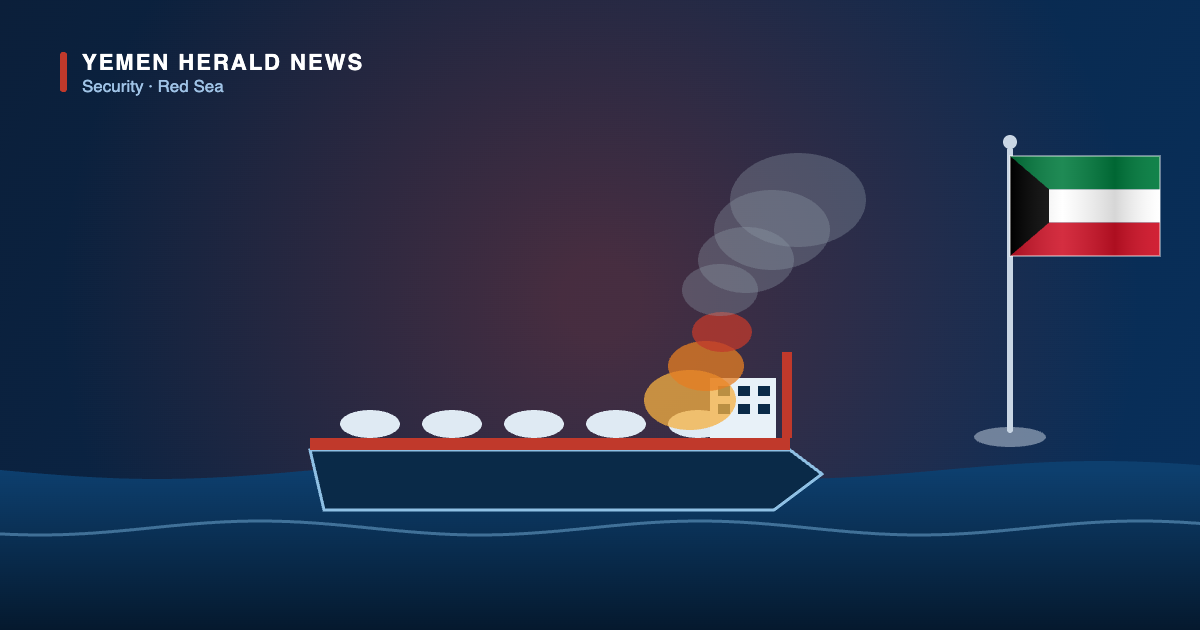
Kuwait has condemned a Houthi attack on a Saudi-flagged tanker in the Red Sea, describing the strike as a flagrant violation of international law and a direct threat to maritime security, freedom of navigation and the movement of global energy supplies. The statement from Kuwait’s Ministry of Foreign Affairs placed the country alongside a widening group of Gulf and Arab governments that have publicly criticised the Yemeni movement’s decision to extend its campaign from the battlefield to commercial shipping off Saudi Arabia’s western coast.
The vessel at the centre of the case is the Encelia, a Saudi-flagged product tanker that had sailed from the Red Sea port of Yanbu on 20 July 2026. The ship’s master reported that it had been hit by a projectile roughly 70 nautical miles south-west of Al Shuqaiq, starting a fire near the bow. The blaze was brought under control, the crew was reported unharmed, and no casualties or pollution were recorded. A second Saudi tanker, the Layla, was named in the same claim of responsibility.
Houthi military spokesman Yahya Saree said the group had targeted both ships with ballistic and cruise missiles as well as drones, arguing that they had violated a blockade order issued by the movement’s armed forces. Days earlier the Houthis’ Humanitarian Operations Coordination Centre had emailed shipping companies to say that vessels were banned from loading or discharging cargo at Saudi ports, and warned that ships ignoring the instruction could be targeted anywhere within reach of Yemeni forces.
In its statement, Kuwait affirmed what it called full solidarity with Saudi Arabia and voiced support for the measures the kingdom takes to safeguard its sovereignty, security and interests. The ministry also rejected any practice that undermines the security and stability of the region, wording Gulf capitals have used repeatedly since the Houthis began striking shipping. Kuwait framed the incident less as a bilateral grievance than as an assault on a shared interest, arguing that the safety of trade through the Red Sea underpins the economies of every state along its shores.
Kuwait was not alone. Bahrain issued a parallel condemnation, while the United Arab Emirates and Qatar also denounced the attack on the Encelia and called for stronger protection of international shipping lanes. The unusually broad response reflects how quickly the Yemen conflict has moved from a largely land-based war into a maritime one, and how directly that shift touches states whose export revenues depend on uninterrupted sea traffic.
Geography explains much of the alarm. The Bab al-Mandab strait, at the southern mouth of the Red Sea, is one of a handful of chokepoints through which a large share of seaborne crude and container traffic passes on its way to the Suez Canal and Europe. Ships that avoid it must instead sail around the Cape of Good Hope, adding roughly two weeks and substantial fuel costs to a voyage between the Gulf and northern Europe. With the Strait of Hormuz already disrupted by the wider confrontation between the United States and Iran, pressure on a second chokepoint compounds an already difficult picture for shipowners.
The market reaction has been visible. Brent crude moved above 100 dollars a barrel on 23 July as traders absorbed news of the tanker attacks, and war-risk insurance premiums for voyages through the southern Red Sea have climbed sharply. Owners now face a choice between higher premiums and longer routes, and both feed through to freight rates and, in time, to consumer prices well beyond the Middle East.
Saudi Arabia answered militarily. Houthi officials said airstrikes hit targets in and around the Houthi-held port city of Hodeidah on Yemen’s Red Sea coast, in what Riyadh presented as action against the infrastructure used to launch attacks on shipping. Hodeidah is also the principal entry point for imported food and fuel serving northern Yemen, which is why strikes there draw immediate warnings from humanitarian agencies.
Those warnings rest on a grim baseline. United Nations agencies estimate that more than 18 million Yemenis need some form of humanitarian assistance after more than a decade of war, with millions displaced from their homes and recurring outbreaks of cholera and measles straining a health system that has never recovered. Almost all of the country’s food, medicine and fuel arrives by sea, so any measure that raises the cost or the risk of calling at Yemeni ports is felt quickly by civilians.
Kuwait’s statement stopped short of proposing a mechanism, calling instead for concerted international efforts to protect navigation. That reflects the limits of the options currently available. United Nations-brokered talks between the internationally recognised Yemeni government and the Houthis have been stalled, and the movement has tied its maritime campaign to the wider regional confrontation rather than to any Yemeni negotiating file. Until that link is broken, the pattern of attack, condemnation and retaliation looks likely to continue, with the shipping industry absorbing the cost.
Kuwait’s own recent experience gives the statement added weight. Earlier in July, Iranian missile and drone salvoes aimed at United States military facilities across the Gulf struck several of Washington’s regional partners, and a Kuwaiti power plant was among the sites reported damaged. Having absorbed the consequences of a confrontation it did not choose, Kuwait City has been consistent in arguing that attacks on civilian and commercial infrastructure, whoever launches them, carry costs that spread far beyond the intended target.
About the Author