Houthis Say They Launched a Second Missile Operation Against Israel a Day After Entering the Iran War
 Yemen Herald News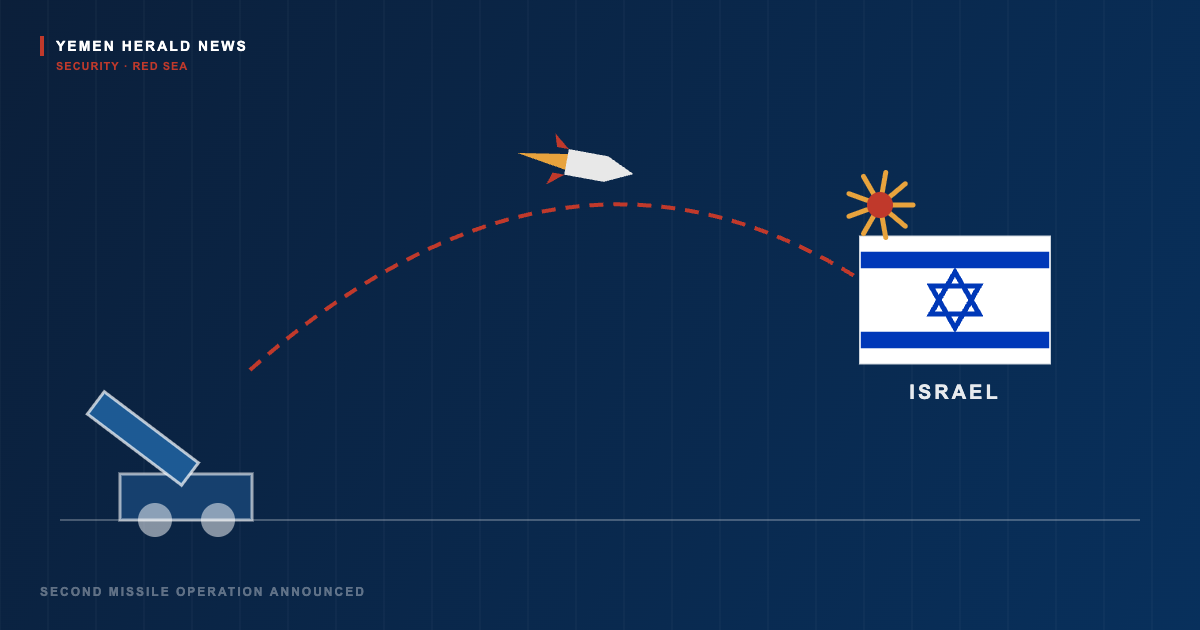
Yemen’s Houthi movement said it had carried out a second military operation against Israel on 29 March 2026, a day after the group formally entered the war between Iran and the United States and Israel. The group’s military spokesman, Brigadier General Yahya Saree, said the operation involved a barrage of cruise missiles and drones directed at what he described as vital and military sites in southern occupied Palestine, and he claimed the launches had successfully achieved their objectives. Israeli officials said a missile fired from Yemen was intercepted and reported no casualties and no damage.
The launch came roughly twenty-four hours after the Houthis announced their first operation of the conflict, which the group said used a batch of ballistic missiles against sensitive Israeli military targets. That first attack, on 28 March, fell on the twenty-ninth day of the wider campaign and marked the movement’s entry into a war that had until then been fought primarily between Iran, Israel and the United States. A third operation followed on 1 April, which Saree said had been coordinated with Iran and with Hezbollah in Lebanon.
Saree framed the second operation as part of what he called the Holy Jihad Battle and said it had been timed to coincide with military action by allied groups. The Houthis have consistently presented their strikes as support for the Palestinians and as retaliation for Israeli and American operations in the region, and the group vowed to continue its attacks until its stated objectives were met. These are the movement’s own characterisations of its actions and its motives, and they are contested by Israel, the United States and Yemen’s internationally recognised government.
The Houthis are widely described by Western and regional governments as an Iranian proxy, and the group’s alignment with Tehran is central to how Israel and the United States read its behaviour. The Houthis themselves reject the label of proxy while acknowledging their alliance with Iran and with other groups in what Tehran calls the axis of resistance. Israeli officials have argued that the movement’s entry into the war reflected Iranian direction at a moment when Tehran was under pressure on several fronts rather than an independent Houthi decision.
The wider campaign began on 28 February 2026, when the United States and Israel opened strikes against Iran under the American code name Operation Epic Fury, targeting nuclear facilities, military infrastructure and leadership. The Houthi launches from Yemen opened what amounted to a southern front, adding a third axis to Iranian strikes from the east and Hezbollah activity to Israel’s north. The group also carried out strikes on Saudi Arabia during the conflict, extending the confrontation to the Gulf.
For Israel, the Yemeni launches were militarily manageable but strategically awkward. The distance involved means missiles from Yemen have a long flight time, giving Israeli air defences considerable warning, and the great majority of launches over the course of the Houthi campaign have been intercepted. The cost is measured instead in disruption: sirens across wide areas, populations moved to shelters, and the diversion of air defence attention and munitions at a time when Israel was engaged on multiple fronts.
The Houthis had attacked Israel and international shipping repeatedly between 2023 and 2025 before pausing after the ceasefire that ended the Gaza war, and Israel struck targets in Yemen several times during that period, including in Sanaa in August 2025. The March 2026 launches therefore represented a resumption of an established pattern rather than something new, which is part of why Israeli officials publicly played down their significance while making clear that they intended to respond at a time and in a manner of their choosing.
The trajectory of the Houthi campaign since then has shifted from missiles aimed at Israel towards pressure on maritime trade. By July 2026 the group had returned to attacking shipping in the Red Sea and had threatened to blockade the Bab al-Mandeb strait, the southern gateway to the Suez route and a corridor that carries a significant share of global seaborne trade. The threat of simultaneous disruption to Gulf and Red Sea export routes contributed to oil trading above 100 dollars a barrel. During earlier phases of the Houthi campaign against shipping, many operators rerouted vessels around the Cape of Good Hope, adding time and expense to voyages between Asia and Europe.
Efforts to end the conflict have so far failed to hold. Mediators announced a memorandum of understanding on 14 June intended to bring the war to a formal conclusion within sixty days, but the arrangement broke down after renewed fighting. The United States paused new strikes on Iran in late July, with President Donald Trump saying the pause followed a request from the Iranian government, while Tehran said it was not engaged in negotiations with Washington at that point.
For Yemen itself, the consequences of the movement’s decision to join the war fall on a country already enduring one of the world’s most severe humanitarian emergencies after a decade of internal conflict. Renewed international attention on the Houthis raises the prospect of further external strikes on Yemeni territory and of tighter restrictions on the ports and airports through which aid reaches a population heavily dependent on imported food and fuel.
About the Author