Yemen and Djibouti Foreign Ministers Discuss Red Sea Security Across the Bab al-Mandab Strait
 Yemen Herald News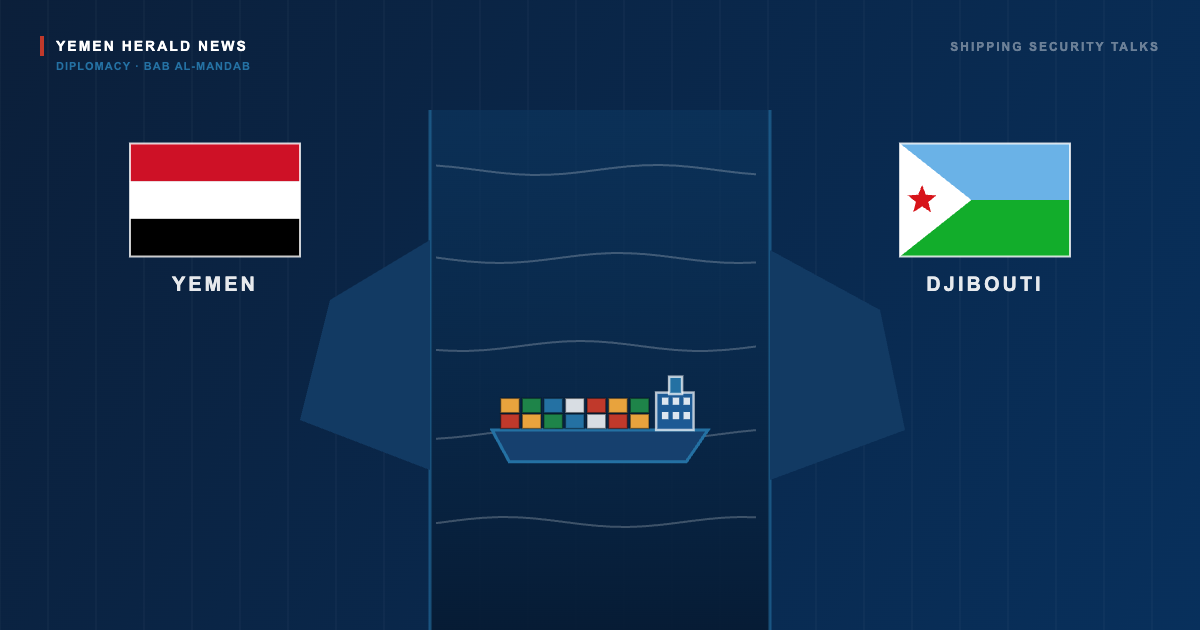
Yemen’s foreign minister, Afrah al-Zouba, spoke by telephone on Saturday with her Djiboutian counterpart, Abdoulkader Houssein Omar, in a call the two governments framed around cooperation between the states that border the Red Sea and the protection of international shipping through the corridor. It was one of a series of contacts al-Zouba has opened with regional counterparts since taking office last month.
Djibouti is Yemen’s closest neighbour across the water. The two countries face each other across the Bab al-Mandab strait, which narrows to roughly 30 kilometres at its tightest point and forms the southern gateway to the Red Sea and, beyond it, the Suez Canal. Almost every vessel moving between Asia and Europe by the short route passes within sight of both coastlines, which is why the security of the strait has become a question that neither capital can treat as somebody else’s problem.
That geography has given Djibouti an outsized role in maritime security. The country hosts foreign military installations belonging to the United States, France, Japan, China and Italy, and its ports have served as a base for the international naval operations that have escorted and monitored merchant traffic in the Gulf of Aden and the southern Red Sea. Its own economy is heavily built on port services and transshipment, so any sustained diversion of shipping away from the Red Sea is felt directly in Djiboutian revenues as well as in Egyptian ones.
The Yemeni government says the Houthi movement’s campaign against shipping is the central threat to that corridor. In remarks delivered in late July, al-Zouba argued that the group was seeking to apply to the Red Sea and Bab al-Mandab the approach Iran has taken to the Strait of Hormuz, in effect claiming leverage over two chokepoints that together carry a substantial share of world trade. The Houthis reject that description of their operations, which they present as pressure tied to the wider regional conflict rather than an attempt to control the waterway.
Neither ministry published a detailed list of outcomes from the call. The readouts describe an agreement to keep consulting on threats to regional stability and on the safety of navigation, and to look for ways to deepen bilateral ties. In practice, cooperation between the two states runs through several channels at once: coordination on maritime security and information sharing, port and logistics links across the strait, and consular work on behalf of the Yemenis who have crossed to the African shore.
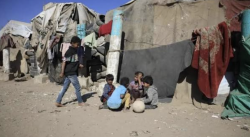
That last file sits squarely within al-Zouba’s portfolio, which covers expatriates as well as foreign affairs. Djibouti has hosted Yemeni refugees since the early stage of the war, most visibly at the Markazi camp near the northern town of Obock, and the movement of people across the strait has continued in both directions throughout the conflict, including onward migration by East Africans travelling towards the Gulf.
Omar has been Djibouti’s minister of foreign affairs and international cooperation since April 2025, when President Ismail Omar Guelleh appointed him to succeed Mahamoud Ali Youssouf, who left the post after being elected chairperson of the African Union Commission. Since then Djibouti has continued to position itself as a broker in the Horn of Africa and as a partner to the naval coalitions operating off its coast.
Al-Zouba, for her part, took office on 23 July, becoming the first woman to serve as Yemen’s foreign minister. She had been minister of planning and international cooperation since February, and before entering government spent more than 25 years working in development and peacebuilding. She served as first deputy secretary-general of the National Dialogue Conference, the transitional body that followed the departure of former president Ali Abdullah Saleh and began work on a new constitution. She originally trained as a pharmacist in Sanaa and later took degrees in business administration and health economics.
Her early diplomacy has concentrated on the maritime file. Over the same weekend she also spoke with Egypt’s foreign minister, Badr Abdelatty, offering Yemen’s solidarity after a drone attack on shipping at the Egyptian port of Damietta and pressing the same argument about the vulnerability of the corridor. The pattern suggests a deliberate effort to build a shared position among the states along the Red Sea rather than to treat the Houthi campaign as a purely Yemeni security matter.
Whether that translates into concrete arrangements is a separate question. Djibouti has generally avoided taking a public side in Yemen’s internal conflict, preferring to protect its relationships across the region and its standing as a neutral logistics hub. Cooperation on navigation and on humanitarian access is easier ground for both governments than any alignment on the political settlement inside Yemen, where the internationally recognised government and the Houthi authorities remain far apart.
For Yemen’s government, which controls only part of the country’s territory and depends heavily on external backing, the value of such calls lies partly in the recognition they carry. Each exchange with a neighbouring foreign ministry reinforces the Presidential Leadership Council’s claim to represent the state, at a moment when the maritime crisis has pushed Yemen back towards the centre of international attention for reasons that have little to do with the war’s internal dynamics.
About the Author