Yemen’s Women’s Affairs Minister Discusses Empowerment Cooperation With China’s Envoy
 Yemen Herald News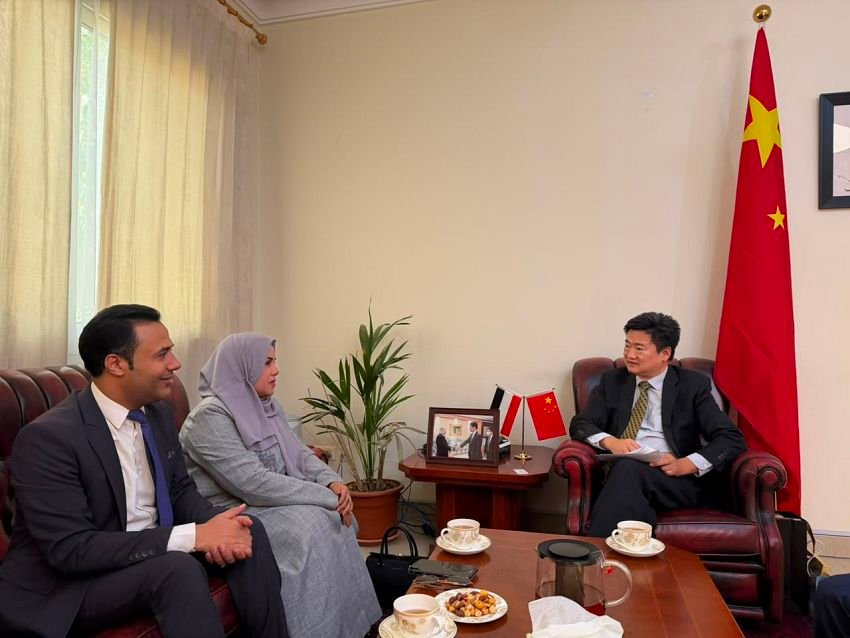
Yemen’s Minister of State for Women’s Affairs, Dr. Ahd Jaasous, has met the Chargé d’Affaires of the Chinese Embassy to Yemen, Shao Zheng, to discuss broadening cooperation on women’s empowerment, according to a readout carried by the state news agency Saba. The talks centred on increasing the participation of Yemeni women in development, public service and peacebuilding after more than a decade of war.
The portfolio Jaasous holds is among the newest in the Yemeni cabinet. She was appointed Minister of State for Women’s Affairs in the government sworn in before Presidential Leadership Council Chairman Rashad al-Alimi in the Saudi capital, Riyadh, a reshuffle that brought three women into ministerial office. The ministry has since positioned itself as the government’s main channel for engaging foreign missions on gender policy.
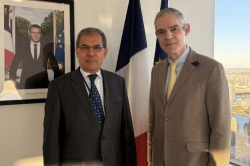
That engagement has been steady. Jaasous has held separate talks with the ambassadors of France, Italy and the United States, discussing women’s economic and political empowerment and the case for greater female representation in Yemen’s diplomatic service. She has also signed a memorandum of understanding with the PASS Foundation for Sustainable Communities on coordinating the work of Yemeni women’s institutions, arguing that fragmented efforts have diluted the impact of individual programmes. She has also called publicly for a unified national effort to advance women’s rights, urging Yemeni women’s organisations and leaders to align their agendas rather than compete for the same donors.
Shao Zheng has led China’s diplomatic mission in Yemen through a period of cautious re-engagement. Chinese diplomats returned to Aden in December 2022 after an absence of several years, and Shao has since met a succession of senior officials, among them the defence minister, the minister of information and the deputy foreign minister for political affairs. Beijing has publicly backed the internationally recognised government while maintaining contacts with the Houthis, and has opposed attacks on commercial shipping in the Red Sea.
In the meeting with Jaasous, the two sides reviewed cooperation across economic, developmental and political areas, and looked at expanding existing programmes that build the skills of Yemeni women so they can take on more active roles across a range of sectors. Saba reported that the minister pressed for a stronger partnership with Beijing, pointing to China’s own development experience as a model for designing higher-quality initiatives aimed at women.
The Chinese envoy, for his part, reaffirmed his government’s interest in deepening ties with Yemen and said cooperation on women’s issues deserved a place on the bilateral agenda, a file that often sits at the margins of humanitarian and development discussions. No specific projects, funding figures or timelines were announced, and the readout described the exchange in general terms.
The backdrop to the talks is a humanitarian emergency that has grown rather than eased. The United Nations estimates that more than 22 million people in Yemen will need humanitarian assistance and protection in 2026, among them close to 11 million women and girls. The country hosts roughly 5.2 million internally displaced people, alongside several hundred thousand migrants, refugees and asylum seekers. Some 18.3 million people are acutely food insecure, and more than 2.2 million children under five are acutely malnourished.
Funding has not kept pace. The United Nations and its partners have asked for about $2.16 billion to reach 12 million people this year, a target that has repeatedly gone unmet in previous appeals. Aid agencies have warned that shortfalls fall hardest on women and girls, who make up a disproportionate share of the displaced and who face additional barriers to reaching clinics, food distribution points and cash assistance.
Yemen’s economy has compounded the pressure. The rial has lost much of its value in government-held areas, driving up the cost of imported food and fuel and eroding household purchasing power, while public sector salaries have gone unpaid for extended periods in parts of the country. Households headed by women, which often depend on informal or irregular income, have limited buffers against shocks of that kind.
Yemeni officials argue that this is precisely why women’s participation cannot be treated as a secondary concern. Women head a growing number of displaced households and are heavily represented among community health and relief workers, yet remain thinly represented in formal decision-making. Programmes that build technical and leadership skills, the government says, would make service delivery more responsive and give development projects a firmer grounding in the needs of affected communities.
The ministry’s stated approach is to fold gender considerations into mainstream policy rather than treat them as a standalone track, placing women in governance, the judiciary, the private sector and peace negotiations rather than confining the agenda to targeted welfare schemes. That framing mirrors language used by international partners, though translating it into appointments and budget lines has proved slower than the rhetoric suggests.
Whether the exchange with Beijing translates into concrete programmes remains to be seen. China’s development footprint in Yemen is modest compared with its activity elsewhere in the region, and security conditions continue to limit what international partners can implement on the ground. For now, the meeting registers as a signal of intent, an attempt to place women’s empowerment inside a bilateral relationship that has been rebuilt slowly and mainly through political channels. Yemeni officials have said they hope future engagement moves beyond declarations towards funded training schemes with measurable targets.
About the Author