Yemen’s Ambassador in Ankara Discusses Academic Cooperation With Turkish Aeronautical University
 Yemen Herald News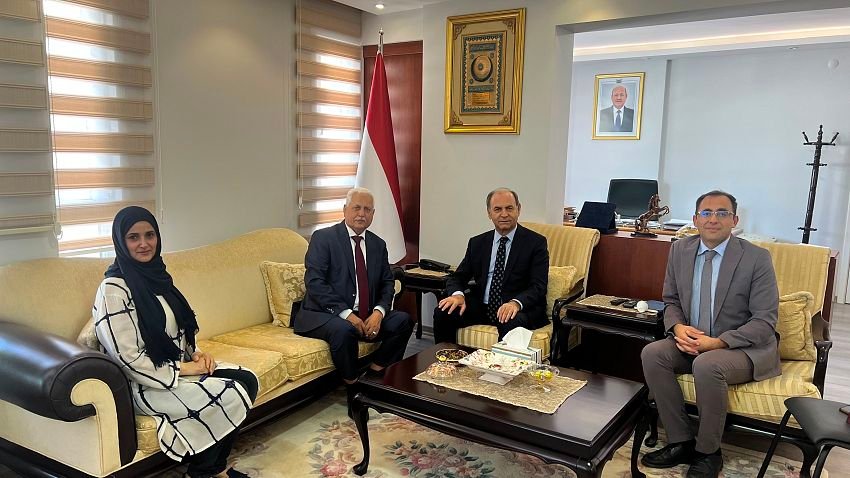
Yemen’s Ambassador to Türkiye, Mohammed Tareq, has discussed expanding scientific and academic cooperation with Prof. Dr. Rahmi Er, Rector of the University of Turkish Aeronautical Association, at a meeting in Ankara. The state news agency Saba reported that the two sides examined ways to build a partnership across education, training and scientific research, at a time when Yemen’s universities are struggling to recover from more than a decade of war.
Tareq used the meeting to review the long historical relationship between Yemen and Türkiye, which reaches back to the Ottoman presence in the southern Arabian Peninsula and has been sustained in the modern era through trade, migration and a substantial Yemeni student community in Turkish cities. He argued that those ties give the two countries a natural basis for cooperation in higher education, and pressed for practical arrangements that would open Turkish classrooms and laboratories to Yemeni students.
Much of the ambassador’s presentation focused on the condition of Yemen’s education sector. Years of fighting have damaged school and university buildings, interrupted salary payments to teaching staff and pushed many qualified academics abroad. Tareq described the need for innovative solutions to rebuild the capacity of Yemeni students, framing access to foreign universities not as a substitute for reconstruction at home but as a way to preserve a generation of graduates while the country’s own institutions are repaired.
Er, for his part, set out the range of programmes his university offers. The institution specialises in aviation and space sciences and also teaches engineering and business administration, and the rector said he was ready to conclude an academic cooperation agreement covering the exchange of knowledge and training tailored to Yemeni students. Neither side announced a timetable or a signing date, and no details were given on how many places might eventually be made available or how any scholarships would be funded.
The University of Turkish Aeronautical Association is a foundation university in Ankara established in 2011 under Law No. 6114 and backed by the Turkish Aeronautical Association, the civil aviation body known in Turkish as Türk Hava Kurumu. It describes itself as Türkiye’s first higher education institution dedicated to aviation and space sciences, and it has built cooperation programmes with several countries, including pilot training arrangements for students from Central Asia.
The Ankara meeting forms part of a wider pattern of educational diplomacy by the Yemeni embassy. Tareq has also met Prof. Erol Özvar, the president of Türkiye’s Council of Higher Education, to discuss bilateral relations and cooperation in higher education, scientific exchange and vocational training, according to Saba. Taken together, the contacts suggest the embassy is trying to convert Türkiye’s dense network of foundation universities into a durable channel for Yemeni students.
Aviation training carries a particular resonance for Yemen. Civilian air links have been repeatedly curtailed during the war, and Yemenia, the national carrier, has operated a reduced network from a small fleet, while airport infrastructure at Sanaa and elsewhere has sustained damage. A supply of locally trained engineers, air traffic specialists and aviation managers would be needed for any eventual restoration of routine civil aviation, though nothing at the Ankara meeting was framed in those terms.
The backdrop is a humanitarian emergency that has persisted since the conflict escalated in 2015. United Nations agencies have consistently estimated that more than 18 million people in Yemen require some form of humanitarian assistance, and that several million remain displaced from their homes. Education has been among the sectors hit hardest: aid agencies have repeatedly warned that millions of Yemeni children are out of school, and that teachers across large parts of the country have gone long stretches without regular pay.
Against that background, agreements with foreign universities carry obvious limits. They can help only a comparatively small number of students at a time, and they do little on their own to restore classrooms inside Yemen or return salaries to teachers. Officials in Aden have nonetheless treated such partnerships as a low-cost element of reconstruction planning, on the argument that a cohort of graduates trained abroad will be needed once conditions allow more substantial rebuilding to begin.
Türkiye has been an active provider of scholarships across the Middle East and Africa through its state-funded Türkiye Bursları programme, and Turkish universities host large numbers of international students. For Ankara, educational outreach forms part of a broader diplomatic and commercial engagement with the region. For the internationally recognised Yemeni government, meanwhile, contacts of this kind also serve to demonstrate that its embassies continue to function and to represent the country abroad.
For Yemeni students already in Türkiye, any new agreement would land amid a familiar set of difficulties. Many depend on family remittances that have lost value as the Yemeni rial has weakened, and interruptions to banking links between Yemen and the outside world have at times made routine fee transfers hard to complete. A workable arrangement between the embassy and a Turkish university would need to account for those pressures rather than assume students can simply fund themselves.
Whether the proposed agreement progresses beyond a statement of intent will depend on funding and on the practical questions that usually decide such schemes: visas, language preparation, recognition of Yemeni secondary qualifications and the cost of living in Ankara. Saba’s account of the meeting did not indicate that any of those issues had been settled, and no follow-up session was announced.
About the Author