Yemen’s social affairs minister and WFP director discuss tighter aid coordination in Aden
 Yemen Herald News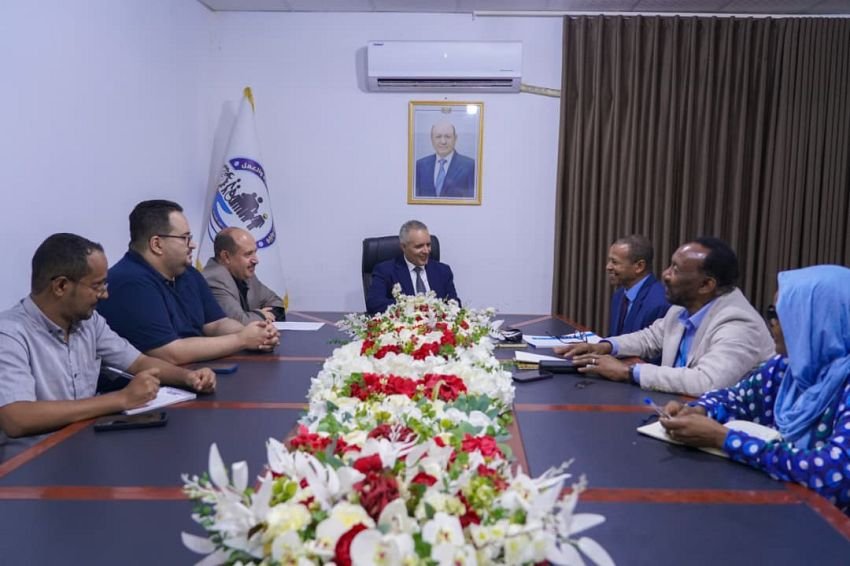
Yemen’s Minister of Social Affairs and Labour, Mukhtar al-Yafaei, met the World Food Programme’s representative and country director in Yemen, al-Khidr Daloom, in the interim capital Aden on Thursday for talks on how the government and the United Nations agency can coordinate their response to the country’s food crisis more closely. The state news agency Saba, which reported the meeting, said the two men reviewed continuing efforts to tackle food insecurity and malnutrition, to strengthen the resilience of poor communities and to support household livelihoods.
Saba said both sides underscored three priorities in particular: linking food assistance programmes to local production and the wider economy, developing a unified national registry of aid beneficiaries, and building the capacity of Yemeni institutions and local organisations. No figures, timelines or funding commitments were announced, and the agency’s account did not indicate whether the discussions produced any binding agreement.
The meeting comes at a point of acute strain for food assistance in Yemen. In June, the Food and Agriculture Organization, the World Food Programme and UNICEF jointly reported that nearly half the population in government-controlled areas, about 47 percent or roughly five million people, was facing crisis levels of acute food insecurity or worse, the threshold the Integrated Food Security Phase Classification labels IPC Phase 3 and above. About 1.4 million of them were in the more severe Emergency category, IPC Phase 4.
The projections for the months immediately ahead are worse. The same analysis expected 5.4 million people, or 51 percent of the population in government-held areas, to face crisis-level food insecurity during the June to September lean season, with the number in Emergency conditions climbing to about 1.5 million. For the post-harvest period from October to December, the agencies projected that the Emergency caseload would rise further, to roughly 1.8 million.
Taken across the country as a whole, United Nations projections for 2026 place more than 18 million Yemenis at crisis levels of acute food insecurity, a caseload that ranks among the most severe anywhere in the world.
Funding, rather than access alone, is the immediate constraint. The World Food Programme has repeatedly warned that its Yemen operation is running far below requirements, and in February it launched a redesigned targeted emergency food assistance programme in government-controlled areas that cut the number of people it supports from about 3.4 million to roughly 1.6 million, concentrating what remains on the most food-insecure households. The agency has also suspended its operations in Houthi-controlled areas since September 2025.
The wider aid picture is similarly constrained. The 2026 humanitarian needs and response plan for Yemen seeks about 2.16 billion dollars to reach 12 million people. The previous year’s appeal, for 2.48 billion dollars, closed with roughly 720 million dollars received, around 29 percent of the request and the weakest showing in a decade, according to the UN Office for the Coordination of Humanitarian Affairs.
Against that backdrop, the emphasis both sides placed on linking food programmes to domestic production reflects an argument that has gained ground among aid planners in Yemen: that buying more of what is distributed from Yemeni farmers and processors, where quality and volume allow, keeps money circulating inside a badly weakened economy and reduces the exposure of the response to shipping costs and import bottlenecks. It is not a substitute for imported grain in a country that depends heavily on foreign wheat, but it is a hedge.
The proposed unified beneficiary registry addresses a different weakness. Aid in Yemen is delivered by a large number of agencies and non-governmental organisations that have historically maintained separate lists, which makes duplication hard to detect and gaps hard to close. A World Bank review of social registries found that Yemen, like a number of other low-income countries, had used its registry to serve a single programme rather than as a shared targeting platform across the social protection system. A common registry would, in principle, let the ministry and its partners work from the same picture of who is receiving what, though building one requires data systems, verification capacity and a degree of political agreement that have all been scarce.
The third priority, institutional capacity, is the longest-term of the three. Yemen’s Social Fund for Development, established in 1997, was for years regarded as one of the country’s more effective delivery vehicles and kept operating through successive periods of instability. Public institutions across the board, however, have been eroded by more than a decade of conflict, currency collapse and unpaid salaries. Rebuilding the ministries and local organisations that would eventually have to run a national social protection system is slow work, and donors have generally been less willing to fund it than emergency distributions.
Al-Yafaei has held a series of similar meetings with international partners in Aden in recent months, including talks with United Nations agencies on humanitarian and development cooperation and separate discussions on the standing of the Social Development Fund. His ministry is the government’s principal counterpart for social protection, disability services and labour policy in the territory under its control.
Neither the ministry nor the World Food Programme has published further detail on how the three priorities raised in Aden would be sequenced or paid for. For now the practical question facing both is narrower: how to stretch a shrinking food assistance budget across a caseload that every current projection expects to keep growing through the end of the year.
About the Author