KSrelief flies 154 Somali refugees home from Aden under UNHCR return program
 Yemen Herald News
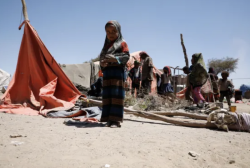
ADEN, Yemen — A Saudi relief agency flew 154 Somali refugees home from Aden International Airport in cooperation with the UN refugee agency, the Saudi Press Agency reported on Aug. 28.
The King Salman Humanitarian Aid and Relief Center, known as KSrelief, said the departure formed part of a protection and humanitarian assistance program for refugees in Yemen.
Armen Yedgaryan, the UN High Commissioner for Refugees representative in Yemen, thanked the Saudi agency for facilitating the procedure, according to the same report. He said the arrangement was meant to ensure the refugees returned voluntarily.
The account of the flight rests on KSrelief and UNHCR, relayed through the Saudi Press Agency. Yemen Herald found no independent confirmation of the departure published elsewhere.
The refugees travelled under UNHCR’s Assisted Spontaneous Return program, which the agency runs for Somalis in Yemen who ask to go home.
UNHCR defines voluntary repatriation as the free and informed return of refugees to their country of origin in safety and dignity. The agency says it supplies information on conditions in the home country so that refugees can decide for themselves.
Participation is voluntary and every service is free, according to the agency’s Yemen information site. UNHCR tells refugees to report anyone who asks them for payment.
Somali refugees apply at return help desks in Basateen, in Aden, at Kharaz camp, at al-Mukalla, or at the UNHCR reception centre in Sanaa.
Applicants need a refugee identity card issued through the IPNA registration system, birth certificates for any children, and contact details for family in Somalia.
UNHCR then verifies the applicant’s identity and reviews the file, according to the same guidance.
The agency assists with travel documents and exit permits. It also arranges the Somali “Go Home” travel document.
Travel is organised from Aden. Applicants are given accommodation and food for up to 10 days before departure, UNHCR says.
Cash grants are communicated to eligible applicants separately.
Services listed for the program include counselling, medical screening, documentation, transportation and reintegration support in Somalia.
Eligibility extends beyond registered Somali refugees. Those married to Yemeni nationals may apply if the Somali consulate confirms legal residency for non-Somali family members.
Somali asylum seekers registered in Yemen for at least six months are also eligible, the agency says.
Applicants who change their minds are told to notify UNHCR and cancel. The agency maintains separate return hotlines for Aden, Kharaz, al-Mukalla and Sanaa for those awaiting a decision.
UNHCR does not run a repatriation program for refugees of other nationalities in Yemen. Ethiopians and others are directed to the International Organization for Migration and its Voluntary Humanitarian Return program.
Refugees who stay in Yemen rely on a separate set of services. The agency’s Yemen operation lists cash assistance, healthcare, education, legal aid, mental health support and services for refugee women and children.
Resettlement to a third country and family reunification are handled as separate processes, according to the same operation.
Registration is split geographically. Refugees and asylum seekers register either in Sanaa or in the Aden area.
The return program dates to 2017. UNHCR has said more than 4,800 Somali refugees have used it since it began.
Early movements went by sea rather than air. The first carried 133 refugees out of the Port of Aden on a vessel chartered by IOM, UNHCR said at the time.
Departures reported during 2026 have used aircraft from Aden International Airport instead.
Yemen hosts around 61,240 refugees and asylum seekers, most of them Somali and Ethiopian, according to UNHCR operational data. The agency has published higher estimates elsewhere, and the figures vary by collection method and date.
UNHCR has linked rising interest in return to conditions inside Yemen, in a briefing note issued under that heading.
KSrelief said separately that it had distributed 720 food baskets in al-Mahrah governorate. That distribution reached 5,040 people and formed the second phase of an emergency food program, the agency said.
The Saudi agency runs other programs in the country. It distributed 1,806 food baskets in Hadhramaut governorate, the Saudi Press Agency reported earlier this year.
KSrelief also signed an agreement to support small-scale farmers, which it said would benefit 800 people directly and about 6,500 indirectly.
The agency held a discussion session on the 2026 Yemen Humanitarian Response Plan at its Riyadh headquarters on Feb. 27.
Humanitarian need across the country remains wide. The UN Office for the Coordination of Humanitarian Affairs said in its March 2026 response plan that more than 22 million people require assistance.
The same plan put 18.3 million people at acute food insecurity.
More than 2.2 million children under five are acutely malnourished, OCHA said. It classed 516,157 of those cases as severe.
The plan counted 5.2 million internally displaced people inside Yemen.
OCHA appealed for 2.16 billion dollars to reach 12 million people during the year.
Yemen’s war began in 2015. Fighting has continued between the Houthi movement, which holds Sanaa, and the internationally recognised government seated in Aden, and the two sides give competing accounts of the conflict.
Refugees and asylum seekers in Yemen sit outside that division. Many crossed the Gulf of Aden before the war and stayed.
KSrelief said the repatriation formed part of a series of ongoing humanitarian programs in the country.
About the Author