UAE President and Keir Starmer Discuss Regional Escalation in a Phone Call
 Yemen Herald News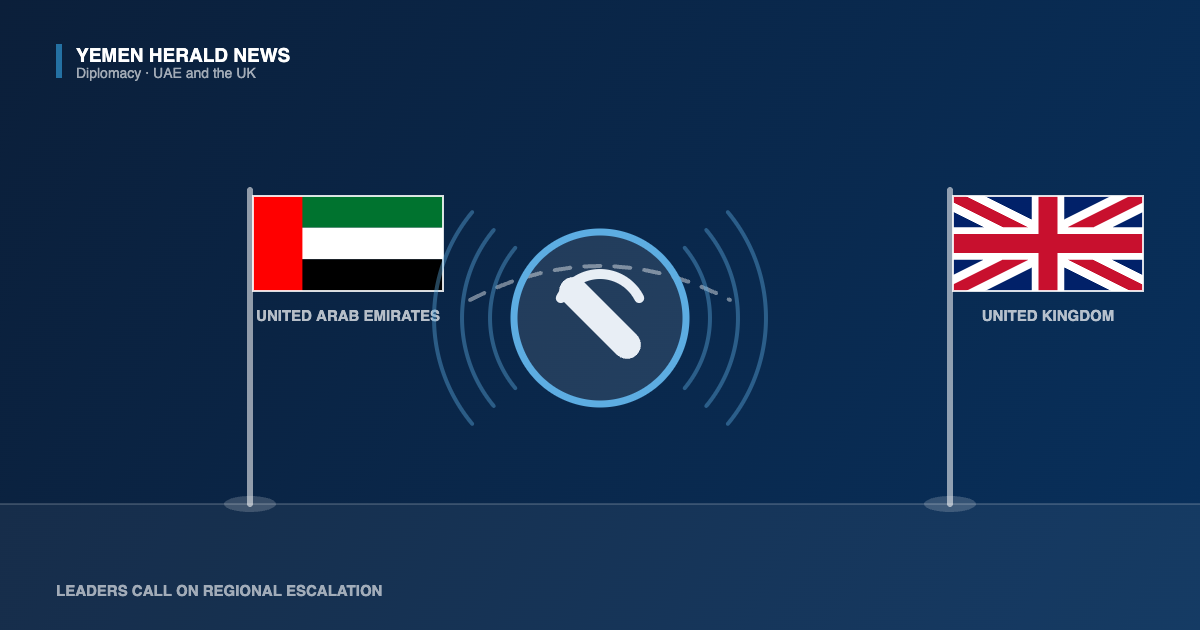
Sheikh Mohamed bin Zayed Al Nahyan, the president of the United Arab Emirates, and the British prime minister, Sir Keir Starmer, discussed the military escalation in the Gulf and its implications for regional security in a telephone call in early March 2026, according to accounts published at the time.
Starmer condemned the Iranian attacks on UAE territory and on a number of other Arab countries, describing them as a violation of those states’ sovereignty and a threat to regional security and stability. Both leaders stressed the need to halt the escalation in order to prevent the conflict widening further.
The call came days into a campaign that had begun at the end of February 2026, after American and Israeli strikes on Iran drew retaliation against Gulf states hosting or associated with United States forces. By early March the UAE’s defence ministry was already publishing daily interception counts running to dozens of drones and several ballistic missiles, alongside cumulative totals in the hundreds.
Sheikh Mohamed has been president of the UAE since May 2022 and is also the ruler of Abu Dhabi. Starmer has led the United Kingdom since July 2024. Neither government characterised the call as producing any new commitment; on the published accounts it was an expression of political support and a shared statement of preference for de-escalation, delivered while the attacks were still intensifying.
The United Kingdom’s stake in the Gulf gives such calls more weight than routine diplomatic contact. A large British expatriate community lives and works in the UAE, British commercial and financial interests in the Emirates are substantial, and the United Kingdom maintains military facilities in the region, including a naval support facility in Bahrain and a logistics base at Duqm in Oman. An escalation that closed Gulf airspace or shipping lanes would reach British interests directly.
Neither readout published at the time recorded any discussion of British military deployment, arms transfers or participation in air defence. The absence is as informative as the content: London’s contribution in the early phase was rhetorical and diplomatic, and the accounts of the call reflect that without dressing it up.
The exchange formed part of a wider Emirati diplomatic effort. Sheikh Mohamed spoke with a succession of world leaders about the attacks through the same period, and the foreign minister, Sheikh Abdullah bin Zayed Al Nahyan, conducted rounds of calls with counterparts and international officials on 4 and 9 March to set out the UAE’s account of the strikes and their consequences.
The purpose of that effort was not primarily to obtain military assistance. It was to accumulate a record of international condemnation and to establish the UAE’s framing of events: a state being attacked on its own territory rather than a belligerent in someone else’s war. Every call in which a foreign leader described the strikes as a violation of Emirati sovereignty reinforced that position.
The framing mattered because it was contestable. The UAE hosts United States military facilities, and the attacks on Gulf states were presented by Tehran as responses to American and Israeli action. Establishing in public, through allied governments, that the strikes were violations of an uninvolved state’s sovereignty was a diplomatic objective in its own right.
What the calls did not deliver was any change in the tempo of the attacks. Statements calling for de-escalation from third parties, however senior, had no evident effect on the volume of launches, which continued through March and into the spring and were still being reported in the summer. Interception figures from the UAE, Bahrain and Kuwait rose steadily across that period.
For the several hundred thousand British citizens resident in the Emirates, the practical questions during this period were more immediate than the diplomatic ones: whether flights would operate, whether schools would open, and what to do when air-defence engagements were audible overhead. UAE authorities issued civil guidance to residents regardless of nationality, and commercial air traffic through Dubai and Abu Dhabi was repeatedly disrupted by airspace closures during engagements.
The relationship continued to develop beyond the phone call. Starmer travelled to the UAE in April 2026 for talks with Sheikh Mohamed on the war and its implications, moving the contact from a call placed days into the campaign to a face-to-face meeting some weeks later. The pattern of escalating diplomatic engagement tracked the escalating military situation fairly closely.
The UAE also kept channels open in the other direction. Its foreign minister held the first publicly announced call with his Iranian counterpart since the outbreak of the war in late June 2026, a step consistent with a long-standing Emirati preference for maintaining contact with Tehran even during periods of confrontation, and one that distinguished the UAE’s approach from that of some of its neighbours.
Read against what followed, the March call reads less as a turning point than as an early entry in a lengthening record. Its practical content was condemnation and a call for restraint. Its lasting significance is as documentation: a British prime minister stating, at the start of a campaign that would run for months, that attacks on the UAE constituted a violation of its sovereignty, and an Emirati president using the exchange to place his country on the receiving end of a war rather than inside it.
About the Author